How many orders will you get on Black Friday? Most small sellers guess. Then they either run short of cash, stock or time, or spend too much preparing for orders that never come. A simple holiday sales forecast fixes that. You do not need software or a data team. You need your October numbers, a calendar and about 20 minutes.
In this guide, you will build a forecast in four steps and see a full worked example with clearly labeled example numbers. Then you will turn the forecast into three practical plans: cash (your Rabfy Wallet buffer), stock (if you keep inventory) and time (orders and customer messages).
Key takeaways

Start with your baseline: your average orders per day in October.
Multiply it by an estimate for each holiday period, based on last year or a cautious guess.
Plan for three cases: low, expected and high.
Turn orders into cash: orders × cost per order, plus a buffer for fees and tax.
Compare real orders with the plan every evening during Cyber Week, and adjust.
Why a small store needs a holiday sales forecast
Orders do not grow evenly in November and December. They jump on a few days, like Black Friday and Cyber Monday, then stay higher until the last shipping dates. Adobe reported that US shoppers spent $44.2 billion online over the five days from Thanksgiving to Cyber Monday 2025, and that Cyber Monday remains the biggest online shopping day. Your store will follow its own pattern, but the peaks are real.
A forecast helps you answer three practical questions before the rush:
 Cash: How much money do I need available to pay for orders on peak days?
- Stock: If I keep inventory, how many units should I have ready?
- Time: How many orders and messages will I handle each day?
It will not be perfect, and that is fine. A rough forecast is much better than a surprise. Here is the whole method at a glance:

Step 1: Find your baseline
Your baseline is your average number of orders per day in a normal period. October works well, because it is recent and usually comes before the big holiday rush. Take your total October orders across all channels and divide by 31.
Example: 310 orders in October ÷ 31 days = 10 orders per day. All numbers in this guide are examples, so replace them with your own.
If October was unusual, for example because of a big promotion or a stock problem, use the average of the last four to six normal weeks instead. If your store is brand new, use your best recent week and treat the forecast as a rough guide.
Step 2: Choose a multiplier for each period
A multiplier shows how much busier a period will be than your baseline. If you normally get 10 orders a day and expect 30 on Black Friday, your Black Friday multiplier is ×3.
The best source is your own history. If you sold last year, divide your orders on each peak day by your average daily orders in the October before. That is your real multiplier. Then adjust it for changes this year, such as more ads, more products or a new sales channel.
If you have no history, choose cautious numbers and plan for a range. In our worked example, we use these example multipliers:
- Nov 19–25: ×1.2, as early deals and gift research begin.
- Thanksgiving (Nov 26): ×1.5, if you send early access emails.
- Black Friday to Cyber Monday (Nov 27–30): ×3, your main sale days.
- Dec 1–11: ×1.8, as gift shopping continues.
- Dec 12–17: ×1.4, the last days before US ground shipping cutoffs.
Step 3: Map your forecast to the calendar
Now put the multipliers on the calendar. For each period, multiply your baseline by the multiplier to get orders per day, then multiply by the number of days.

Why stop at Dec 17? That is the USPS recommended mail-by date for Ground Advantage and First-Class Mail to the contiguous US in 2026. After that, ground shipping may not reach buyers by Christmas, so gift orders usually slow down. Set your own order-by date a few days earlier to allow for production.
Step 4: Turn orders into a wallet buffer
Now turn orders into money. With Rabfy, each order's costs (product, shipping, processing fee and tax) are paid from your Rabfy Wallet when the order comes in. Your customers pay you through your store or marketplace, but those payouts often arrive days later. That gap is why you need a buffer before the peak days.
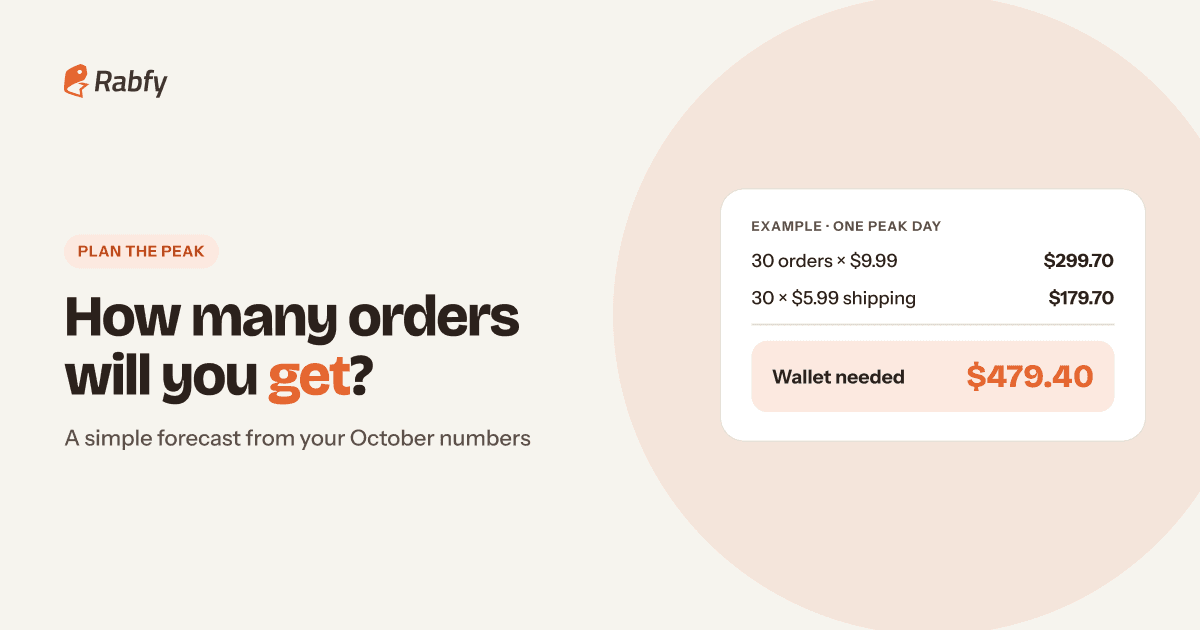
Use this simple formula: orders per day × cost per order, plus a buffer for fees and tax.

In this example, one Black Friday with 30 orders needs about $527 in the wallet. The four days from Black Friday to Cyber Monday need 120 × $15.98 = $1,917.60, or about $2,109 with the 10% buffer. Top up before Thanksgiving, check the balance each evening and top up again if orders run ahead of the plan.
The $9.99 product cost and $5.99 standard shipping come from the Soul Spark Necklace example on the Rabfy homepage. Your products and costs may differ, so use the numbers in your own dashboard. Orders on the Rabfy Store work differently: the customer pays Rabfy, and Rabfy deducts the costs and pays you the rest on Net 15 terms. Our guide to cash flow for print-on-demand sellers explains how to plan for these gaps. This is not financial advice.
Plan for three scenarios, not one number
A single number gives you false confidence. Plan for a low case, an expected case and a high case. Prepare fully for the expected case, and write down what you will do if the high case happens.

For the high case, decide in advance: will you top up the wallet again, pause some ads, or answer messages in batches? Deciding now is much easier than deciding late at night on Black Friday.
Forecast order volume for stock and time
Cash is not the only thing to plan. Use the same numbers to forecast order volume for stock and working time. This is the core of simple ecommerce demand planning.
If you hold inventory
If you keep your own stock with a 3PL, multiply your expected orders by the units per order for each product, and send stock early. Inventory has to arrive, be checked and be stored before it can ship, so leave time for receiving before the peak. That is the heart of Q4 inventory planning. If you are new to this, read what a 3PL is and when you need one. Rabfy's own US warehouse offers receiving and inventory checks, storage and pick, pack and ship for sellers who send their own stock.
If you sell print on demand
With print on demand, each piece is made after the order comes in, so you do not need to stock finished products. Production still takes time. With Rabfy, it takes 1–3 days, so include that in your order-by dates.
Your own time
Count the work that grows with orders. If you sell on Etsy, Amazon or eBay with Rabfy, each sale is placed as a custom order in the Rabfy dashboard. At 30 orders a day, that is 30 custom orders to place and check. Block time for it in the morning and evening, and expect more customer messages too. Shopify orders import automatically, which saves this step.
Check and adjust during Cyber Week
A forecast is a plan, not a promise. During the peak, compare real results with the plan once a day:
- 1Each evening, write down real orders, wallet spend and the most common customer questions.
- 2If orders are well above the plan, switch to your high-case plan.
- 3If orders are well below the plan, check your store, stock and ads before you cut prices.
- 4After Cyber Monday, update the December part of your forecast with what you learned.
For the full list of tasks to finish before the rush, use our Black Friday and Cyber Monday checklist. If you sell personalized jewelry, our print-on-demand jewelry guide covers products, pricing and fulfillment.
Frequently asked questions
How do I forecast holiday sales for a small store?
Take your average orders per day in October, multiply it by an estimated multiplier for each holiday period, and multiply by the number of days. Plan for a low, expected and high case, and update the forecast daily during the peak.
What multiplier should I use for Black Friday?
Use your own history if you have it: peak-day orders divided by your normal daily average. If you have no history, choose cautious numbers and plan for a range. No single multiplier fits every store.
How much should I keep in my Rabfy Wallet for Black Friday?
Multiply your expected orders per day by your cost per order (product and shipping), then add a buffer for processing fees and tax. Top up before Thanksgiving and check the balance every evening.
Do I need a forecast if I use print on demand?
Yes. You do not need to stock finished products, but you still need cash for order costs, time to handle orders and messages, and order-by dates that include production time.
Until when should I forecast holiday gift orders?
Plan through your last order-by date for Christmas. In 2026, USPS recommends mailing Ground Advantage by Dec 17 for the contiguous US, so set your own date a few days earlier.
Plan your peak with a clear wallet
Create a free Rabfy account, check your product and shipping costs, and set your wallet buffer before Thanksgiving. No subscription, and you pay only when an order comes in.
Start selling free