Print on Demand Jewelry: The Complete 2026 Guide for New Sellers
By the Rabfy Team · 9 min read · Oct 1, 2026
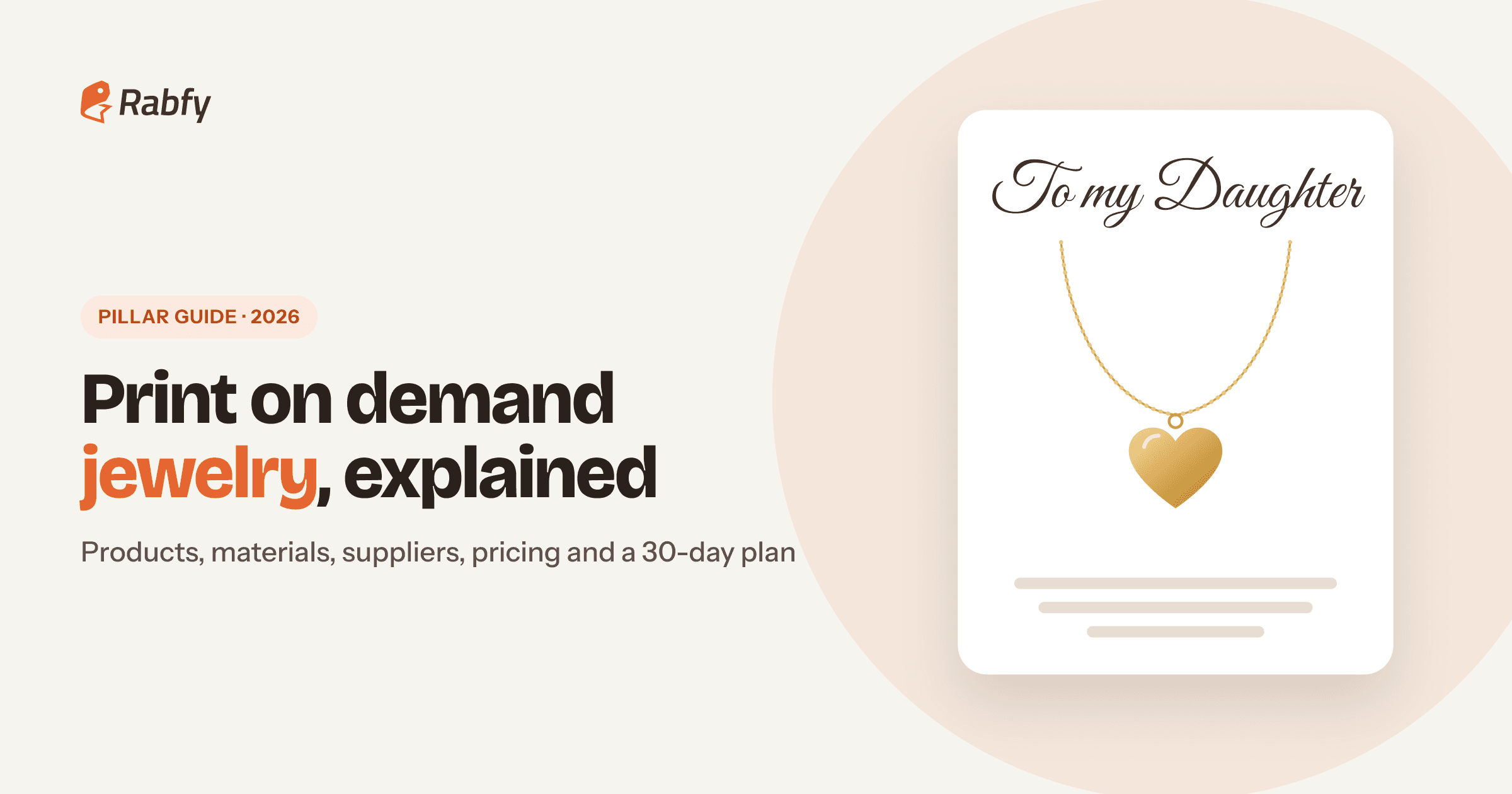
Print on demand jewelry lets you sell personalized necklaces, bracelets and rings without buying stock, renting a workshop or learning to engrave. You design the product and the listing, a production partner makes each piece after a customer orders, and it ships under your brand. In this guide you will learn how the model works, which products sell, what the materials mean, how to choose a custom necklace supplier, how to price for profit and how to launch in 30 days.
Key takeaways
- Print on demand jewelry is made after the order, so you do not buy inventory up front.
- Personalized pieces (names, initials, dates, message cards) sell best because they are gifts.
- Describe materials honestly: “gold plated” and “gold vermeil” mean different things.
- Choose a supplier on production time, accuracy, tracking and US fulfillment, not only price.
- Price from your full cost, including shipping and marketplace fees, then protect your margin.
What is print on demand jewelry?
Print on demand (POD) is a make-to-order model. Nothing is produced until a customer pays. When an order arrives, your production partner personalizes the piece, checks it, packs it and ships it to your customer. You never touch the product, and you never pay for pieces that do not sell.
For jewelry, “print” is a loose word. Most personalized jewelry is engraved, cut or finished to order rather than printed. A name necklace, an initial pendant or a bracelet with a date is made for one person, which is exactly why buyers value it.
How it differs from classic dropshipping
In classic dropshipping you resell a ready-made product that someone else designed and stocks. Every other store can sell the same item, so you compete mostly on price. With personalized jewelry print on demand, each piece carries your design, your product photos, your card message and the buyer's own text. That gives you more room to build a brand and charge a fair price.
Print on demand vs holding your own inventory
Some sellers buy 200 blank pendants and engrave them at home. That can work, but it ties up cash, space and time. The comparison below shows why most new sellers start with print on demand and only consider bulk stock later.
Side by side Print on demand vs buying stock
Buying stock Print on demand Upfront cost Pay for stock first Pay per order Unsold pieces Your loss None Personalization You engrave by hand Done for you New designs Buy more stock Add a listing Packing and shipping You do it Partner does it Cost per piece Lower at volume Higher, but no stock risk
The trade-off is simple: print on demand usually costs more per piece than bulk buying, but you pay nothing for stock that does not sell. For a new brand that is still testing designs, that protection matters more than a few cents per unit. Once a design sells steadily, you can review the numbers again.
Why personalized jewelry is a strong first product
Jewelry is one of the easiest categories for a new seller. Here is why it works so well, especially in the fourth quarter (Q4):
- It is a gift. Most buyers shop for someone else: a daughter, a mom, a partner, a best friend. Gifts are bought with emotion, not only on price.
- It is small and light. Necklaces and bracelets ship in small packages, which keeps shipping costs lower than bulky items like mugs.
- It has occasions all year. Birthdays, Mother's Day, Valentine's Day, graduations, weddings and Christmas all create demand.
- Personalization adds value. A name or a date turns a simple pendant into a keepsake, and buyers happily pay more for it.
- It is harder to copy. A clear niche angle, like “gifts for a daughter from dad”, is harder to copy than a plain product.
Need inspiration? Our list of personalized gift ideas to sell breaks down 25 proven angles by occasion and recipient.
How print on demand jewelry works, step by step
Every order follows the same path. Once you understand it, you can spot delays early and set honest delivery promises. We explain each stage in detail in how print on demand works, but here is the short version:
A customer orders on your store or marketplace and types the personalization, for example a name.
The order reaches your partner. On Shopify this can happen automatically; on other channels you place it as a custom order.
Production starts. The piece is personalized and finished. With Rabfy, production takes 1–3 days.
Quality check and packing. The piece is checked, packed and, if ordered, paired with a message card.
Shipping and tracking. The order ships with tracking, and your customer can follow it to the door.
The order path How a print on demand jewelry order works
01 02 03 04 05 Customer orders Order reaches partner Made to order Checked and packed Shipped with tracking Buyer adds a name, date or message Auto-import or a custom order Personalized and finished in 1–3 days Quality check, box and message card Across the US or to Canada via DHL
The best personalized jewelry products to start with
You do not need 100 products. Start with three to five that fit one clear audience. These types are reliable starting points:
Product type Why it sells Best occasions Name necklace The buyer sees their own words on it Birthdays, Christmas Heart or circle pendant Simple, classic and easy to gift Mother's Day, anniversaries Name bracelet Easy to stack, works for men too Father's Day, graduations Message card jewelry The card tells the story Gifts for daughters, moms, partners Matching sets Two pieces, one bond Couples, best friends, sisters
Rabfy's own jewelry line covers these types with pieces such as the Soul Spark Necklace, Lumen Heart Necklace, Two as One Necklace and Name Bracelet. Many sellers add a message card, which often does as much selling as the necklace itself. Our guide to message card jewelry explains how to write cards that convert.
Pick one audience first “Jewelry for everyone” is hard to market. “Gifts from mom to daughter” is easy: you know who to target, which words to use and which occasions to plan for. Start narrow, then expand.
Materials and finishes: what you must tell buyers
Material questions cause many returns and bad reviews. A buyer who expects solid gold and receives a plated piece will feel misled, even if the product is well made. Learn the basic terms and use them accurately.
In the US, the Federal Trade Commission's Jewelry Guides describe how these words should be used. At the time of writing, the Guides say:
- Gold vermeil is sterling silver coated or plated with gold of at least 10 karat, at least 2.5 microns thick.
- Gold plated or gold electroplate means a layer of gold on a base metal. The Guides allow a much thinner layer than vermeil.
- Gold filled means the gold layer makes up at least 1/20th of the total metal weight.
- Solid gold, for example 14K, means the whole piece is a gold alloy of that karat.
When a product says “18K gold finish”, describe it as a finish, not as solid gold. Ask your supplier for the base metal and finish details, then copy them into every listing. Our jewelry materials guide for sellers covers stainless steel, plating and vermeil in more depth. Always confirm the current rules on the FTC website.
Never guess a material If you are not sure what a piece is made of, do not write “hypoallergenic”, “waterproof” or “solid gold”. Unclear claims lead to returns, bad reviews and marketplace policy problems.
How to choose a custom necklace supplier
Your supplier is part of your brand. The customer never sees them, but they feel every delay and every spelling mistake. Compare each custom necklace supplier on these points before you list a single product:
Before you sign up Custom necklace supplier checklist
✓ Production time stated clearly ✓ US fulfillment for US buyers ✓ Tracking on every order ✓ Quality check before packing ✓ Clear personalization fields ✓ No minimums or monthly fee ✓ Message cards and gift packing ✓ Store sync or easy custom orders ✓ Shipping to Canada available ✓ Support that answers fast
Two points matter most in Q4. First, where the jewelry is made and shipped from. A piece produced in the US usually reaches a US buyer faster than one shipped from overseas, which means fewer “where is my order?” messages. Second, how orders reach the supplier. Automatic order sync saves hours when volume grows.
Always place a test order before you launch. Check the engraving, the finish, the packaging and the time from order to tracking number. It is the cheapest insurance you can buy.
How Rabfy helps Rabfy makes its own personalized jewelry line (necklaces, bracelets, pendants and rings) with 1–3 days production time and US fulfillment. Every order is quality-checked, packed and shipped with tracking across the US and to Canada via DHL. There is no subscription or contract: you pay only when you get an order.
Where to sell jewelry online without inventory
You can sell jewelry online without inventory on almost any channel. The difference is how orders reach your partner and how much work each order takes.
Shopify
Your own store gives you the most control over branding, pricing and customer data. With Rabfy, you connect Shopify in a few clicks, map each variant once, and new orders import automatically. Tracking goes back to your store on its own. See our guide to Shopify print on demand fulfillment.
Etsy, Amazon and eBay
Marketplaces bring buyers who are already searching. Each has its own rules. For example, at the time of writing Etsy allows items you design and a production partner makes, but you must disclose that partner. With Rabfy, you place each marketplace sale as a custom order in the dashboard. Read how to sell on Etsy without inventory for the full workflow.
No website yet?
Rabfy Store lets you pick products from the Rabfy catalog, add your design or personalization, set your price and list them without building a website. The customer pays Rabfy, and Rabfy deducts costs and pays you the rest on Net 15 terms.
Pricing print on demand jewelry for profit
Price from your costs, not from your competitors. Start with the product cost and shipping, then add marketplace fees, payment processing, ads and a margin you are happy with. Here is an example based on the Soul Spark Necklace:
Example margin Where a $49.95 necklace sale goes
Soul Spark Necklace (example) Selling price $49.95 Rabfy product cost −$9.99 Standard shipping −$5.99 Processing fee & tax Varies Marketplace fees Varies Margin before fees $33.97
Example only. Costs vary by product, channel and destination.
You set the price. Retail price and margin are yours.
Paid from your wallet. Costs are deducted per order.
Marketplace fees change the picture. For example, as of 2026 Etsy charges a $0.20 listing fee, a 6.5% transaction fee on the item price plus shipping, and a US payment processing fee of 3% + $0.25. Check each platform's official fee page before you set prices. Our guide on how to price print on demand products walks through the full formula, and you can see how Rabfy charges on the pricing page.
About these numbers All figures above are examples, not a promise of profit. Fees change, so confirm them on each official page. This isn't legal, tax or financial advice.
Your 30-day launch plan
A clear plan beats a perfect plan. Here is a simple 30-day path from idea to first sales:
Days 1–3: Choose one audience and one main sales channel.
Days 4–7: Shortlist three to five products and order samples.
Days 8–12: Create mockups, write product titles and prepare message card texts.
Days 13–16: Build listings, set prices and write your shipping and returns policy.
Days 17–20: Place a full test order and check every step, from personalization to tracking.
Days 21–30: Launch, share with your network, test small ads and improve listings based on data.
For the full business setup, including naming, branding and first marketing, read how to start an online jewelry business.
Start with one audience, three products and one channel. Focus beats variety in your first 90 days.
— The Rabfy team
Common mistakes new sellers make
- Too many products too early. Five strong listings beat fifty weak ones.
- Vague material descriptions. Say exactly what the piece is made of and how to care for it.
- No personalization check. Add a clear text field and ask buyers to double-check spelling.
- Promising dates you do not control. Quote production time and tracked shipping, not a guaranteed delivery day.
- Pricing without fees. Include marketplace, payment and ad costs from day one.
Frequently asked questions
Is print on demand jewelry profitable? It can be. Because you pay only when an order comes in, your risk is low. Profit depends on your price, product cost, shipping, marketplace fees and ad spend, so work out the full cost per order before you set a price.
Do I need to make jewelry myself? No. With print on demand, a production partner personalizes, packs and ships each piece. You focus on design, listings, marketing and customer service.
How long does print on demand jewelry take to arrive? It is production time plus shipping time. Rabfy produces orders in 1–3 days, then ships them with tracking within the US or to Canada via DHL. Transit time depends on the carrier and destination.
Can I sell print on demand jewelry on Etsy? Yes, if you are the designer and you disclose your production partner, as Etsy's policies require at the time of writing. Always check Etsy's current Creativity Standards before you list.
What is the best personalized jewelry to start with? Name necklaces, heart or circle pendants, name bracelets and message card jewelry are reliable starting points because they are easy to gift and easy to personalize.
Start your jewelry brand without inventory
Create a free Rabfy account, pick your first products and pay only when you get an order.
[ Start selling free ]