If you're competing on a plain design against a thousand near-identical listings, you're in a price war you can't win, and the way out isn't a better design. It's making the product impossible to price-compare in the first place. A generic mug sits next to fifty other generic mugs, so the buyer picks the cheapest. A mug with someone's name, a meaningful date, and an inside joke has no direct competitor, because nobody else sells exactly that one. That's the entire case for personalisation: it moves you out of the commodity bin and into the gift aisle, where people pay for meaning, not the lowest price.
This guide covers which personalisation formats sell best and command the highest prices, how to price and run them, and, just as importantly, the operational downsides nobody warns you about until they've burned you in Q4. Because this article will be read most during the holiday rush, the honest version of the downsides matters as much as the upside. If you've validated a niche using our guide on finding a profitable POD niche, personalisation is often how you turn that niche into products buyers can't shop around on.
Why Do Personalised Products Sell for More?
Personalised products sell for more because a custom item can't be price-compared against anything else, and because buyers treat it as a meaningful gift rather than a commodity. Research consistently shows most consumers will pay a premium for personalised products, and they convert better too. The mechanism is simple once you see it: personalisation removes the two things that drag prices down, direct comparison and emotional detachment.
Think about what happens on the buyer's side. A generic product invites comparison shopping, so the buyer opens five tabs and picks the cheapest, and your margin gets crushed. A personalised product can't be compared, because it's one of one, so price becomes secondary to whether it's right. On top of that, personalised items are overwhelmingly bought as gifts, and gift buyers judge value by how meaningful and thoughtful the item feels, not by whether it's the cheapest option. Around four in five consumers say they're more likely to buy, and willing to pay extra, when a product is personalised, and the personalised-products market has been growing at strong double-digit rates year on year. For a seller stuck in a price war, personalisation is the clearest escape route. It's also one of the clearest directions in our look at print-on-demand trends for 2026, where personalisation stands out as a category still rising rather than saturating.
The Six Personalisation Formats, Ranked by Value
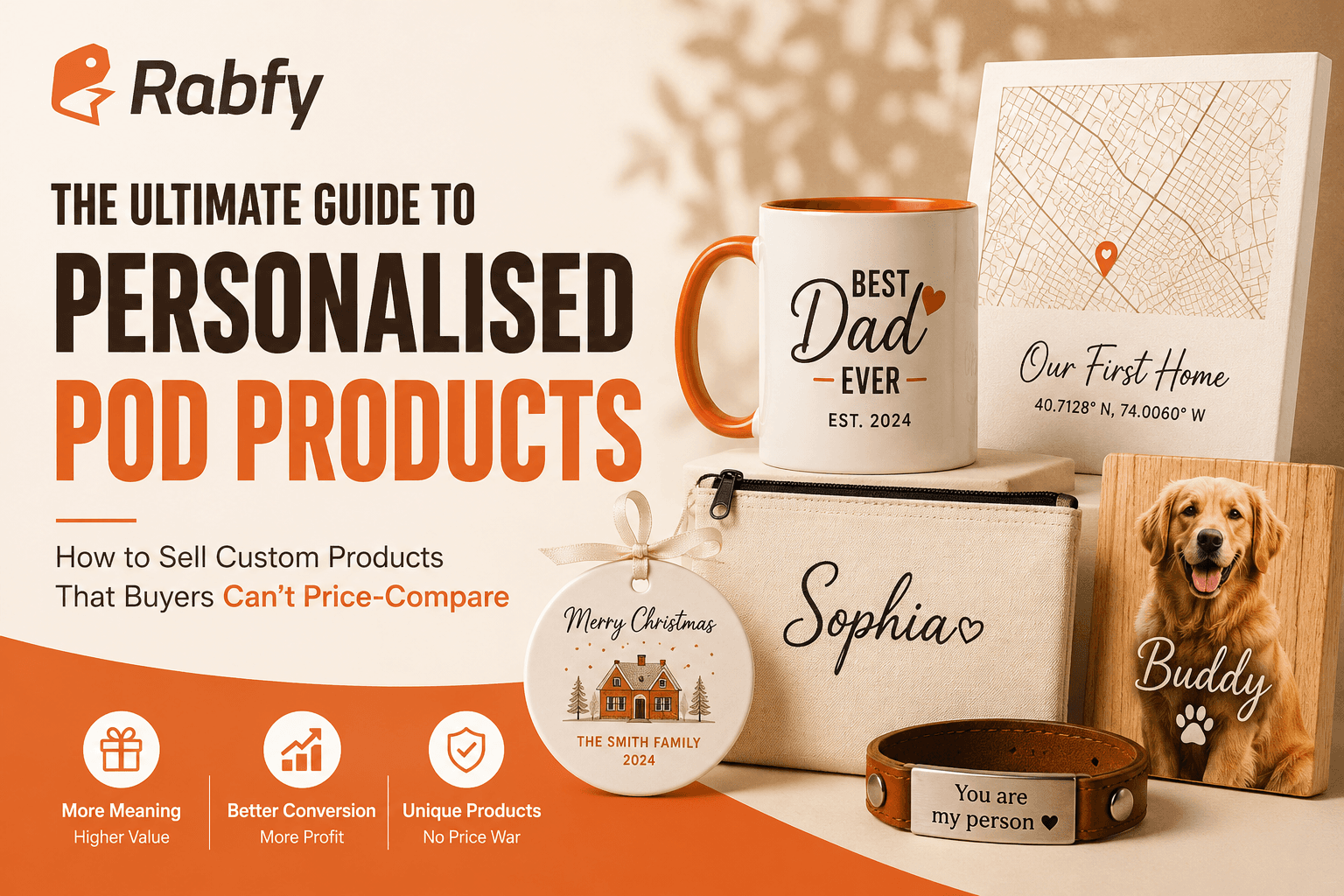
The six main personalisation formats, roughly from most accessible to highest perceived value, are custom text, name and date, photo upload, map or coordinates, pet portrait, and family or group designs. The more emotional and effortful the personalisation, the higher the price it supports. Knowing which format fits your product and audience helps you choose where to compete.
Here's each format, what it suits, and its relative value:
Format What it is Typical value Complexity to run Custom text A buyer's chosen word, name, or phrase Solid uplift Low Name and date A name plus a meaningful date Strong uplift Low Photo upload The buyer's own photo on the product High uplift Medium (photo quality) Map or coordinates A meaningful location rendered as art High uplift Medium Pet portrait The buyer's pet illustrated or printed Very high uplift Higher (artwork) Family or group Names or figures for a whole family Very high uplift Higher (multiple inputs)
Custom Text and Name-and-Date
Custom text is the easiest entry point: a name, a word, or a short phrase the buyer chooses. Adding a meaningful date turns it from decorative into commemorative, which is exactly what pushes it into gift territory for anniversaries, birthdays, and memorials. These are the simplest formats to run and a natural place to start, because they add real perceived value with minimal operational complexity.
Photo Upload
Photo products (a buyer's own photo on a mug, canvas, or ornament) carry high emotional value, because the buyer is putting something irreplaceable on the product. That's also where the first real operational challenge appears, since customer photo quality varies wildly, which we cover honestly below. Handled well, photo products are among the most giftable items you can sell.
Map, Coordinates, Pet Portraits, and Family Designs
The highest-value formats turn personal meaning into art. A map or coordinates of a meaningful place (where a couple met, a first home) becomes wall-worthy decor. Pet portraits tap into how owners feel about their animals, and command premium prices because the emotional pull is enormous. Family and group designs, naming or depicting a whole household, carry similar weight. These take more effort to produce, sometimes real artwork, but they support the highest prices precisely because that effort can't be commoditised. Many of these formats appear in our roundup of POD products that sell in Q4, with margin notes for each.
How Do You Price Personalised Products?
Price personalised products above your generic equivalents, because personalisation adds genuine value the buyer will pay for, but build the extra production effort and time into that price. The higher price should reflect both the added value to the buyer and the added work for you. Underpricing personalisation is a common mistake that throws away the whole advantage.
The logic runs two ways. On the value side, a personalised product is worth more to the buyer, so pricing it the same as a generic version leaves money on the table and, oddly, can even signal lower quality. On the cost side, personalisation genuinely takes more work: setting up the customisation, checking the input, sometimes approving a proof, and often a longer production time. Your price needs to cover that added effort, not just match a generic competitor. Set your personalised price with a healthy margin above the plain version, and remember you're not competing on price anymore, since the whole point is that your product can't be directly compared. For the full arithmetic on pricing after every cost, see our guide on POD pricing and profit margins.
The Operational Downsides Nobody Warns You About
Personalisation raises your prices and conversions, but it also brings real operational costs: collecting customisation details cleanly, handling unusable customer photos, approving proofs, a higher rate of return requests, and longer production times. Sellers who ignore these get overwhelmed in Q4, exactly when personalised orders peak. This is the section most guides skip, and it's the one that saves you from a holiday-season disaster.
Here's the honest picture of what personalisation adds to your workload, and how to manage each:
Collecting the details cleanly. Every personalised order needs the buyer's input (the name, the date, the photo), and if you collect it messily, you get errors, misspellings, and back-and-forth messages. Use your marketplace's personalisation field so the buyer enters their details at checkout, in a structured way, rather than relying on messages you might misread.
Unusable customer photos. For photo products, buyers will send low-resolution, blurry, or badly cropped images, and printing those produces a poor result and a likely complaint. You need a clear, upfront policy: state the photo quality you need in the listing, and have a process to contact the buyer for a better image before you produce, rather than printing something that'll disappoint.
Proof approval. For higher-value formats, sending the buyer a proof to approve before production prevents expensive mistakes, but it adds a step and can slow the order. It's usually worth it for pet portraits and complex designs, and often skippable for simple custom text. Decide per format.
Higher return-request rate. Personalised items generate more "this isn't what I expected" contacts, often from a buyer's own error (a misspelling they submitted). Clear listings, the personalisation field, and proof approval all reduce this, but plan for a higher contact rate than generic products.
Longer production time. Personalisation adds production steps, so turnaround is longer than for generic items. This matters enormously in Q4, when cut-off dates are tight. Set honest processing times that account for the extra work, and communicate cut-off dates clearly, so you're not promising delivery you can't make during the rush.
None of these should scare you off personalisation. They should make you set it up deliberately, with a photo policy, structured detail collection, and honest timelines, before the Q4 flood arrives.
Can Personalised Items Be Returned?
Personalised items are generally exempt from standard return policies, because they're custom-made and can't be resold, but you're still responsible for genuine errors and defects on your side. Marketplaces distinguish between buyer's remorse (usually not refundable for custom items) and a real fault (which you must make right). Understanding this line protects you without being unfair to buyers.
Here's how it works in practice. Because a personalised item can't be resold to anyone else, most marketplaces let sellers exempt custom products from the usual change-of-mind returns, which protects you from a buyer simply deciding they don't want it. But that exemption doesn't cover your mistakes: if you misprint the name, use the wrong photo, or the product arrives damaged or defective, that's on you and you must replace or refund it. The key is separating the two clearly. A buyer who submitted a typo and wants a free replacement is different from a product that arrived faulty. State your custom-item policy plainly in your listings, honour genuine errors immediately, and you stay both protected and fair. This is also why clean detail collection and proof approval matter, since they cut down the disputes in the grey area.
How Much Longer Does Personalised Production Take?
Personalised products take longer to produce than generic ones because each item is made to a unique specification and often involves a setup or proof step, so build extra time into your processing estimates, especially for Q4. The exact amount varies by format and partner, but the principle is fixed: never quote generic-product turnaround on a personalised order.
Simple custom text adds little time, while photo products, proofs, and artwork-based formats like pet portraits add more. The danger isn't the extra time itself, it's promising a turnaround you set for generic products and then missing it because the personalised order took longer. That's how sellers rack up late-shipment problems in the holiday rush. Set your personalised processing times honestly, add a buffer for proof approval where you use it, and publish clear Q4 cut-off dates so buyers know the last safe order date for guaranteed delivery. Reliable, realistic timelines protect both your ratings and your sanity in December.
Frequently Asked Questions
Do personalised products really sell for more? Yes. Because a personalised item can't be directly price-compared against other listings and is usually bought as a meaningful gift, buyers judge it on relevance and thoughtfulness rather than lowest price. Research consistently shows around four in five consumers are more likely to buy, and willing to pay a premium, for personalised products, and they convert better than generic equivalents. For sellers stuck competing on price, personalisation is the clearest way to command higher margins.
How do I collect customisation details? Use your marketplace's built-in personalisation field so buyers enter their details (name, date, or photo) in a structured way at checkout, rather than relying on messages you might misread or lose. Clean, structured collection is the single biggest thing you can do to prevent errors, misspellings, and endless back-and-forth. For photo products, state your quality requirements clearly in the listing before the buyer uploads.
What if a customer sends a low-quality photo? Have a policy ready before it happens. State the photo quality you need directly in the listing, and build a process to contact the buyer for a better image before you produce, rather than printing a blurry photo that leads to a complaint. Never print a photo you know will disappoint, since the poor result reflects on you regardless of who supplied the image. A quick message asking for a clearer photo protects both the buyer and your reviews.
Can personalised items be returned? Generally, personalised items can be exempted from standard change-of-mind returns because they're custom-made and can't be resold, and most marketplaces allow this exemption. However, you remain fully responsible for genuine errors and defects, so if you misprint, use the wrong input, or the item arrives damaged, you must replace or refund it. State your custom-item policy clearly, and always separate buyer's-remorse requests from real faults you caused.
How much longer does production take? Personalised products take longer than generic ones because each is made to a unique specification and may involve a setup or proof step. Simple custom text adds little; photo products, proofs, and artwork formats like pet portraits add more. The exact time varies, but always set longer processing estimates than for generic items, add a buffer where you use proof approval, and publish clear Q4 cut-off dates so tight holiday timelines don't turn into late shipments.
Key Takeaways
 Personalisation ends the price war by making your product impossible to directly compare, moving it from commodity to meaningful gift where buyers pay for meaning, not lowest price.
- Around four in five consumers are more likely to buy and pay more for personalised products, and the personalised-products market keeps growing at strong double-digit rates.
- Six formats, roughly by rising value: custom text, name and date, photo upload, map or coordinates, pet portrait, and family or group designs. More emotion and effort support higher prices.
- Price personalised products above generic ones to reflect both the added buyer value and your added work, since you're no longer competing on price anyway.
- Plan for the operational downsides honestly: clean detail collection, a photo-quality policy, proof approval, a higher return-request rate, and longer production, especially before the Q4 rush.
How Rabfy Helps
Personalisation is one of the strongest ways to escape the POD price war, and Rabfy's catalogue includes personalisation-ready products across the formats that sell, from custom text and photo items to the higher-value pieces buyers treat as keepsakes. When a personalised order comes in, you place it with Rabfy with the buyer's details, and it's produced and shipped from our US or UK warehouse. Because there's no inventory, you can offer a wide range of personalised products without stocking any of them, and test which formats your audience responds to without risk. Fast, reliable production also protects the honest turnaround times personalisation demands, which matters most in Q4 when personalised orders peak and cut-offs are tight. Over 300 sellers currently fulfil through Rabfy across more than 50,000 orders, with a 0% return rate last Q4. Explore personalisation-ready products on our features page.
Explore Personalisation-Ready Products in the Rabfy Catalogue
You've got the six formats, the pricing logic, and an honest picture of the operational work personalisation takes. The next step is choosing personalisation-ready products your audience will pay a premium for. Create your free Rabfy account and explore the personalisation-ready catalogue before the Q4 gifting rush begins.
Khairul works on community and fulfilment at Rabfy and helps sellers use personalisation to raise their prices without getting buried in operational chaos during the holidays.