"Is it real gold?" is one of the first questions jewelry buyers ask — and one of the easiest to answer wrong. Gold plated vs gold vermeil, stainless steel, sterling silver, solid gold: each term means something specific, and some have definitions in the US FTC Jewelry Guides. This guide explains each material in plain English, shows how they compare, and gives you a simple formula for accurate material descriptions.
Key takeaways

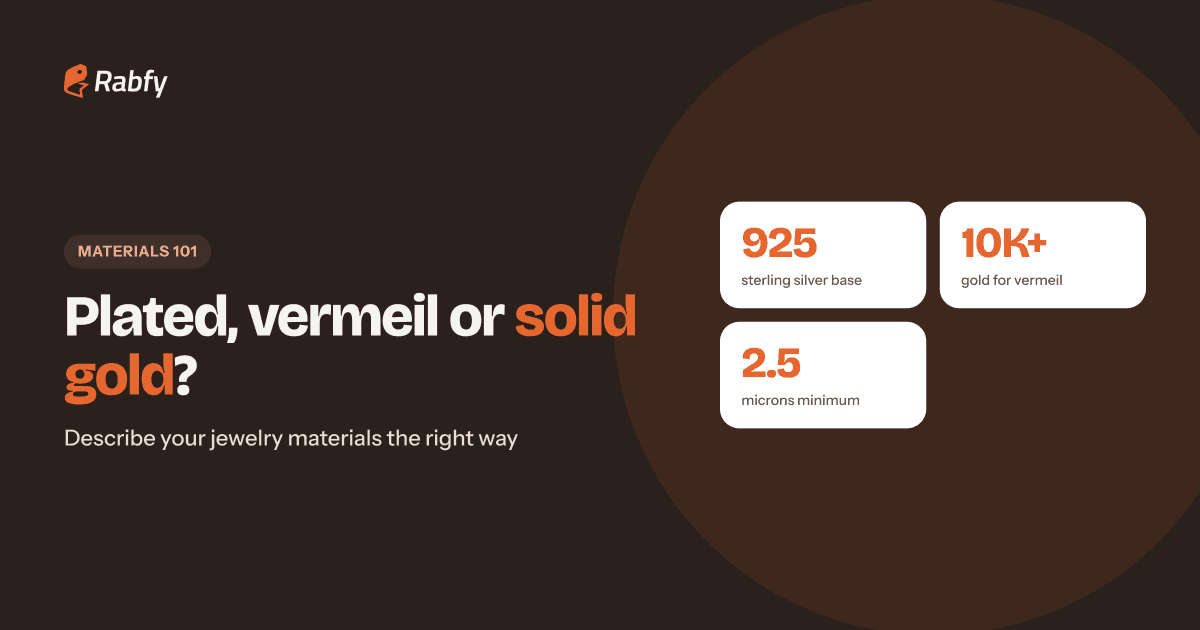
Gold plated means a layer of gold alloy over another metal. Under the FTC Guides, vermeil needs a sterling silver base and at least 10K gold, 2.5 microns thick.
Stainless steel is a durable, tarnish-resistant base metal. State a grade only if your supplier confirms it.
In the US, unqualified "gold" means 24K. Always state the karat.
Describe every material exactly as your supplier specifies — never upgrade the wording.
Why your jewelry material description matters
Material words shape what buyers expect. If a listing says "gold" and the piece is gold-plated steel, the buyer feels misled — even if the necklace is lovely. That leads to returns, bad reviews and, on marketplaces, possible listing problems.
There is also a legal side. In the US, the FTC's Guides for the Jewelry, Precious Metals, and Pewter Industries (16 CFR Part 23) explain when terms like "gold plated," "vermeil" and "sterling silver" can be used. Clear, accurate wording protects you and builds trust. It also makes your return policy much easier to apply.
Material words also affect search. Buyers type phrases like "sterling silver necklace" or "stainless steel bracelet." Accurate words in your title and product attributes help the right buyers find you — and keep away buyers who expect something else.
The five main jewelry materials at a glance
Here is a quick overview before we go deeper. "Price level" is relative — it shows how materials usually compare, not exact prices.

Stainless steel jewelry
Stainless steel jewelry is made from an iron alloy that contains chromium. The chromium forms a very thin protective layer on the surface, which helps the metal resist rust and tarnish. That is why stainless steel is popular for everyday, affordable jewelry.
For sellers, the main benefits are durability and a lower cost per piece, which leaves room for gift packaging, message cards and a healthy margin at gift-friendly prices.
 Grades: jewelry suppliers often use grades such as 316L or 304. Mention a grade only if your supplier specifies it.
- Gold-tone steel: stainless steel can be plated or coated in a gold color. The base is still steel, so say so: "gold-plated stainless steel," not "gold."
- Tarnish resistant, not tarnish proof: "tarnish resistant jewelry" is an honest phrase; "never tarnishes" is a promise you can't keep.
Gold plated jewelry: what the terms mean
Gold plated jewelry has a layer of gold alloy on top of another metal, such as brass, copper or steel. It gives the look of gold at a lower price. The FTC Jewelry Guides describe several related terms:
- Gold plate / gold plated: a surface layer of gold alloy thick enough for reasonable durability, with the karat shown (for example, "14K gold plated").
- Gold electroplate: gold of at least 10K, at least 0.175 microns thick.
- Heavy gold electroplate: gold of at least 10K, at least 2.5 microns thick.
- Gold filled / rolled gold plate: gold alloy bonded to a base metal by a mechanical process, with the karat shown.
What is a micron? One micron is one-thousandth of a millimeter. So even "heavy" plating is a very thin layer — which is why care matters so much.
Plating wears with time. Friction, sweat, perfume, lotion and water all speed it up. How long it lasts depends on thickness and how the piece is worn, so avoid promises like "lasts forever."
Also notice the difference between words like "gold finish," "gold plated" and "gold." They are not the same claim. For example, Rabfy's Soul Spark Necklace has an option listed as "18K Yellow Gold finish" — so describe it with exactly those words, not as "18K gold" or "solid gold."
Gold plated vs gold vermeil: the key difference
Vermeil (say "ver-MAY") sounds like a fancy word for gold plating, but in the US it has a specific definition. Under the FTC Jewelry Guides, a product can be called vermeil if it has a base of sterling silver coated or plated on all significant surfaces with gold or gold alloy of at least 10 karat, with a minimum thickness equivalent to 2.5 microns of fine gold.

So all vermeil is gold-plated sterling silver, but most gold plated jewelry is not vermeil. Vermeil usually costs more, because the base is sterling silver and the gold layer is thicker. If the sterling silver is first covered with another base metal and then plated with gold, the Guides say that construction must be disclosed. Never use "vermeil" unless your supplier confirms the base metal, the karat and the thickness.
Solid gold and sterling silver
Solid gold
Pure gold is 24 karat (24K). Because pure gold is soft, jewelry usually uses gold alloys, and the karat tells you how many parts out of 24 are gold. Under the FTC Guides, the word "gold" used alone should describe only 24K gold, so always state the karat.

Sterling silver
Under the FTC Guides, "sterling silver" (or "sterling") must be at least 925/1,000 pure silver — which is why sterling pieces are often stamped "925." Sterling silver naturally darkens over time as it reacts with the air, but it can be polished back to a bright finish.
Common material mix-ups sellers make
- "Gold" for gold-tone jewelry. Gold color is not gold content. Say "gold-tone" or "gold plated," with the base metal.
- "Silver" for silver-tone steel. Write "silver-tone stainless steel" instead.
- "Vermeil" for any plated silver. Only use it when the base, karat and thickness meet the definition.
- Copying supplier marketing words. "Hypoallergenic" on a supplier's ad is not documentation.
- Mixing finishes in one listing. If options differ (steel vs gold finish), name each option exactly.
How to write an accurate jewelry material description
The golden rule: describe materials exactly as your supplier specifies. Don't round up, don't guess and don't copy a competitor's wording. A simple formula:
Base metal + finish or plating (with karat) + thickness if known + care tip.
- Weak: "Gold necklace, hypoallergenic, never tarnishes."
- Accurate: "Stainless steel pendant with 18K gold plating. To help the finish last, remove before swimming or showering." (Use this only if your supplier confirms steel and 18K plating.)
- For a listed finish: "Finish: 18K Yellow Gold finish." Use the catalog's exact words.
Avoid these words unless you have proof: "solid gold," "real gold," "vermeil," "hypoallergenic," "nickel-free," "waterproof" and "lifetime." Marketplaces also have their own jewelry listing rules, so check those too.

Care instructions that reduce returns
Many "it changed color" complaints come from normal wear, not defects. Clear care instructions set the right expectation and help pieces last longer. Put them in the listing and, if you can, on a small card in the package.
- Take jewelry off before swimming, showering or exercising.
- Put on perfume and lotion first, jewelry last.
- Wipe pieces with a soft, dry cloth after wearing.
- Store each piece separately in a small pouch or box.
- Polish sterling silver with a silver cloth when it darkens.
Accurate materials are one part of an honest, low-return listing. Accurate names and dates are the other — see how to prevent personalization errors. For the bigger picture, read our print on demand jewelry guide, and for seasonal listing ideas, see Christmas jewelry gift ideas.
Jewelry materials FAQ
What is the difference between gold plated and gold vermeil?
Under the US FTC Jewelry Guides, vermeil must have a sterling silver base and a gold layer of at least 10K and 2.5 microns. Gold plated jewelry can have any base metal and is often thinner.
Is stainless steel jewelry good quality?
It can be. Stainless steel is durable, affordable and tarnish resistant. If it has a gold-color plating or coating, that top layer can still wear over time.
Does gold plated jewelry tarnish?
The plating can wear away with time, and the base metal underneath may darken. Gentle care — no water, perfume or lotion contact — helps it last longer.
Can I call my jewelry hypoallergenic?
Only if your supplier can support the claim with documentation. Some people react to nickel, so vague claims can lead to complaints and returns.
How should I describe Rabfy jewelry materials?
Use the exact wording shown in the Rabfy catalog for each product and option, such as "18K Yellow Gold finish" for the Soul Spark Necklace option. If anything is unclear, ask Rabfy support.
Sell personalized jewelry with confidence
Choose from Rabfy's personalized necklaces, bracelets, pendants and rings, describe them accurately and let Rabfy handle production in 1–3 days and tracked US shipping.
Start selling free