Here's the uncomfortable truth most print-on-demand content avoids: plenty of sellers make sales every day and still make no money. They see the orders come in, feel successful, and then wonder why their bank balance never grows. The reason is almost always the same. They priced against a competitor's sticker price without ever doing the arithmetic on what's actually left after base cost, marketplace fees, payment processing, shipping, ads, and returns. This guide does that arithmetic, honestly and in full, with worked examples you can copy.
It's not the most exciting article on this blog, and that's the point. Most POD content sells you the dream because the dream converts better than the maths. But the maths is what determines whether you have a business or an expensive hobby. By the end, you'll be able to price any product knowing exactly what you keep. If you're choosing which products to sell, pair this with our guide on POD products that sell, which lists realistic base-cost and retail ranges. Here, we turn those ranges into real profit.
Is Print-on-Demand Actually Profitable?
Yes, print-on-demand is profitable, but the margins are thinner than beginners expect, and profit depends entirely on pricing correctly for every cost, not just base cost. A typical POD product might carry a 20% to 40% gross margin, which shrinks further once ads and returns are counted. The model works, but only for sellers who price with the full cost stack in view rather than guessing.
The confusion comes from focusing on one number: the gap between base cost and retail price. A mug that costs you $6 and sells for $22 looks like a $16 profit, and beginners price the whole catalogue on that illusion. But that $16 is not profit. It's what's left before the marketplace takes its cut, before payment processing, before you factor shipping, before ad spend, and before returns. By the time all of those come out, that $16 can become $6, or less. Print-on-demand is genuinely profitable, but the profit lives in the details most sellers never calculate, which is exactly what the rest of this guide walks through. If you're still weighing whether the model is right for you at all, our guide on what print-on-demand is covers the fundamentals.
The Difference Between Gross Margin and Contribution Margin
Gross margin is your retail price minus the direct cost of the product (base cost plus fulfilment). Contribution margin goes further, subtracting the variable selling costs like marketplace fees, payment processing, and ad cost, to show what each sale actually contributes to your business. Confusing these two is the single most common reason sellers think they're profitable when they aren't.
Here's why the distinction matters so much. Gross margin flatters you, because it only counts the product cost, so it looks healthy while hiding the fees that erode it. Contribution margin tells the truth, because it counts everything that varies with each sale. A product with a 60% gross margin can have a contribution margin closer to 25% once marketplace fees, processing, and a share of ad spend come out. When you price a product, gross margin is where you start, but contribution margin is what you actually live on. Every worked example below tracks the price all the way down to what's genuinely left, because that bottom number is the only one that pays you.
What Comes Out of Every POD Sale
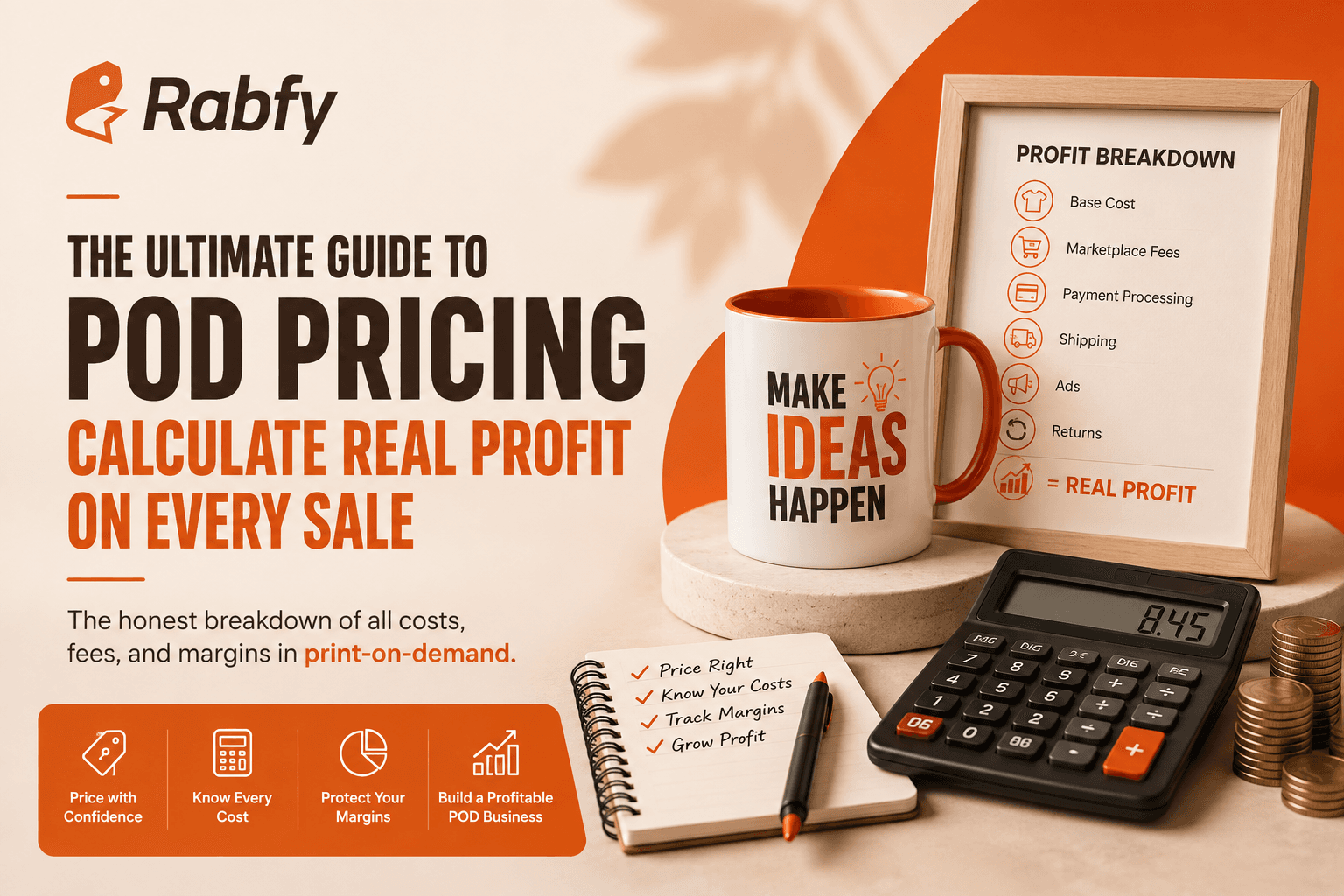
Every POD sale is reduced by a stack of costs: the product base cost, fulfilment and shipping, the marketplace referral or transaction fee, payment processing, any ad spend attributed to the sale, and a share of returns. Understanding the full stack is the whole basis of pricing correctly. Miss any layer and your real margin is smaller than you think.
Here's the full deduction stack that turns a retail price into actual profit:
 Base cost: what your fulfilment partner charges to make the product.
- Fulfilment and shipping: the cost to produce and ship each order (sometimes bundled into base cost, sometimes separate).
- Marketplace fee: the platform's cut, a referral or transaction fee that varies by platform and category.
- Payment processing: the cost of taking the payment, often bundled into the marketplace fee, sometimes separate.
- Ad spend: if you advertise, the cost of ads divided across the sales they generate.
- Returns and replacements: a small allowance per sale for the orders that go wrong.
Notice how many of these are percentages, not fixed amounts, which means they scale with your price and quietly compound. The rest of this guide takes real products and runs them through this exact stack, so you can see where the money goes.
Worked Example 1: An Etsy T-Shirt
On Etsy, a t-shirt with a $12 base cost sold at $26 leaves roughly $8 to $9 after Etsy's fees, before any ad spend, which is a healthy starting point but not the $14 the price gap suggests. Let's walk the whole calculation so you can copy it for your own products.
Etsy charges a $0.20 listing fee, a 6.5% transaction fee on the item price plus shipping, and payment processing of roughly 3% plus $0.25 (rates vary by country). Here's the arithmetic on a $26 tee with free shipping:
Line Amount Retail price $26.00 Base cost -$12.00 Etsy listing fee -$0.20 Etsy transaction fee (6.5%) -$1.69 Payment processing (~3% + $0.25) -$1.03 Contribution before ads $11.08 (43%)
So the honest number is about $11, not the $14 the base-to-retail gap implied. That's still a solid contribution margin, and it's why apparel on Etsy can work. But now imagine you run Etsy Ads and one in every few sales is attributed to an ad costing $3 to $4: that ad cost comes straight out of this $11 on the sales it touches, which is how sellers running ads at a thin margin end up working for almost nothing. The lesson: know your pre-ad contribution first, then decide how much of it you can afford to spend acquiring a customer.
Worked Example 2: An Amazon Mug
On Amazon, a mug with a $6 base cost sold at $19.99 leaves roughly $10 after Amazon's referral fee, a strong-looking margin that shrinks once fulfilment, ads, and Amazon's other costs are added. Amazon's fee structure is simpler on the surface but has more moving parts underneath.
Amazon charges a referral fee, typically 15% for most categories, on the total sale. Here's the base arithmetic on a $19.99 mug:
Line Amount Retail price $19.99 Base cost -$6.00 Amazon referral fee (15%) -$3.00 Contribution before ads and fulfilment extras $10.99 (55%)
That looks excellent, and mugs are a genuinely strong-margin product. But the honest picture adds more: if you use Amazon's own fulfilment, per-unit fulfilment and storage fees come out too; if you advertise with Amazon PPC, that ad cost is deducted from this contribution on the sales it drives; and Amazon's algorithm rewards conversion, so competitive pricing matters. The $10.99 is your ceiling before those, not your take-home. The discipline is the same as Etsy: establish the clean contribution first, then subtract fulfilment and ad realities to find what you actually keep.
Worked Example 3: A Shopify Hoodie
On your own Shopify store, a hoodie with a $28 base cost sold at $55 leaves roughly $22 after payment processing, but unlike a marketplace, you also carry the store subscription and, crucially, the full cost of driving your own traffic. Shopify's per-sale fees are lower, but the hidden cost is customer acquisition.
On Shopify, there's no marketplace referral fee, just payment processing of around 2.9% plus $0.30 (via Shopify Payments), on top of your monthly subscription. Here's the per-sale arithmetic on a $55 hoodie:
Line Amount Retail price $55.00 Base cost -$28.00 Payment processing (2.9% + $0.30) -$1.90 Contribution before ads and subscription $25.10 (46%)
Per sale, Shopify looks better than a marketplace, because no platform takes a 15% cut. But here's the catch that sinks new Shopify sellers: a marketplace brings you buyers, and Shopify does not. Every visitor to your store is one you have to bring, usually through ads, so your real customer acquisition cost often exceeds any marketplace fee. If it costs you $15 in ads to acquire the buyer of that hoodie, your $25 contribution becomes $10, lower than the marketplace equivalent. The Shopify margin is only better if you can drive cheap traffic, which is the hard part, covered in our guide on Rabfy Storefront vs Shopify and on scaling a store in growing a Shopify POD business.
The Margin Waterfall: Watch a Price Become Profit
A margin waterfall shows your retail price stepping down through every deduction, base cost, fees, processing, ads, returns, until you reach actual net profit. Visualising it this way makes clear how a healthy-looking price becomes a thin profit. It's the single most useful mental model for pricing.
Picture a $26 Etsy tee as a staircase going down. You start at $26. Base cost drops you to $14. Etsy's fees drop you to about $11. Attribute an ad cost and you fall to perhaps $8. Set aside a returns allowance and you land around $7. That $7, not the $14 the price gap suggested, is your real net profit per sale. Every product you sell has a waterfall like this, and the sellers who make money are simply the ones who can see the whole staircase before they set the price, rather than looking only at the top step. When you price a new product, sketch its waterfall: start at retail, subtract every layer, and make sure the bottom step is a number worth having.
How Much Should You Budget for Ads?
Budget for ads out of your contribution margin, not your retail price, and know your break-even ROAS, the return on ad spend at which ads neither make nor lose money. If your contribution margin is 40%, your break-even ROAS is 2.5, meaning you need $2.50 in sales for every $1 of ad spend just to break even. Getting this number wrong is how sellers lose money while their revenue grows.
Here's the logic in plain terms. Your contribution margin is the pool that ad spend comes out of, so if a product contributes 40% and you spend all 40% on ads, you've made nothing on that sale. Break-even ROAS is simply one divided by your contribution margin: at 40% margin, that's 1 ÷ 0.40 = 2.5. Any ROAS above 2.5 makes money; below it loses money. This is why the earlier examples insisted on finding contribution before ads. You cannot know what you can afford to spend acquiring a customer until you know what each sale contributes. Set your ad budget as a deliberate slice of contribution margin, track your actual ROAS against your break-even point, and you'll never again be surprised that more sales somehow meant less money. One factor that changes this maths in your favour is repeat purchases: a customer who buys more than once spreads their acquisition cost across several orders, which is why retention is such a powerful margin lever, covered in our guide on customer retention for POD brands.
How Do Returns Affect Your Margin?
Returns reduce your real margin because a returned order usually costs you the product, the fulfilment, and sometimes the return shipping, with no revenue to offset it, so you should build a small returns allowance into every price. Even a low return rate meaningfully lowers your effective margin across a catalogue. Ignoring returns is a quiet but real drain.
The arithmetic is unforgiving. When an order is returned and refunded, you've often paid to produce and ship it and now get nothing, so that loss has to be recovered from your profitable sales. If your products carry a 20% net margin and even a small percentage of orders are lost to returns, your effective margin across all sales drops noticeably. The defence is twofold: reduce returns at the source with accurate listings, honest photos, clear sizing, and reliable production, and build a small returns allowance into your pricing so the occasional return is already accounted for. This is one more reason production quality matters to your bottom line, since a low return rate isn't just good service, it's direct margin protection. Fulfilment reliability affects this directly, and knowing when to move fulfilment to a dedicated partner is covered in our guide on when to stop self-fulfilling.
Should You Price the Same Across Marketplaces?
No. Price for each marketplace's specific fee structure and audience, not with one universal price. The same product needs a different price on Etsy, Amazon, and your own store, because each takes a different cut and each audience expects different pricing. A single flat price across platforms guarantees you're either underpriced somewhere or uncompetitive somewhere else.
The reason is simple: the deduction stacks differ. Amazon's 15% referral fee is more than double Etsy's 6.5% transaction fee, so an identical take-home requires a different retail price on each. On your own Shopify store you keep more per sale but pay to acquire the buyer. Beyond fees, each marketplace's buyers have different price expectations. The right approach is to decide the contribution margin you want, then work backwards to the retail price that delivers it on each specific platform, given that platform's fees. Price the margin you need, not a number you copied from one marketplace and pasted everywhere.
Should You Offer Free Shipping?
Free shipping usually helps conversion, but it isn't free to you, so build the shipping cost into your product price rather than absorbing it. Buyers strongly prefer "free shipping," and marketplaces often favour it, but the cost still has to be covered somewhere. The trick is psychological pricing, not giving away margin.
Most buyers respond better to a $26 item with free shipping than a $22 item plus $4 shipping, even though the total is identical, and some marketplace algorithms favour free-shipping listings. So offering free shipping is usually smart. The mistake is treating it as genuinely free and eating the cost out of your margin. Instead, fold the shipping cost into your retail price so the item covers its own delivery. On our worked examples, that means the "free shipping" price already has shipping built in. Offer free shipping for the conversion benefit, but price it in, never absorb it, or you've quietly cut your own margin on every order.
Frequently Asked Questions
What's a healthy POD margin? A healthy print-on-demand product often carries a gross margin of 20% to 40%, with personalised and home-decor items reaching higher. But the number that matters is contribution margin, what's left after marketplace fees, processing, and a share of ad spend, which is always lower than gross margin. Aim to know your contribution margin on every product and to keep it high enough that ad spend and returns still leave you a real profit, rather than chasing a gross-margin figure that hides those costs.
Should I price the same across marketplaces? No. Each marketplace takes a different cut (Amazon's referral fee is roughly 15%, Etsy's transaction fee 6.5%, while your own store charges only payment processing but requires you to bring traffic), so the same take-home needs a different retail price on each. Decide the contribution margin you want, then work backwards to the price that delivers it on each specific platform given its fees and its audience's price expectations.
How much should I budget for ads? Budget ads out of your contribution margin, not your retail price, and calculate your break-even ROAS as one divided by your contribution margin. At a 40% contribution margin, break-even ROAS is 2.5, so you need $2.50 in sales per $1 of ad spend just to break even, and you profit only above that. Never commit an ad budget without knowing this number, since spending your whole margin on ads means making nothing per sale.
How do returns affect margin? Returns lower your real margin because a refunded order usually costs you the product and fulfilment with no revenue to offset it, so that loss must be recovered from profitable sales. Even a modest return rate reduces your effective margin across a catalogue. Protect yourself two ways: reduce returns with accurate listings, clear sizing, and reliable production, and build a small returns allowance into every price so the occasional return is already paid for.
Should I offer free shipping? Usually yes, because buyers prefer free shipping and many marketplace algorithms favour it, but never absorb the cost out of your margin. Build the shipping cost into your product's retail price, so a "free shipping" item already covers its own delivery. Buyers respond better to one inclusive price than to an item price plus a separate shipping charge, even when the total is the same, so free shipping is a pricing-psychology win as long as you price it in.
Key Takeaways
- Making sales isn't making money. Sellers go broke pricing against a competitor's sticker without doing the arithmetic on what's actually left.
- Gross margin flatters; contribution margin tells the truth. What you live on is retail minus base cost, fees, processing, ads, and returns, not just base-to-retail.
- Run every product through the full deduction stack. A $26 tee with a $14 gap can leave around $7 in real net profit once fees, ads, and returns are counted.
- Budget ads from contribution margin and know your break-even ROAS (one divided by contribution margin). At 40% margin, you need a 2.5 ROAS just to break even.
- Price for each marketplace's fees separately, build a returns allowance into every price, and offer free shipping only when it's priced into the product, never absorbed.
How Rabfy Helps
Every calculation in this guide starts with one number you control by choosing your fulfilment partner: the base cost. A lower, predictable base cost widens every margin downstream, and Rabfy's pricing is transparent so you can run the arithmetic above with real figures rather than estimates. Because you produce only when a customer orders, there's no inventory cost eating your margin before a sale, and no unsold stock to write off. Production and shipping from our US and UK warehouses keep fulfilment fast and returns low, and a low return rate directly protects the margin this whole guide is about, our sellers saw a 0% return rate last Q4. Over 300 sellers currently fulfil through Rabfy across more than 50,000 orders. Check the live base costs for your products on our features page, then run them through the arithmetic here.
Run Your Real Numbers
You've got the full deduction stack, three worked examples, and the break-even maths that separates a business from an expensive hobby. The next step is running your own products through it with real base costs. Create your free Rabfy account, check your products' base costs, and price every one of them knowing exactly what you keep.
Khairul works on community and fulfilment at Rabfy and helps sellers price their catalogues honestly, so making sales actually means making money. Fee figures reflect published marketplace rates as of August 2026; confirm current fees on each platform before pricing.