Yes, you can start an ecommerce business from Bangladesh and sell to customers in the United States and Canada. But the path has a few hard parts — especially business setup and getting paid — and many beginners learn them the expensive way. This 2026 roadmap walks you through each step in order: model, sales channels, business structure, payments, fulfillment and customer support.
Key takeaways

Pick a model where products are made or stored in the US — print-on-demand or 3PL — so buyers get fast, tracked delivery.
Check marketplace eligibility for Bangladesh before you build anything. Rules differ by platform.
A US LLC can open more payment options, but it adds yearly filing duties. It is a tool, not a requirement.
Payments are the hardest part. Plan your payout route before launch.
Set a daily support window that matches US hours.
Step 1: Choose a model that works from Bangladesh
Shipping each order from Bangladesh to the US is slow and expensive, and US buyers expect tracked delivery in days, not weeks. So the first decision is simple: your products should be made or stored inside the US.
Two models make this possible for a seller who lives in Dhaka, Chattogram or Sylhet:
 Print-on-demand (POD): a US partner makes each item after a customer orders and ships it for you. No stock and low upfront cost. Best for testing products and for personalized items like name necklaces.
- 3PL (third-party logistics): you buy stock, send it to a US warehouse, and the warehouse stores, packs and ships each order. Better margin per unit, but you need cash for stock. Learn more in what is a 3PL.
Most beginners should start with POD, prove that a product sells, then move best-sellers to 3PL. Our comparison of dropshipping vs print on demand vs 3PL goes deeper, and the print on demand jewelry guide shows how the model works for jewelry.

Step 2: Choose sales channels and check eligibility
Each marketplace has its own rules about which countries it accepts. Check them before you spend money on a company or a website. At the time of writing:
- Shopify from Bangladesh: you can build and run a Shopify store from anywhere. The challenge is payments (see Step 4), not the store itself.
- Sell on Amazon from Bangladesh: Bangladesh appears on the list of countries Amazon accepts for seller registration. Expect to provide a passport, a recent bank or card statement, a card that works for international payments and an account that can receive payouts. Read Amazon FBM vs FBA to choose how you fulfill.
- Etsy: Bangladesh is not on Etsy's list of countries eligible for Etsy Payments, Etsy's main way to pay sellers. Check the official list for updates before you plan an Etsy shop.
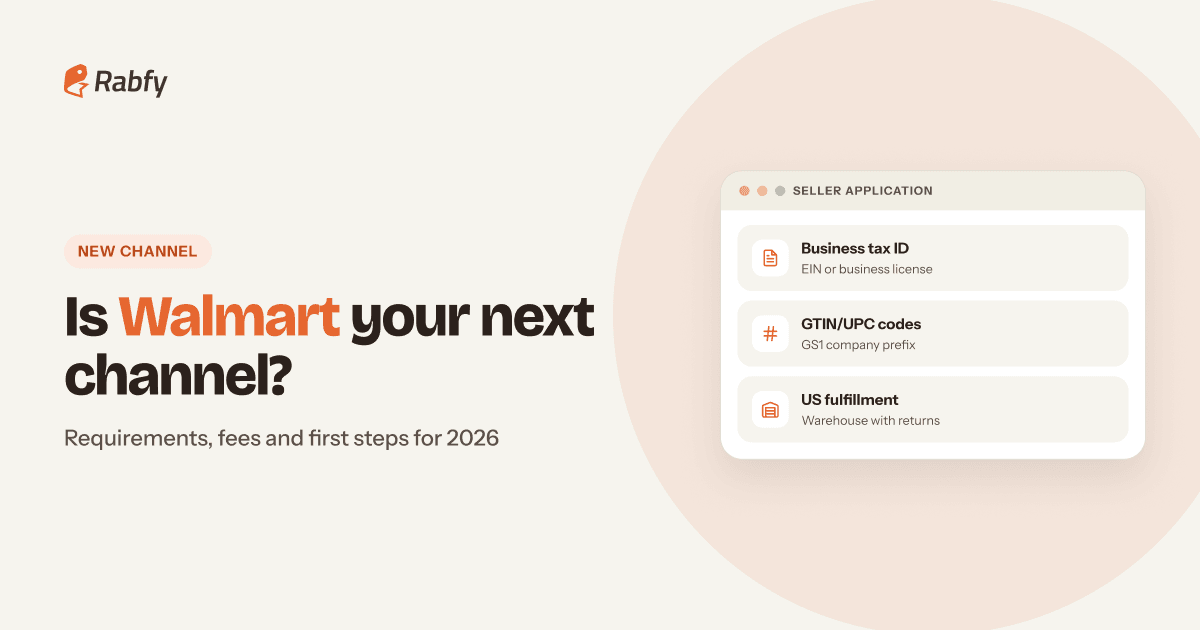
- Walmart Marketplace: Walmart accepts sellers based outside the US only from a short list of countries, and Bangladesh is not on it. A US-registered business is another route, and Walmart also reviews your selling history. See how to sell on Walmart Marketplace.
- eBay: eBay supports sellers in many countries. Check its official payout options for Bangladesh before you list.
Step 3: Do you need a US LLC? Options for non-residents
You have two main paths. Neither is right for everyone.
Path A: Sell as a Bangladesh-based seller
Where a platform accepts Bangladesh (for example, Amazon at the time of writing), you can register with your own identity or your Bangladeshi business. This is simpler and cheaper to start. The limit is payments: some checkout tools are not available for businesses based in Bangladesh.
Path B: Form a US LLC as a non-resident
A US LLC for non-residents is a common route. You don't need to live in the US to form one. You choose a state, appoint a registered agent there and file formation papers — yourself or through a formation service. Stripe Atlas, for example, forms a Delaware C corporation or LLC for founders around the world; at the time of writing its fee is $500, including the first year of registered agent service.
Next you need an EIN, the company's US tax ID. According to the IRS Form SS-4 instructions, applicants with no US residence or US principal office can't use the online EIN application. International applicants can apply by phone at 267-941-1099 (not toll-free; 6 a.m. to 11 p.m. Eastern time, Monday to Friday — late afternoon to early morning in Dhaka), or by fax or mail.
An LLC also brings yearly duties. A single-member LLC owned by a non-US person generally must file IRS Form 5472 with a pro forma Form 1120 every year, even with little activity, and most states require an annual report or fee. On the positive side, FinCEN now says companies created in the US no longer need to file beneficial ownership (BOI) reports.
Step 4: Plan payments and payouts before launch
Payments are the step that stops most sellers outside the US. Here is the situation at the time of writing — confirm each point on the official page:
- Shopify Payments works only for businesses located in supported countries. Bangladesh is not on the list; the US is. For a US LLC, Shopify's help center says a non-US resident can verify with a passport instead of an SSN or ITIN, and payouts need a US checking account in USD. Approval is not guaranteed, and Shopify may ask for proof of real US business activity.
- Stripe is not available for businesses based in Bangladesh, but it is available for US companies.
- PayPal is not generally available for receiving payments in Bangladesh. In 2026, Bangladesh Bank allowed banks to partner with foreign payment platforms, so watch for official announcements.
- Payoneer is widely used in Bangladesh to receive marketplace payouts, and it offers withdrawals to bKash.
- Wise does not list Bangladesh among the countries where residents can hold money in a Wise account.

There is one more option: platforms that collect the money for you. When a customer buys on Amazon, Amazon collects the payment and pays you out. On the Rabfy Store, the customer pays Rabfy, and Rabfy deducts costs and pays you the rest on Net 15 terms — no website or payment gateway of your own needed. Ask the Rabfy team which payout methods work for your country.
Step 5: Fulfill orders from inside the US
Once orders come in, they must reach US and Canadian customers quickly, with tracking. This is where a US partner does the physical work while you run the business from Bangladesh. With Rabfy:
- Shopify: connect your store in a few clicks. New orders import automatically, and tracking goes back to your store. See Shopify print-on-demand fulfillment.
- Amazon, Etsy and eBay: place each sale as a custom order in the Rabfy dashboard. For Amazon FBM, tracking is ready to confirm in Seller Central.
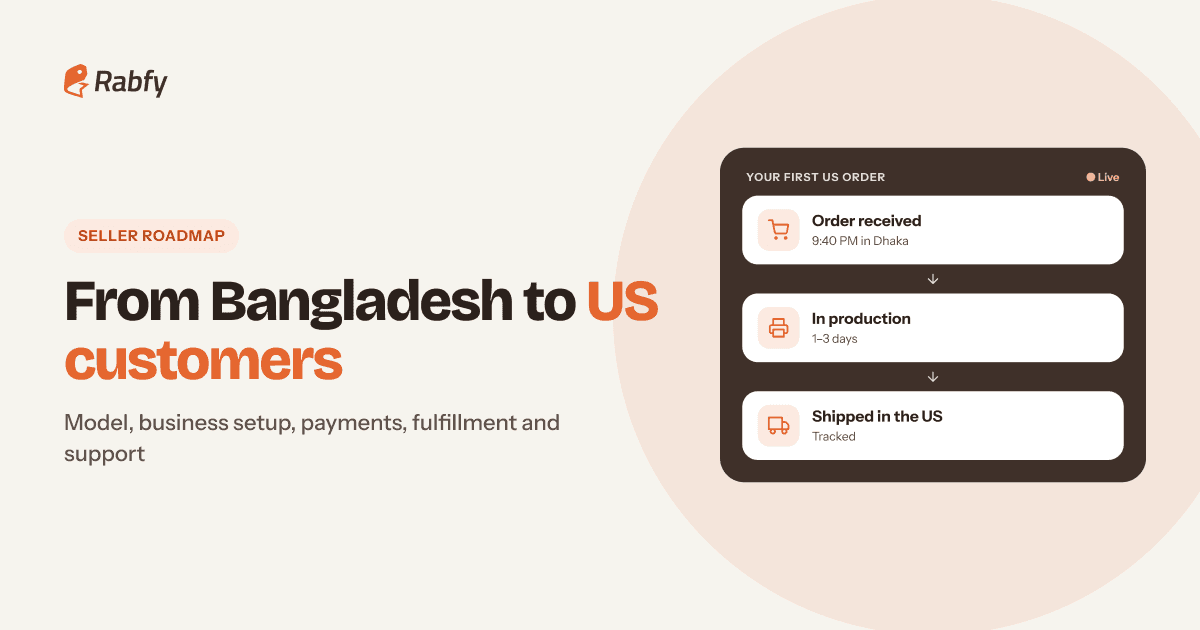
- Production and shipping: 1–3 days production, then tracked US shipping, or delivery to Canada via DHL.
- 3PL and FBA prep: send your own stock to Rabfy's US warehouse for storage, pick/pack/ship and FBA prep and forwarding.
Order costs (product + shipping) come out of your prepaid Rabfy Wallet, so you top up once instead of paying order by order. Also plan returns early: some marketplaces, such as Walmart, ask for a US return address.
Step 6: Run customer support across time zones
Bangladesh Standard Time is UTC+6 and does not change for daylight saving. The US does: on Sunday, Nov 1, 2026, US clocks move back one hour, so the gap with New York grows from 10 to 11 hours.

The good news: your evening is the US morning. At 8:00 PM in Dhaka it is 10:00 AM in New York (until Oct 31). A practical daily routine:
- 1Evening (about 7–10 PM Dhaka): answer customer messages while US buyers are awake and shopping.
- 2Morning: check overnight orders and production status, and reply to anything urgent.
- 3Always: use saved reply templates so answers stay fast and consistent. Start with our customer service templates.
Your 90-day roadmap
Here is a realistic order of work. Most delays come from Steps 3 and 4, so start them early, even while you research products.

For each step, write down what is done and what is missing. When you are ready to launch, our guide to starting an online jewelry business ties the whole plan together. You can create a free Rabfy account at any point — there is no subscription, and you pay only when an order comes in.
FAQ: selling in the US from Bangladesh
Can I start an ecommerce business from Bangladesh and sell to US customers?
Yes. Choose a model where products are made or stored in the US (print-on-demand or 3PL), pick channels that accept sellers from Bangladesh, and plan how you will receive payouts.
Do I need a US LLC to sell on Amazon from Bangladesh?
Not necessarily. At the time of writing, Amazon accepts seller registrations from Bangladesh. A US LLC can open other options, such as Shopify Payments or Stripe, but it adds yearly filings. Confirm on Seller Central.
Can I use Shopify from Bangladesh?
Yes, you can build and run a Shopify store. Shopify Payments isn't available for businesses located in Bangladesh, so you need another payment route, such as a qualifying US company or a third-party provider available to you.
How do I receive money from US sales in Bangladesh?
Many sellers use Payoneer to receive marketplace payouts and withdraw to a local bank or bKash. Follow Bangladesh Bank rules and keep clean records; a local accountant can help.
How does Rabfy help sellers outside the US?
Rabfy fulfills orders from the US with 1–3 day production and tracked shipping, delivers to Canada via DHL, and supports sellers in English and Bangla.
Plan your US launch with us
Tell us your channel and product idea, and we'll help you map the fastest route to your first US order — in English or Bangla.
Book a free strategy call