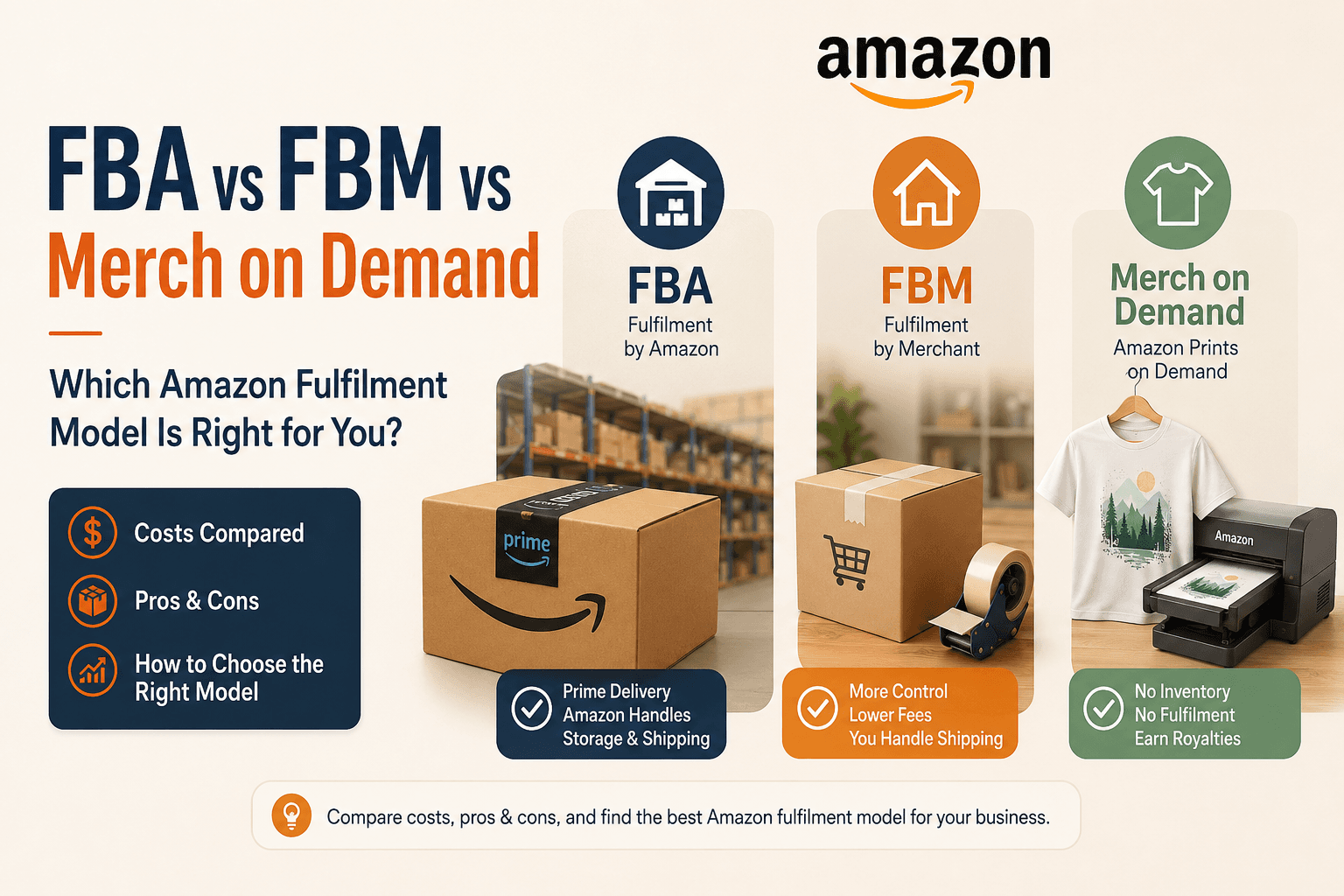
Choosing between Amazon FBM vs FBA is one of the first big decisions you make as an Amazon seller. With FBA, Amazon stores, packs and ships your products. With FBM (Fulfilled by Merchant), you or a partner ship each order. Neither is always better. The right choice depends on your product, your cash and how fast you can ship. This guide explains both in plain words, with a special focus on personalized products, where the answer is clearer than you might think.
Key takeaways

FBA suits stocked products that sell steadily. You pay fulfillment and storage fees and must send inventory first.
FBM suits made-to-order and personalized products. You control production, packaging and shipping.
At the time of writing, Amazon Custom orders must be fulfilled by the merchant, so personalized products are FBM by design.
Seller Fulfilled Prime gives FBM sellers the Prime badge, but its delivery standards are strict.
Many brands use both: FBA for fast-moving stock items, FBM for personalized SKUs.
What is the difference between Amazon FBM and FBA?
The difference comes down to two questions: who holds the stock, and who ships the order. Everything else (fees, Prime, returns) follows from those two answers.
FBA: Fulfillment by Amazon
You send inventory to Amazon's fulfillment centers. When a customer orders, Amazon picks, packs and ships the item, and handles customer service and returns for that order. Your in-stock FBA offers are eligible for Prime, which many shoppers look for.
The trade-off is cost and control. You pay per-unit fulfillment fees and monthly storage fees, and you need to buy and prep stock before you sell anything.
FBM: Fulfilled by Merchant
With fulfilled by merchant, you keep the inventory, or you have none at all if you make to order. When an order comes in, you or your fulfillment partner ship it and confirm tracking in Seller Central. You handle customer questions and returns yourself.
The trade-off is responsibility. Amazon measures how fast you ship and deliver, so your process must work every day, not only in quiet months.

What FBA really costs in 2026
FBA fees are not one fee. They are a stack, and each part changes with your product's size, weight, price and how long it sits in the warehouse. Amazon updates these fees regularly, so always check the current rate card in Seller Central before you decide. At the time of writing, these are the main costs to plan for.

On top of these, every sale pays a referral fee that depends on the category, and Professional sellers pay a monthly plan fee ($39.99 per month at the time of writing). Referral and plan fees apply to FBM too, so they do not change the decision between the two.
If you choose FBA, clean prep matters. Items that arrive with the wrong labels or packaging can be delayed or charged extra. Our guide to FBA prep services walks through labeling, bundling and shipping to Amazon.
What FBM costs (and what it asks of you)
With FBM, your costs are easier to see: the product, the packaging, the shipping label, and your time or your partner's fee. You don't pay storage at Amazon, and you don't pay for stock that hasn't sold yet.
What FBM asks for is discipline. At the time of writing, Amazon measures seller-fulfilled orders with metrics like these:
 Late Shipment Rate: orders confirmed as shipped after the expected ship date. Amazon's target is under 4%.
- Valid Tracking Rate: shipments with a valid tracking number. The target is above 95%.
- On-Time Delivery Rate: orders delivered by the promised date. Amazon asks for 90% or higher.
- Order Defect Rate: negative feedback, A-to-z claims and chargebacks. The target is under 1%.
These targets can change, so check your Account Health page for the current numbers. The key lesson: your handling time must match reality. If production takes up to 3 days, don't promise next-day shipping.
How to set handling time for made-to-order items
Handling time is the number of business days between the order and the moment you ship. For a made-to-order product, it must include production. If your partner produces in 1–3 days, a handling time of 3 business days gives you room in busy weeks. Amazon then adds transit time from your shipping settings to show the buyer a delivery date.
Amazon Custom: why personalized products are FBM by design
If you sell Amazon Custom personalized products, such as a necklace with a name or a bracelet with initials, the decision is mostly made for you. Amazon Custom lets customers add their own text or choose options on the product page. According to Amazon, you need a Professional selling account to use it, and all Custom orders must be fulfilled by the seller using FBM.
This makes sense. A personalized piece only exists after the customer orders, so it can't sit on a warehouse shelf. It must be made and shipped by you or your production partner.
This is where a print-on-demand partner fits. Each Amazon order becomes a production order, the item is made, and it ships directly to the customer with tracking. You never need to hold stock of 500 different names.

Seller Fulfilled Prime: the Prime badge without FBA
Seller Fulfilled Prime (SFP) lets FBM sellers show the Prime badge on orders they ship themselves. It sounds like the best of both worlds, but the standards are strict. You must pass a trial period, keep meeting Amazon's on-time delivery, valid tracking and cancellation targets, and ship within Prime delivery speeds.
For stocked products in a US warehouse, SFP can work well. For made-to-order personalized items with 1–3 days of production, Prime delivery promises are usually too tight. For those SKUs, an honest delivery date on a regular FBM listing is the safer choice.
When to use FBA, FBM or both
Most growing brands end up with a mix. Decide product by product (SKU by SKU), not for the whole store at once.

- Choose FBA for standard, non-personalized products that sell steadily, where you can predict demand and afford the stock.
- Choose FBM for personalized, made-to-order or slow-moving products, and for new products you are still testing.
- Use both when your catalog has a few fast sellers plus many personalized variations.
If you hold your own stock, a 3PL can store it, ship your FBM orders and prep your FBA shipments. Rabfy's US warehouse offers receiving, storage, pick/pack/ship and FBA prep and forwarding. Our plain-English guide to what a 3PL is explains how it works, and our comparison of dropshipping vs print on demand vs 3PL helps you choose a model for each product line.
Common mistakes when choosing FBA or FBM
- Copying FBA delivery promises to FBM. A made-to-order item needs a handling time that includes production, plus a small buffer.
- Sending personalized variations to FBA. Blank versions of a personalized product confuse buyers and lead to returns. Keep personalized SKUs on FBM.
- Ignoring tracking uploads. On FBM, a shipment without valid tracking hurts your Valid Tracking Rate even if the package arrives. Confirm tracking as soon as it's ready.
- Overstocking FBA before the holidays. Extra units cost peak storage in Q4 and can turn into aged inventory in the new year.
Each of these mistakes is easy to fix once you see it. Review your fulfillment settings once a month, and again two weeks before Black Friday.
A simple Amazon fulfillment plan for Q4
- 1List every SKU and mark it: personalized, stocked fast seller or stocked slow seller.
- 2Set personalized SKUs to FBM with Amazon Custom, with a handling time that includes production.
- 3Send only proven fast sellers to FBA, in quantities you can sell by December.
- 4From October, check your Late Shipment Rate and Valid Tracking Rate every week.
- 5Write your holiday order cutoff dates now, before Black Friday on Nov 27.
New to personalized jewelry on Amazon? Start with our print on demand jewelry guide, then check Rabfy pricing to see what an order costs before you list.
Frequently asked questions
Is FBM or FBA better for beginners?
For personalized or untested products, FBM is usually easier to start because you don't buy stock upfront. FBA suits beginners who already have a proven product and the budget to send inventory.
Can I use FBA for personalized products?
Not with Amazon Custom. At the time of writing, Amazon requires Custom orders to be fulfilled by the merchant, so personalized items are sold as FBM.
Do FBM sellers get the Prime badge?
Only through Seller Fulfilled Prime, which has strict delivery and tracking standards. Most made-to-order products are sold as regular FBM listings with a clear delivery date.
Can I use FBA and FBM at the same time?
Yes. You choose the fulfillment method for each offer, so many sellers use FBA for fast-moving stock items and FBM for personalized SKUs.
Which fees apply to both FBA and FBM?
Referral fees on each sale and the Professional plan fee apply to both. FBA adds fulfillment, storage and related fees. FBM adds your own production and shipping costs.
Sell personalized products on Amazon, no stock needed
Create a free Rabfy account, add your first product and fulfill your Amazon FBM orders as custom orders: made in 1–3 days and shipped with tracking.
Start selling free