Every seller trying to get onto Amazon hits the same wall in their first week of research: three fulfilment models, three sets of fees, and no clear answer for which one actually fits their situation. Most guides compare FBA and FBM as if it's a coin flip. It isn't. The right model depends on how much capital you're willing to lock into inventory, whether you have your own products at all, and how much operational control you're willing to give up in exchange for Amazon doing the heavy lifting.
This is a decision framework, not a sales pitch for one model over another. By the end, you'll know which of the three fits where you are right now, and which one to grow into later. If you're still weighing whether print-on-demand is the right business model in general, our guide to print-on-demand covers that groundwork. This one assumes you've decided to sell on Amazon specifically and need to pick a lane.
The Three Models, in Plain Terms
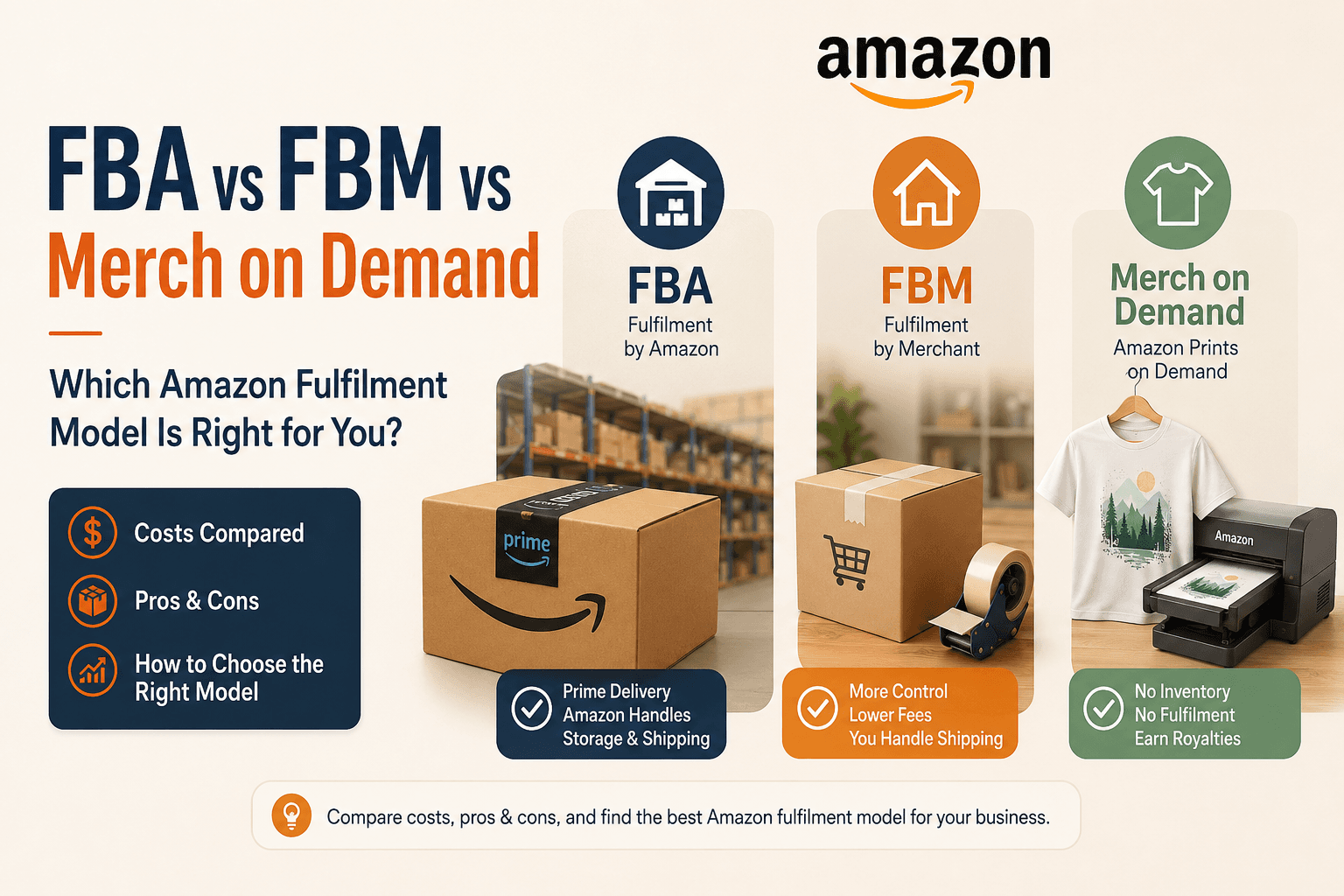
Fulfilment by Amazon (FBA) means you ship inventory to Amazon's warehouses in bulk, and Amazon picks, packs, ships, and handles customer service for every order. You get the Prime badge automatically, which matters more than most new sellers expect. The trade-off is capital: you're paying for inventory and storage before you've sold a single unit.
Fulfilment by Merchant (FBM) means you (or a fulfilment partner) store and ship every order yourself. You keep more control and avoid Amazon's storage and per-unit fulfilment fees, but you lose the automatic Prime badge, and shipping speed becomes entirely your responsibility.
Merch on Demand is Amazon's own in-house print-on-demand program. You upload a design, Amazon prints and ships the product only after a customer buys it, and you earn a royalty on each sale. There's no inventory and no fulfilment work at all, because Amazon handles production itself. This is the one model where a third-party production partner, including Rabfy, isn't part of the equation. Merch on Demand only works with Amazon's own printing operation.
What Each Model Actually Costs
The referral fee is the one constant across all three. Amazon charges it on every FBA and FBM sale regardless of fulfilment method, typically 15% for most categories, though it ranges from around 8% for electronics up to 45% for a handful of accessory categories, with apparel usually landing between 5% and 17% depending on price point.
Beyond that, the costs diverge sharply:
FBA FBM Merch on Demand Referral fee ~15% (category-dependent) ~15% (same rate) Not applicable; royalty-based Fulfilment cost Roughly $3-$6.50 per unit for standard-size items, tier-based Your own shipping and pick-and-pack cost, or a 3PL's rate None; Amazon absorbs production and shipping Storage $0.78/cubic foot (Jan-Sep), jumping to roughly $2.40/cubic foot in Q4 None, unless you're paying a warehouse yourself None Upfront capital Inventory cost plus inbound freight, before any sales Lower; many sellers pay per order as it ships Zero; no inventory ever purchased Earnings model Retail price minus referral fee minus fulfilment/storage Retail price minus referral fee minus your shipping cost Royalty per sale, tiered by traffic source (see below)
Amazon also added a low-inventory-level fee in 2026, charged per unit sold when your FBA stock drops below roughly 35 days of cover, which pushes sellers toward tighter inventory planning than in past years. And as of this year, Amazon stopped offering in-house prep and labelling services for FBA shipments entirely. Sellers now have to handle labelling and polybagging themselves or through a 3PL before inventory ever reaches an Amazon warehouse. We cover exactly what that means for shipment prep in Amazon FBA Prep Requirements: How to Stop Getting Shipments Rejected.
Merch on Demand's Royalty Tiers Changed in 2026
If you're weighing Merch on Demand, one recent change matters more than anything else in this article. Until June 2026, Merch on Demand paid a flat royalty regardless of where your sales came from. That's gone. Amazon now pays on a three-tier system based on how much of your traffic you drive yourself:
 Creator Tier (the default for every seller): roughly half the old flat rate. On a $19.99 t-shirt, that's about $2.44 per sale, and it applies automatically if your sales come entirely from Amazon's own search and recommendations.
- Plus Tier: pays close to double the Creator rate, but only once a meaningful share of your traffic (Amazon has cited figures around 15%) comes from outside Amazon, such as your own social following or email list.
- Premium Tier: the highest rate, requiring a much larger share of external traffic, generally cited around 35% or more.
In practice, this means passive Merch on Demand income, upload a design and let Amazon's algorithm do the rest, now earns roughly half of what it used to. Sellers who treat it as one channel in a broader marketing effort, rather than a set-and-forget listing machine, are the ones still earning meaningfully from it in 2026.
Where Print-on-Demand Actually Fits
This is the point of confusion that trips up more new sellers than anything else in this comparison: Merch on Demand and "selling print-on-demand products on Amazon" are not the same thing.
Merch on Demand is closed to outside production partners. Amazon prints, Amazon ships, Amazon sets the royalty. There's no way to connect a platform like Rabfy to a Merch on Demand listing, because Amazon doesn't allow it.
If you want to sell POD products on Amazon using your own designs and a fulfilment partner that isn't Amazon, the path is FBM. You create a standard Seller Central listing yourself, and when an order comes in, you place it with your POD partner to produce and ship. Amazon treats it exactly like any other merchant-fulfilled sale. This is the model that actually resembles what most new POD sellers picture when they imagine "doing POD on Amazon," and it's the one where a production partner like Rabfy fits.
Control, Risk, and the Buy Box
FBA's biggest advantage isn't really the fulfilment convenience, it's the Prime badge and the conversion lift that comes with it. Products with Prime eligibility tend to win the Buy Box more consistently and convert noticeably better than otherwise-identical FBM listings. That advantage has a cost attached: once inventory sits in an Amazon warehouse, you own the storage fees, the risk of overstocking before a slow season, and the surge in storage costs every Q4.
FBM gives up some of that conversion edge in exchange for control. You're not locked into Amazon's storage costs, you're not exposed to inbound shipment rejections under the tightened 2026 prep rules, and you can adjust your product catalogue without waiting on freight to arrive at a fulfilment centre. The trade-off is that you (or your fulfilment partner) become responsible for shipping speed, and slow shipping is one of the fastest ways to lose the Buy Box regardless of price.
A pattern worth borrowing from more experienced sellers: many run a hybrid approach rather than picking one model permanently. Bestselling, fast-moving SKUs go into FBA to capture the Prime advantage. Slower variants, new product tests, and anything where storage fees would outweigh the benefit stay on FBM. It's not an either/or decision once you're running more than a handful of SKUs.
Seller Fulfilled Prime: The Middle Path
Seller Fulfilled Prime (SFP) lets FBM sellers display the Prime badge while still shipping from their own operation or a 3PL, rather than sending inventory into Amazon's warehouses. Amazon reopened the program to new applicants a few years ago, and it now runs through a prequalification stage followed by a monitored trial.
To even prequalify, Amazon looks at your prior 90 days of merchant-fulfilled performance: at least 100 seller-fulfilled packages shipped, a cancellation rate under 2.5%, a valid tracking rate above 95%, and a late shipment rate under 4%. Delivery speed requirements tightened again in July 2026, raising the bar further. In other words, SFP isn't something a brand-new seller walks into. It's a program you grow toward once you have real FBM order volume and a fulfilment operation reliable enough to hit those numbers consistently.
Common Mistakes Sellers Make Choosing a Model
Committing to FBA inventory before validating demand. Sending a large first shipment into Amazon's warehouses on a product nobody's confirmed wants to buy is the single most expensive mistake in this comparison. Test on FBM or a smaller batch first.
Treating Merch on Demand as passive income in 2026. The old flat-royalty version of that story is over. Without some external traffic strategy, Creator Tier earnings are roughly half what they were before June 2026.
Underestimating FBM's actual shipping cost. FBM avoids Amazon's fulfilment fees, but domestic shipping, packaging, and labour add up, and sellers who only compare referral fees on paper are usually surprised by their real FBM margin.
Ignoring the Q4 storage spike. FBA storage costs roughly triple between October and December compared to the rest of the year. Sellers stocking up for the holidays without accounting for that swing often see their margin shrink right when volume is highest.
Assuming FBM automatically hurts ranking. It doesn't, directly. What hurts ranking is inconsistent shipping performance and losing the Buy Box to a faster-shipping competitor, which FBM makes easier to happen if fulfilment isn't tight. A reliable FBM operation doesn't carry an inherent search penalty.
A Simple Way to Decide
If you're still unsure which model fits, work through it in this order:
Do you have your own product designs or a brand already, or are you starting from nothing? If you have nothing yet and want the lowest possible barrier to entry, Merch on Demand's zero-inventory model is worth applying to, understanding the 2026 royalty structure going in.
Do you have meaningful capital, roughly $1,000 or more, to commit to inventory you haven't sold yet? If yes, FBA is worth testing on a small first batch. If no, FBM keeps your capital exposure close to zero.
Do you already have a production partner or plan to use one for POD products? That rules out Merch on Demand entirely and points you toward FBM.
Can your fulfilment operation reliably hit 95%+ on-time shipping and tracking? If yes and you're already running real FBM volume, Seller Fulfilled Prime becomes worth pursuing for the Prime badge without the FBA inventory commitment.
Your Amazon Model Decision Checklist
- [ ] Confirmed your product category's actual referral fee, not just the general 15% figure
- [ ] Calculated FBA storage cost at both standard and Q4 rates before committing to a first shipment
- [ ] Decided whether you're testing demand first (smaller batch or FBM) before scaling into FBA
- [ ] If considering Merch on Demand, understood the Creator/Plus/Premium tier structure before assuming passive income
- [ ] If using POD, confirmed you're building an FBM listing, not attempting to connect a partner to Merch on Demand
- [ ] Reviewed FBA's 2026 prep requirements if inventory is heading into Amazon's warehouses
- [ ] Checked whether your fulfilment metrics could realistically prequalify for Seller Fulfilled Prime down the line
Frequently Asked Questions
Which is cheaper, FBA or FBM? Neither is universally cheaper; it depends on your product's size, weight, and sell-through speed. FBM tends to cost less for slow-moving or bulky items where FBA's fulfilment and storage fees would exceed your own shipping cost. FBA tends to work out cheaper per unit for fast-selling, standard-size products where storage time stays short and the Prime conversion lift outweighs the fees.
Can I use print-on-demand with FBM? Yes, and this is the standard way to run POD on Amazon. You create a normal Seller Central listing under FBM yourself, and when an order comes in, you place it with your production partner to print and ship. This is different from Merch on Demand, which only works with Amazon's own in-house printing and doesn't allow outside production partners.
How do I get into Amazon Merch on Demand? You apply at merch.amazon.com using an existing Amazon account. Approval isn't guaranteed and Amazon reviews applications manually. Once approved, you start at a low upload-slot tier (typically 10 slots) and unlock more slots as your designs sell.
Does FBM hurt my listing's search ranking? Not directly. Amazon's ranking factors respond to sales velocity, conversion rate, and fulfilment reliability, not the fulfilment method itself. Where FBM sellers lose ground is when shipping is slow or inconsistent, since that hurts conversion and Buy Box eligibility, which then affects visibility indirectly.
What is Seller Fulfilled Prime? It's a program that lets FBM sellers display the Prime badge while shipping orders themselves rather than through Amazon's warehouses. It requires prequalifying with strong recent fulfilment performance (100+ shipped packages, low cancellation rate, high tracking accuracy) and passing a monitored trial before Prime branding appears on your listings.
Key Takeaways
- The referral fee is the same across FBA and FBM; the real cost difference comes from fulfilment, storage, and how fast a product sells.
- Merch on Demand's flat royalty ended in June 2026. Passive earnings are now roughly half of what they were unless you drive your own external traffic.
- Print-on-demand on Amazon runs through FBM with a production partner, not through Merch on Demand, which is closed to outside suppliers.
- FBA's Prime badge drives real conversion advantages, but it comes with upfront capital risk and a Q4 storage cost spike worth planning for in advance.
- Seller Fulfilled Prime offers a middle path, but it's something to grow into with real FBM order history, not a day-one option.
How Rabfy Helps
If your path forward is FBM with a production partner, that's exactly where Rabfy fits. You list your products on Amazon, and when an order comes in, you place it with Rabfy to print and ship from our US and UK warehouses within 24-48 hours, then add the tracking to your Amazon order. There's no inventory to buy and no minimum order. If you're starting from nothing and don't yet have your own designs or brand, Rabfy's Marketplace Program is a separate on-ramp worth knowing about: it lets you sell Rabfy's own catalogue on Amazon and Etsy without building products from scratch. Either way, you're paid out 15 days after fulfilment, and it's free to start. Over 300 sellers currently fulfil through Rabfy across more than 50,000 orders, with a 0% return rate last Q4.
Not Sure Which Model Fits?
Three models, three cost structures, and the right answer depends on capital, product ownership, and how much operational control you actually want. If you'd rather talk it through than work it out alone, compare your options with our team and we'll help you map the right model to where your business actually is right now.
Rakib is the founder of Rabfy and mentors Amazon sellers directly inside Rabfy's seller community.