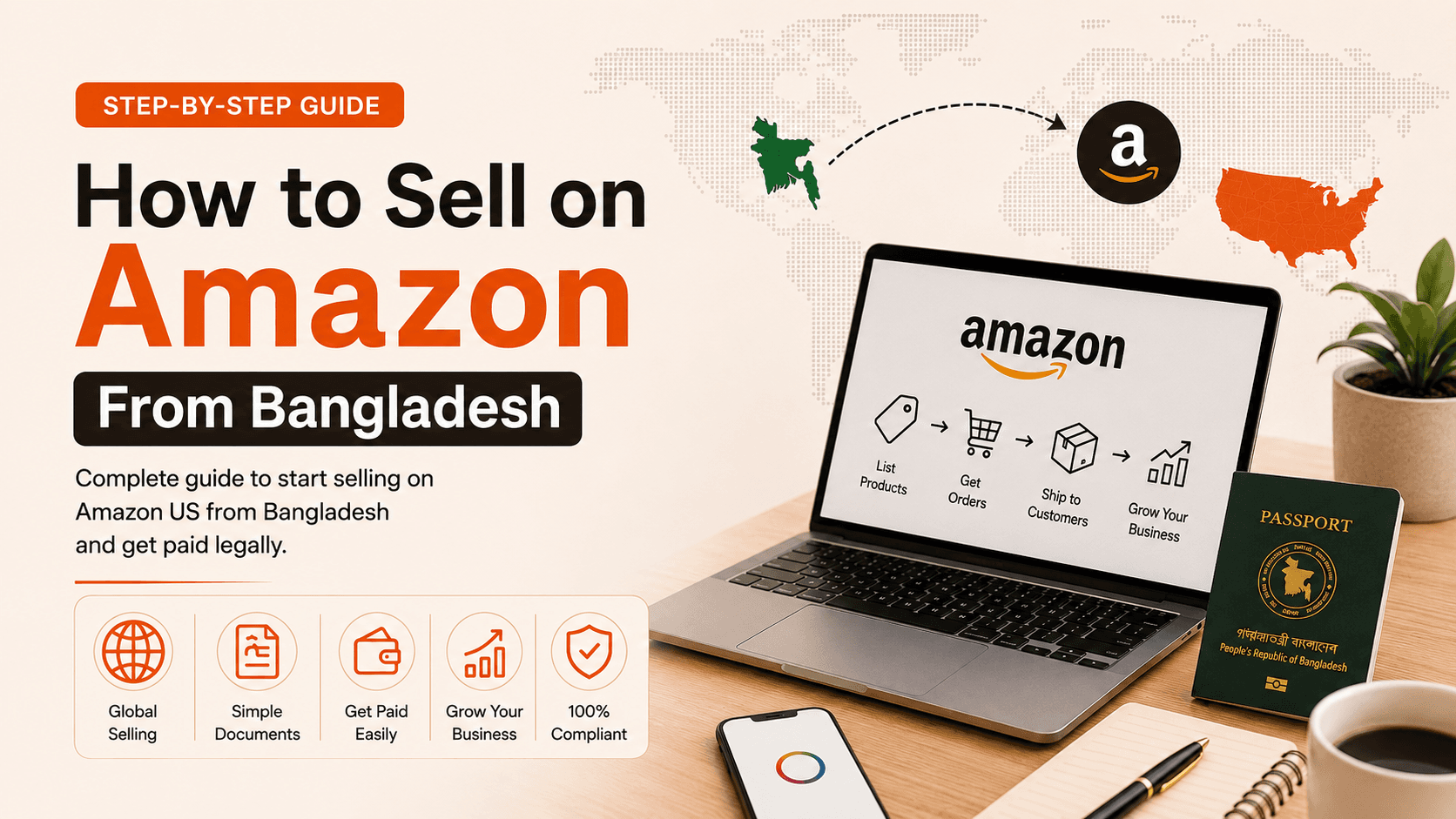
Yes, a seller in Dhaka can list products on Amazon and reach American buyers without ever leaving Bangladesh. The confusion, and there's a lot of it, isn't about whether it's possible. It's about the two things that actually trip Bangladeshi sellers up: getting an account approved without a rejection, and getting your money home legally once you've made sales. Most guides wave past both. This one walks through them honestly.
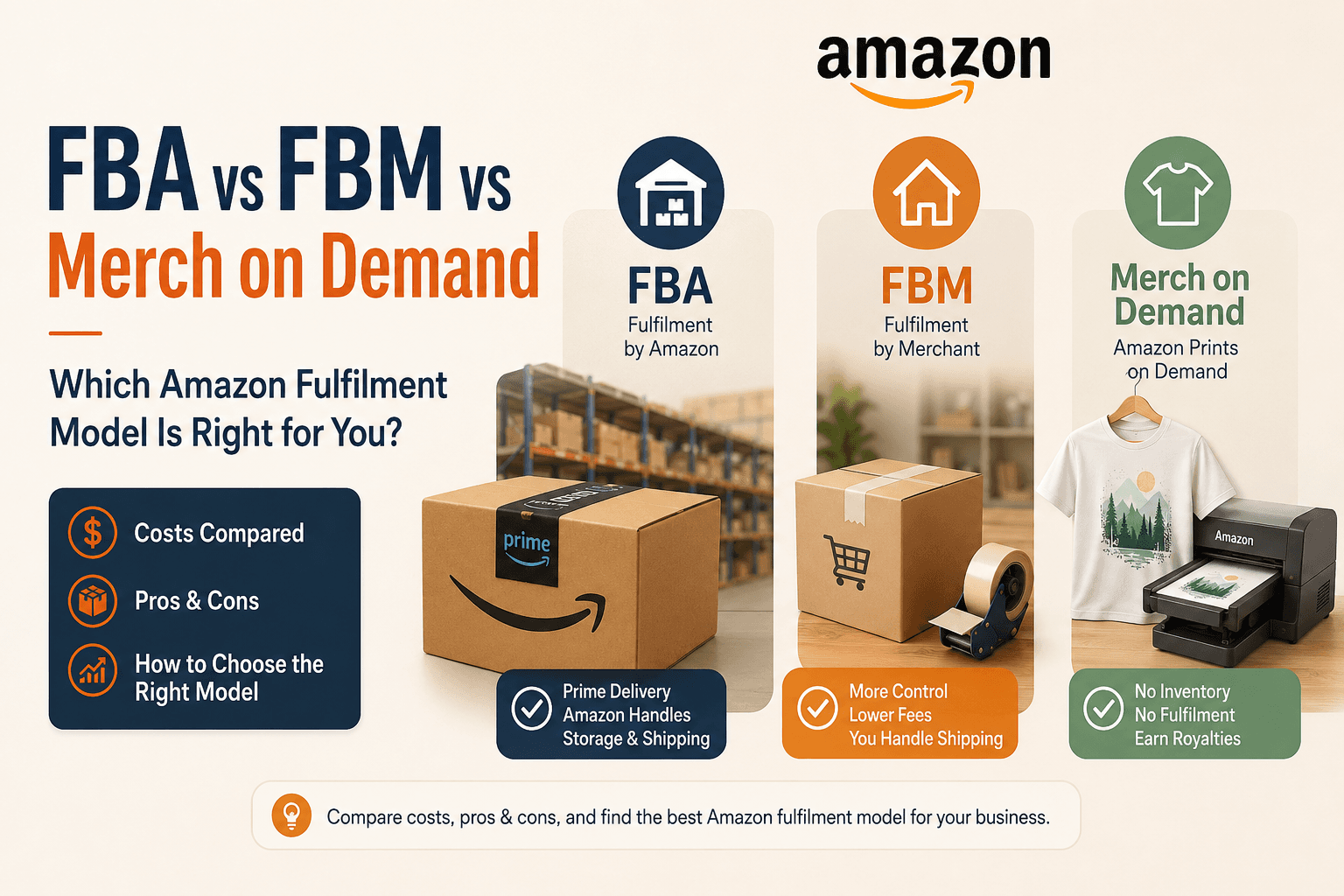
A note before we start, because it matters for a topic like this. Payment, tax, and remittance rules in Bangladesh change, and the details below reflect what was accurate as of August 2026. Treat this as a starting map, not a final authority, and confirm the current requirements directly with Amazon, with Payoneer or your chosen payment provider, and with your bank before you act. If you're still deciding which Amazon model to use, our guide on Amazon FBA vs FBM vs Merch on Demand covers that first decision.
Can Bangladeshis Sell on Amazon?
Yes. Bangladesh is on Amazon's list of accepted seller-registration countries, and Bangladeshi sellers can sell on Amazon US through the Global Selling program without needing a US company or a US bank account. This is the question everyone asks first, and the answer is genuinely yes, with conditions you have to meet.
Amazon accepts sellers from over 100 countries, and a Dhaka-based seller can list on Amazon.com and reach American customers directly. What you need instead of a US presence is a way to prove your identity, a way to get paid that Amazon recognises, and complete, consistent documents. You don't need to fly anywhere or register a company abroad. What you do need is to get the paperwork exactly right, because that's where most applications fail.
What Documents Do You Need for an Amazon Seller Account in Bangladesh?
To open an Amazon seller account from Bangladesh, you generally need a valid passport or national ID, proof of address, an internationally accepted payment method like a Payoneer account, and an international credit or debit card for the registration fee. Having every one of these ready and consistent before you start is the single biggest factor in getting approved.
Here's the practical checklist most Bangladeshi sellers need to prepare:
Document / requirement What it's for The common mistake Passport or National ID (NID) Identity verification Name spelled differently than on other documents Proof of address (utility bill or bank statement) Address verification Address doesn't match the one entered Payoneer (or similar) account Receiving Amazon payouts Name on the account not matching your ID International credit/debit card Paying the registration/subscription fee Card not accepted for international charges Phone number and email Contact and verification Not reachable during verification Bank account details Linked for payouts via your provider Details entered inconsistently
The single thread running through every rejection is inconsistency. Your name, address, and details must match across every document exactly. A passport that says one spelling and a Payoneer account that says another is one of the most common reasons a Bangladeshi application gets rejected, and it's entirely avoidable. Get every document showing the same name, the same address, the same details, before you begin.
How Do You Register an Amazon Seller Account From Bangladesh?
You register through Amazon Seller Central by choosing your marketplace (usually Amazon US), selecting a selling plan, entering your identity and business details, providing your payment method, and completing Amazon's identity verification. The process itself is straightforward once your documents are consistent. Here's the order it happens in.
Step 1: Prepare Your Documents First
Before you touch the registration form, gather everything from the checklist above and check every name, address, and number matches across all of them. This preparation is not optional busywork. It is the step that decides whether you get approved.
Step 2: Choose Your Marketplace and Plan
Register at Amazon Seller Central for your target marketplace, most commonly Amazon US, which reaches over 200 million active customers. Choose between the Individual plan, which has no monthly fee but charges a per-item fee, and the Professional plan, which charges a monthly subscription. Starting on Individual to test is reasonable; the plans and their trade-offs are covered in our Amazon selling models guide.
Step 3: Enter Your Details and Payment Method
Fill in your identity and contact details exactly as they appear on your documents, and connect your Payoneer (or equivalent) account and international card. Amazon treats a provider like Payoneer as the account it deposits your earnings into, since it can't transfer directly to a Bangladeshi bank.
Step 4: Complete Identity Verification
Amazon verifies your identity, sometimes including a video call or document review. Respond promptly and make sure your submitted documents are clear and match what you entered. This is the final gate, and consistency carries you through it.
How Do You Get Paid in Bangladesh?
Amazon does not transfer earnings directly to Bangladeshi bank accounts. You receive payouts into an international payment provider such as Payoneer, WorldFirst, or Wise, and then bring the money into Bangladesh in taka through a legal route such as the official Payoneer-to-bKash service or a bank transfer. This two-stage flow is the part that confuses sellers most, so here it is clearly.
The flow works in two stages. First, Amazon pays your sales earnings in USD into your linked international account (Payoneer is the most widely used by Bangladeshi sellers). Second, you move that money from that account into Bangladesh as taka. For the second stage, there is an official, legitimate route: bKash has an official partnership with Payoneer, letting you open a Payoneer account from within the bKash app and withdraw foreign earnings into your bKash wallet, with a minimum of BDT 1,000 per transaction. A bank transfer into a Bangladeshi bank account is the other standard legal route.
Two things you must know here, both about staying on the right side of the rules:
First, use only official, legitimate channels. Bangladesh Bank regulations require foreign-currency conversions to go through licensed banks and authorised services. Unofficial third-party "exchangers" that advertise instant conversions operate outside those rules and can put your accounts at risk. The official Payoneer-to-bKash service and standard bank transfers are the legitimate routes. Stick to them.
Second, declare your income. Under current National Board of Revenue guidance, foreign earnings brought into Bangladesh are income, and once cumulative deposits cross the reporting threshold in a fiscal year, you're expected to declare the source when you file your tax return. Keep your Payoneer records and bank statements showing the conversion history. This isn't optional, and treating your export earnings properly from the start protects you. Because tax and remittance rules change, confirm the current thresholds and requirements with your bank and a tax professional.
Can You Ship From Bangladesh, or Do You Need US Stock?
You can ship to Amazon customers from Bangladesh, but shipping physical products across the border means freight cost, customs duty, and long delivery times. Producing or holding stock inside the US, closer to your customers, means fast domestic dispatch instead. This choice shapes your delivery speed, your costs, and your customer reviews, so it deserves real thought.
Picture the two routes side by side. In the first, you make or buy products in Bangladesh and ship them to your US customers (or into Amazon's US warehouses for FBA). That means international freight, customs and duty, and delivery times measured in weeks, plus the risk of shipments being held or rejected at prep. In the second, your products are produced inside the US and dispatched domestically, reaching customers in days with no border to cross on each order.
For many Bangladeshi sellers targeting US buyers, the second route is far more practical, because Amazon customers expect fast delivery, and slow shipping hurts both your Buy Box chances and your ratings. If you're using FBA, the prep and labelling rules are strict and worth understanding before you ship anything, which we cover in Amazon FBA prep requirements. Print-on-demand is one model that removes the shipping-from-Bangladesh problem entirely, because products are produced in-country to the customer, which we come back to at the end.
Dhaka to Delivered: Comparing Your Two Shipping Routes
The practical choice for a Bangladeshi Amazon seller comes down to two routes: ship physical products from Bangladesh across the border, or produce and dispatch inside the US. The two differ sharply on cost, speed, and reliability. Seeing them side by side makes the decision concrete rather than abstract.
Here's the honest comparison of what each route actually means for your business:
Factor Ship from Bangladesh Produce or stock in the US Delivery time Weeks (international freight) Days (domestic dispatch) Per-order border cost Customs duty, freight None per order Risk Shipments held, delayed, or rejected at prep Minimal border risk Customer expectation Often missed on US Amazon Met, matching Prime-era norms Upfront burden Freight arrangement, customs paperwork None if using a US fulfilment partner
The reason this matters so much on Amazon specifically is that US Amazon buyers are conditioned to expect fast delivery, and slow shipping quietly costs you the Buy Box, ratings, and repeat purchases. A product shipped from Dhaka that takes three weeks to arrive competes badly against an identical product dispatched domestically in three days, even if yours is cheaper. That gap is why so many overseas sellers eventually move to a US-based fulfilment route.
For sellers holding real inventory, a US third-party logistics partner can receive, store, and dispatch your stock domestically, which our guide on what 3PL is explains in plain terms. For sellers who'd rather not hold inventory at all, print-on-demand produces each item in the US only after it sells, removing both the border problem and the inventory cost. And if Amazon's approval and payout hurdles feel like a lot right now, remember that the same US-buyer market is reachable through other platforms too. Our guide on reaching US buyers from Bangladesh covers the Etsy angle for sellers weighing their options.
Why Do Amazon Seller Accounts From Bangladesh Get Rejected?
Most Amazon seller account rejections from Bangladesh come down to inconsistent or incomplete documents: a name, address, or detail that doesn't match across your ID, proof of address, and payment account. Understanding the real reasons lets you avoid nearly all of them, because they're almost always preventable paperwork problems, not a ban on Bangladeshi sellers.
The leading cause, by a wide margin, is a mismatch between documents. If your passport, your utility bill, and your Payoneer account don't all show the same name and address in the same format, Amazon's verification flags it. Other common causes include blurry or unreadable document scans, an address that doesn't match what you typed, a payment method Amazon doesn't accept, and being unreachable during verification. None of these is about Bangladesh being unwelcome. They're all about the application being clean. Prepare consistent, clear documents and respond promptly to verification, and you remove the causes of most rejections.
Do You Need a US Company to Sell on Amazon From Bangladesh?
No, you do not need to register a US company to sell on Amazon US from Bangladesh. You can register as an individual using your Bangladeshi identity documents and receive payments through an international provider like Payoneer. This clears up one of the most common and expensive misconceptions.
Some sellers are told they must form a US LLC before they can start, and rush to spend money on company formation they don't need. For selling on Amazon US from Bangladesh, that's not a requirement. A US company can offer certain advantages as you grow, and it's a legitimate choice, but it is not necessary to open an account and start selling. Beginning as an individual seller with consistent Bangladeshi documents is a valid, common starting point. If and when a US entity makes sense for your business, treat it as a considered decision later, not a barrier to starting.
Your Bangladesh-to-Amazon Launch Checklist
Run through this before you apply:
 [ ] Passport or NID ready, with your name spelled consistently everywhere
- [ ] Proof of address that matches the address you'll enter
- [ ] Payoneer (or equivalent) account opened in the exact same name as your ID
- [ ] International credit/debit card that works for foreign charges
- [ ] Reachable phone and email for verification
- [ ] Every document clear, readable, and consistent with the others
- [ ] Marketplace chosen (usually Amazon US) and selling plan decided
- [ ] A plan for the payout route home (official Payoneer-to-bKash or bank transfer)
- [ ] A record-keeping habit for Payoneer and bank statements, for tax declaration
- [ ] A shipping plan decided: cross-border from Bangladesh, or US-based production/stock
Frequently Asked Questions
Can Bangladeshis open an Amazon seller account? Yes. Bangladesh is on Amazon's list of accepted registration countries, and Bangladeshi sellers can register to sell on Amazon US through the Global Selling program without a US company or US bank account. Approval depends on providing consistent identity and address documents, an accepted payment method like Payoneer, and passing Amazon's verification.
Which documents are required? Generally a valid passport or National ID, proof of address such as a utility bill or bank statement, a Payoneer or equivalent international payment account, an international credit or debit card for the fee, and reachable contact details. The most important thing is that your name and address match exactly across every document, since mismatches are the top cause of rejection.
How do I get paid in Bangladesh? Amazon pays your earnings in USD into a linked international account like Payoneer, because it can't deposit directly to a Bangladeshi bank. You then bring the money into Bangladesh in taka through a legal route, such as the official Payoneer-to-bKash service (you can open Payoneer inside the bKash app) or a bank transfer. Use only official channels, keep your records, and declare the income on your tax return, since remittance and tax rules apply and change.
Do I need a US company? No. You can sell on Amazon US from Bangladesh as an individual using your Bangladeshi documents and an international payment provider. A US company can offer advantages as you scale and is a legitimate option, but it isn't required to open an account or start selling.
Can I ship from Bangladesh or do I need US stock? You can ship from Bangladesh, but cross-border shipping means freight, customs duty, and delivery times in weeks, which Amazon customers dislike and which can hurt your ratings. Producing or holding stock in the US allows fast domestic dispatch. For sellers targeting US buyers, a US-based fulfilment route is usually far more practical.
Why do accounts get rejected? Almost always because of inconsistent or incomplete documents, a name or address that doesn't match across your ID, proof of address, and payment account, plus issues like unclear scans or being unreachable during verification. These are preventable paperwork problems, not a ban on Bangladeshi sellers. Consistent, clear documents remove most rejection causes.
Key Takeaways
- Bangladesh is an accepted Amazon registration country. Bangladeshi sellers can sell on Amazon US via Global Selling with no US company and no US bank account required.
- Document consistency is everything. A name or address that doesn't match across your ID, proof of address, and Payoneer account is the top cause of rejection.
- Amazon can't pay Bangladeshi banks directly. You receive USD into an international provider like Payoneer, then bring it home in taka through a legal route such as the official Payoneer-to-bKash service or a bank transfer.
- Use only official remittance channels and declare your foreign income on your tax return. Remittance and tax rules change, so confirm current requirements with your bank and a tax professional.
- Shipping physical goods from Bangladesh means freight, duty, and long delivery. US-based production or stock allows fast domestic dispatch, which US Amazon customers expect.
How Rabfy Helps
The hardest operational problem for a Bangladeshi seller targeting US buyers is the one this guide keeps returning to: getting products to American customers fast, without shipping every order across a border. Rabfy solves that by producing inside the US. When you sell a print-on-demand product, you place the order with Rabfy, and it's produced and shipped from our US warehouse and dispatched domestically, reaching your customer in days rather than the weeks cross-border freight takes. There's no inventory to buy, no international shipping for you to arrange, and no customs to manage on each order. Over 300 sellers currently fulfil through Rabfy across more than 50,000 orders, with a 0% return rate last Q4. For a Dhaka seller reaching US buyers, producing in the US is often the difference between competitive delivery and lost sales. Our full walkthrough of how Rabfy works maps the whole process end to end, and you can see plans on our features page.
Talk to Rabfy About Your Route to Amazon US
You've got the registration steps, the legal payout routes, and the document discipline that gets accounts approved. The remaining piece is fulfilment: reaching US customers fast without shipping from Dhaka on every order. Create your free Rabfy account and see how producing in the US shortens your delivery to American buyers.
Rabfy and mentors Amazon sellers, including Bangladeshi sellers building toward US and UK marketplaces, inside Rabfy's community. This article is informational and reflects requirements as of August 2026; confirm current rules with Amazon, your payment provider, and your bank before acting.