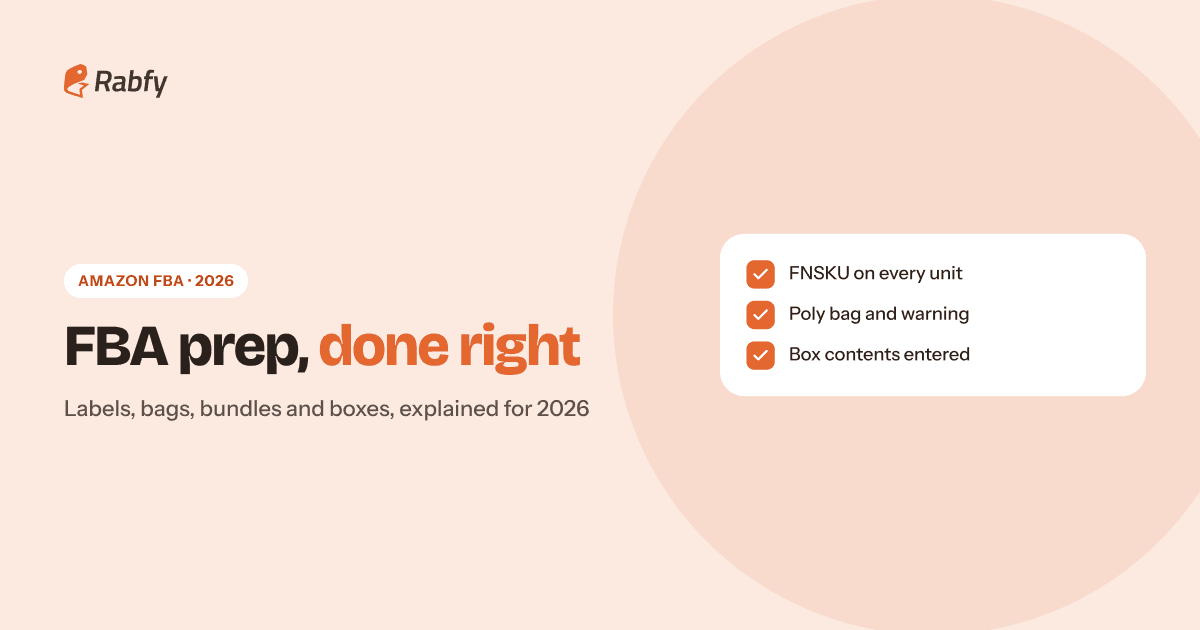
An FBA prep service gets your products ready for Amazon’s warehouses. It labels each unit, bags or bundles items when needed, packs the cartons and ships them to Amazon. In 2026 this work matters more than ever, because Amazon stopped offering its own prep and item labeling services for US shipments on January 1, 2026. This guide explains Amazon FBA prep in plain English, what changed this year and how to choose between doing it yourself and using a prep center.
Key takeaways

Since January 1, 2026, Amazon no longer offers prep and item labeling services for US FBA shipments. You or a prep partner must do this work.
Every unit needs one scannable barcode. For most small brands, that means an Amazon barcode (FNSKU) label on every unit.
Poly bags, bundles and cartons all have rules. Small mistakes can slow down check-in or lead to extra fees.
A US prep center can inspect, label and forward your stock, and keep backup inventory for busy months like Q4.
What is an FBA prep service?
FBA means Fulfillment by Amazon: you send inventory to Amazon, and Amazon stores it and ships it to buyers. Before Amazon accepts your units, they must be "prepped". Prep means each unit can be scanned, stored and shipped without damage or confusion.
An FBA prep service (also called a prep center) does this work for you. It is usually a warehouse or 3PL that sits between your supplier and Amazon. Typical services include:
 Receiving and inspection: counting units and checking for damage before Amazon sees them.
- FBA labeling: printing and applying Amazon barcode (FNSKU) labels.
- Poly bagging and protection: bagging, bubble wrap or boxes for fragile or small items.
- Bundling: packing several items together as one sellable set.
- Carton packing and forwarding: packing boxes, adding box labels and shipping to Amazon.
If your products are personalized and made after each order, FBA is often not the right fit, because you cannot stock every name in advance. In that case, merchant-fulfilled orders with print on demand usually work better. Our print on demand jewelry guide explains that model.
What changed in 2026 for FBA prep and labeling
In 2025, Amazon announced that prep and item labeling services for FBA shipments in the US would end on January 1, 2026. According to Amazon’s developer notice, the change covers all inventory sent to US FBA. Trade press also reported that items arriving without proper prep after that date are not eligible for reimbursement if they are damaged or cannot be traced.

A second change affects barcodes. Amazon ended "commingling" for inventory shipped on or after March 31, 2026. Commingling meant Amazon could ship a matching unit from another seller’s stock. Now the rules depend on who you are:

For most small jewelry and gift brands, the simple answer is: put an FNSKU label on every unit.
Amazon FBA prep requirements: the basics
FBA labeling: one scannable barcode per unit
Each unit needs one barcode that Amazon can scan, with the number printed below it. When you use FNSKU labels, cover any other barcode on the package, so the scanner cannot read the wrong one. Place the label on a flat surface, not over a seam, corner or curve.
Poly bags
Amazon’s poly bag guidance, shared on the Seller Forums, asks for:
- Bags at least 1.5 mil thick.
- A suffocation warning on bags with an opening of 5 inches or more (measured flat).
- A barcode that can be scanned through a clear bag, or a label on the outside of the bag.
- A bag that is fully sealed with tape or an adhesive strip.
Small items like jewelry
Small items are easy to lose or damage. Bag each piece, put any gift card or insert inside the same bag, and place the FNSKU label on the outside. Use Amazon’s prep guidance in Seller Central to check the exact rule for your product type.
Bundles and sets
If one listing includes several items, such as a necklace, a gift box and a message card, they must arrive as one unit. Bag or wrap them together and add a label such as "Sold as set, do not separate". Only the bundle’s barcode should be scannable.
Boxes (cartons)
- Size: since June 20, 2025, standard FBA boxes can be up to 36 inches long and 25 inches wide and high.
- Weight: keep boxes at 50 lb or less, unless one single item is heavier.
- Box labels: put the FBA box ID label on a flat side of each box, not over a seam.
- Box contents: enter what is inside each box in Send to Amazon. Missing box content information can lead to manual processing fees.

How an FBA prep center works, step by step
Most prep centers follow the same flow. You stay in control of the shipment in Seller Central, and the prep center does the physical work.

- 1Your supplier ships to the prep center. This works well when you import, because the stock is checked in the US before Amazon sees it.
- 2You create the shipment in Send to Amazon, choose yourself as the one who preps and labels, and share the labels with the prep center.
- 3The prep center labels, bags and packs the units, then adds box labels and box contents.
- 4The boxes ship to Amazon. You track check-in in Seller Central.
When you create a shipment, Amazon may also charge an inbound placement fee based on the placement option you choose. Options that split your shipment across more Amazon locations usually have lower placement fees but more boxes to ship, so compare the totals before you confirm.
DIY prep vs an FBA prep center in the USA
| Do it yourself | FBA prep center | |
|---|---|---|
| Best for | Low volume, few SKUs | Growing volume, many SKUs |
| Your time | High | Low |
| Space needed | Your home or office | None |
| Error risk | Higher when rushed | Lower with trained staff |
| Cost | Supplies and your time | Per-unit and per-box fees |
Doing it yourself is fine when you send a few boxes a month. Once you import larger orders, sell many variants or need to restock often, an FBA prep center in the USA saves time and reduces mistakes.
What to ask an FBA prep center
- Do you follow the latest Amazon prep and labeling rules?
- What do you charge per unit for labeling, bagging and bundling?
- How long from receiving my stock to shipping it to Amazon?
- Can you store extra stock and send restocks when I ask?
- Can you also ship my merchant-fulfilled (FBM) and website orders?
- How do you report damaged or missing units?
7 common FBA prep mistakes to avoid
- 1Two scannable barcodes on one unit, so the wrong product gets received.
- 2Labels on curves or seams that cannot be scanned.
- 3Thin bags or missing warnings on larger poly bags.
- 4Set items packed loose, so Amazon receives them as separate units.
- 5Wrong or missing box contents in Send to Amazon.
- 6Boxes that are too big or too heavy.
- 7Mixing shipments in one box. Each box should belong to one shipment.
Get your FBA stock Q4-ready
Amazon warehouses get very busy before Black Friday (November 27, 2026) and Cyber Monday (November 30, 2026). Check-in can take longer than usual, and stock that arrives late may miss the peak. Plan backwards from those dates and send inventory early. Our Q4 2026 e-commerce calendar lists every date to plan around.
Also check Seller Central for any capacity limits or peak-season deadlines on your account before you create Q4 shipments.
If you are new to Rabfy, you can create a free account and then talk to our team about your FBA prep needs.
Frequently asked questions
What does an FBA prep service do?
It receives your stock, inspects it, applies Amazon barcode labels, bags or bundles items when needed, packs cartons with box labels and ships them to Amazon.
Does Amazon still prep and label items in 2026?
Not in the US. Amazon ended its prep and item labeling services for US FBA shipments on January 1, 2026. Sellers or their prep partners now do this work.
Do I need an FNSKU label if my product has a UPC?
It depends. For inventory shipped on or after March 31, 2026, Brand Representatives in Brand Registry can use manufacturer barcodes. Resellers, and products without manufacturer barcodes, need Amazon barcodes.
Which poly bags need a suffocation warning?
Amazon’s guidance asks for a suffocation warning on poly bags with an opening of 5 inches or more. Bags should also be at least 1.5 mil thick and fully sealed.
Can my overseas supplier ship to a US prep center?
Yes. Many sellers import to a US prep center first. The center checks and preps the units, then forwards them to Amazon.
Get your FBA stock prepped in the US
Send your inventory to Rabfy’s US warehouse for receiving, FBA prep and forwarding to Amazon, and ship your other orders from the same place.
Talk to our 3PL team