Most "best POD products" lists are just adjectives. Trending. Popular. High-demand. None of that tells you whether a product actually makes money once the base cost, the marketplace fees, and the shipping come out. This list is different. Every one of the 32 products below comes with the arithmetic: a realistic base-cost range, a realistic retail range, the gross margin that leaves you, the marketplace it fits best, and how hard it is to compete in. Numbers, not adjectives.
One honest note before the list. The base-cost and retail figures here are realistic industry ranges to help you reason about margin, not exact prices. Base costs vary by supplier, size, and print method, so before you commit to any product, check the live base cost in your fulfilment partner's catalogue and run your own numbers. If you want the full method for calculating true margin after every fee, our guide on POD pricing and profit margins walks through it. Now, the products.
What Sells Best in Print-on-Demand During Q4?
In Q4, the strongest print-on-demand sellers are gift-friendly products across five categories: apparel, drinkware, home decor, jewellery, and personalised keepsakes. Home decor and personalised items tend to carry the highest margins, while apparel drives the highest volume. Understanding why these win in Q4 specifically helps you choose, not just copy a list.
The reason is gifting. In the fourth quarter, a huge share of buyers aren't shopping for themselves, they're buying presents, and that changes what sells and how much people will pay. Gift buyers pay for perceived value and personalisation rather than hunting the lowest price, which is why a personalised mug or a plush blanket outsells a plain tee in December even at a higher price. Apparel still moves the most units because it suits every budget and audience, while home decor and personalised keepsakes earn the fattest margins because buyers compare them to retail gift prices, not to other POD products. The five categories below are organised around that logic.
Best Print-on-Demand Apparel to Sell in Q4
Apparel is the highest-volume POD category, making up roughly 39.5% of the market, and it's where most sellers start because demand is constant and designs are easy to test. The trade-off is margin: apparel is competitive, so standard margins sit around 25% to 40% unless you go premium or personalised.
Here's how the apparel picks break down on the numbers.
Product Base cost (typical) Retail (typical) Gross margin Best marketplace Difficulty Custom t-shirt $8-$13 $22-$28 40-55% Etsy, Amazon High Pullover hoodie $22-$30 $45-$60 35-50% Etsy, Shopify Medium Crewneck sweatshirt $18-$25 $38-$50 40-50% Etsy, Shopify Medium Long-sleeve tee $12-$16 $28-$36 45-55% Etsy Medium Premium heavyweight tee $14-$20 $35-$48 45-55% Shopify, Etsy Medium Embroidered cap $12-$18 $28-$38 45-55% Etsy, Shopify Medium
The pattern in apparel is clear: plain basics are a race to the bottom, so the money is in going premium or niche. A generic t-shirt competes with millions of others, but a heavyweight tee or an embroidered cap for a specific community (a profession, a hobby, a fandom) commands a higher price and faces less competition. Hoodies and sweatshirts shine in Q4 because they double as cold-weather gifts. Start apparel with a clear niche rather than a broad design, which our guide on finding a profitable POD niche covers in detail.
Best Print-on-Demand Drinkware to Sell in Q4
Drinkware is the third-largest POD category and one of the most consistent, because buyers use it daily and buy it as gifts, giving it strong margins of roughly 40% to 60% on personalised pieces. It's a favourite for Q4 because a personalised mug or tumbler is a classic, affordable gift.
The drinkware numbers are genuinely attractive for margin-focused sellers.
Product Base cost (typical) Retail (typical) Gross margin Best marketplace Difficulty Ceramic mug (11oz/15oz) $5-$9 $18-$26 55-65% Etsy, Amazon Medium Accent/colour-rim mug $6-$10 $20-$28 55-65% Etsy Medium Insulated tumbler (20oz) $14-$20 $30-$42 45-55% Etsy, Shopify Medium Insulated tumbler (30/40oz) $18-$24 $38-$50 45-55% Shopify, Etsy Medium Stemless wine glass $10-$15 $26-$35 50-55% Etsy Low-Medium Stainless water bottle $14-$20 $30-$42 45-55% Shopify, Amazon Medium
Drinkware rewards personalisation more than almost any other category. A blank mug is a commodity, but a mug with a name, a date, or an inside joke becomes a gift someone will pay a premium for and won't return. Ceramic mugs with sublimation printing dominate the category on volume and margin, while large insulated tumblers have become a genuinely viral gifting product with high perceived value. The stemless wine glass is a standout for wedding and bachelorette gifting with lower competition than mugs. We cover why personalised products outsell generic ones in our guide on personalisation in print-on-demand.
Best Print-on-Demand Home Decor to Sell in Q4
Home decor is the fastest-growing POD category, expanding at around 24.5% a year, and it carries the highest margins in the whole industry, commonly 45% to 60%, because buyers judge it against retail and gallery prices rather than other POD products. For a margin-focused seller, this is where the real money sits in Q4.
The home decor numbers show why the category is so attractive.
Product Base cost (typical) Retail (typical) Gross margin Best marketplace Difficulty Gallery-wrapped canvas $10-$40 $30-$90 45-60% Etsy, Shopify Medium Framed poster $12-$28 $32-$70 45-55% Etsy, Shopify Medium Sherpa/plush blanket $30-$38 $65-$110 45-55% Etsy, Shopify Medium Throw pillow / cover $8-$15 $25-$45 40-55% Etsy Low-Medium Ceramic ornament $4-$8 $16-$26 55-65% Etsy Medium Metal/wood wall sign $12-$22 $32-$55 45-55% Etsy, Shopify Medium
Home decor buyers are making a visual-identity purchase, which is exactly why they'll pay more. A framed print or a multi-piece canvas set reads as art, not merch, so it escapes the price comparison that flattens apparel margins. Plush blankets are high-ticket Q4 gift champions, and personalised ceramic ornaments are a seasonal category all their own, small, cheap to produce, and bought in multiples every December. If you launch one home decor product for Q4, a personalised ornament or a plush blanket is a strong bet.
Best Jewellery Products to Sell in Q4
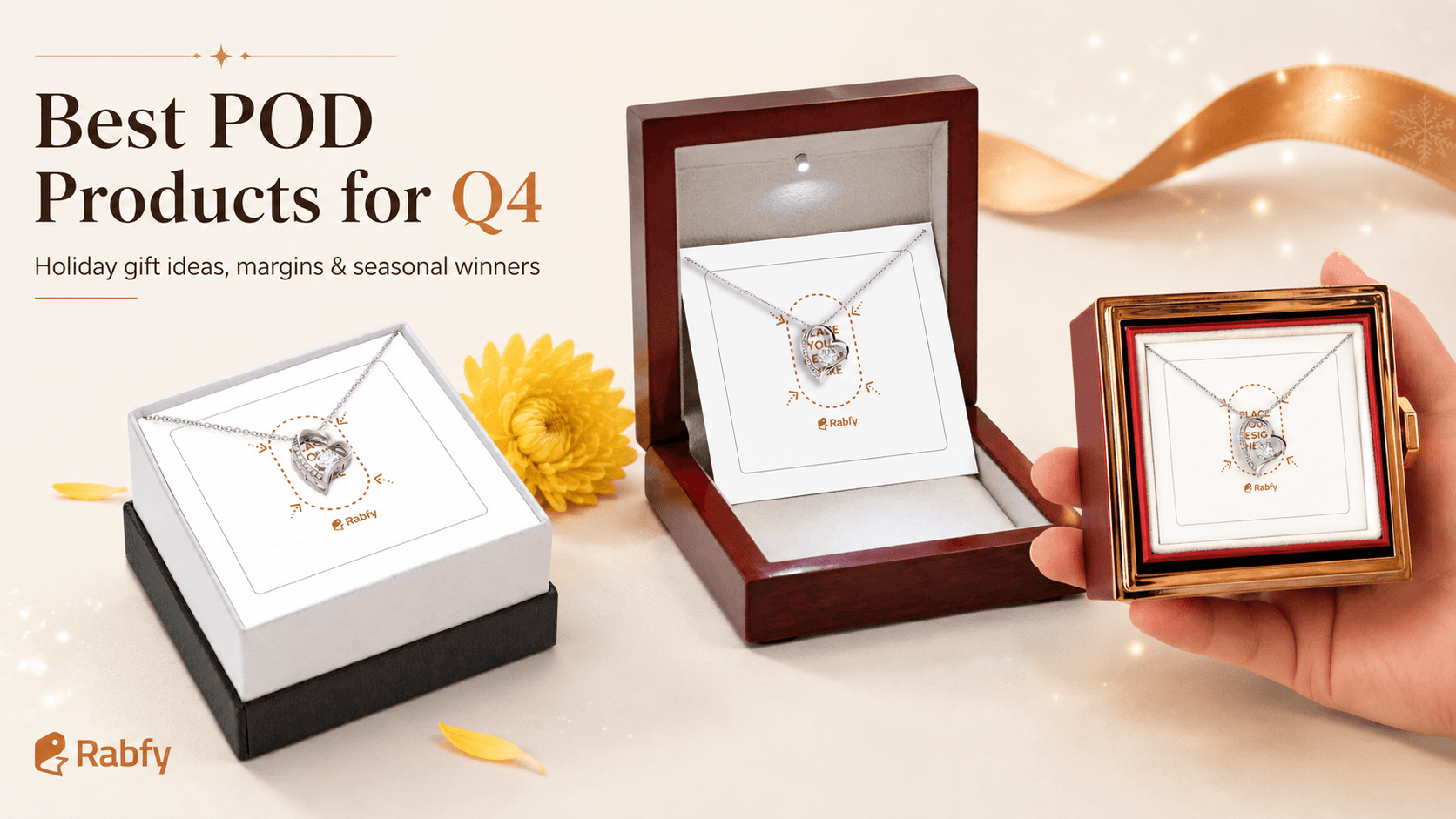
Jewellery deserves its own place in a Q4 catalogue because it combines high perceived gift value with recipient- and occasion-based positioning, letting one physical product serve many different gift angles. Unlike generic apparel, jewellery can be marketed around the relationship and the gifting moment, a gift for a daughter, wife, mum, girlfriend, soulmate, or granddaughter, without changing the underlying product.
Because these are real Rabfy catalogue products, the figures below are actual base costs from Rabfy's seller pricing guide, not industry estimates. One important caveat first: the price gap shown is not net profit. Marketplace fees, advertising, discounts, taxes, shipping, and a return allowance all still come out before you reach profit. Treat the gap as room to work with, not money in hand.
Rabfy jewellery product Base cost Recommended retail Gap before fees Production time Best marketplace Soul Spark Necklace $12.49 $49.95 $37.46 1-3 days Etsy Bond of Grace Necklace $12.49 $49.95 $37.46 1-3 days Etsy Two as One Necklace $13.04 $49.95 $36.91 1-3 days Etsy Nexoro Link Chain $13.49 $59.95 $46.46 1-3 days Etsy, Shopify Noir Bond Bracelet $13.65 $49.95 $36.30 1-3 days Etsy Twilight Arc Necklace $12.49 $49.95 $37.46 1-3 days Etsy Clarity Bloom Necklace $12.95 $59.95 $47.00 1-3 days Etsy, Shopify
These products work best when you build the offer around recipient, occasion, and message, rather than simply listing the jewellery type. The same necklace becomes a different listing depending on who it's for and why:
 Soul Spark Necklace for a daughter, at Christmas, carrying encouragement
- Bond of Grace Necklace for a wife, at Christmas, carrying love and appreciation
- Two as One Necklace for a soulmate, at an anniversary or Christmas, about connection
- Nexoro Link Chain for a husband or son, at Christmas, about appreciation
- Noir Bond Bracelet for a son or partner, as a meaningful keepsake
- Twilight Arc Necklace for a mum, at Christmas, about gratitude
- Clarity Bloom Necklace for a daughter or granddaughter, at a graduation, birthday, or Christmas, about pride
The commercial advantage isn't that jewellery removes competition. It's that message-card positioning and personalisation reduce direct like-for-like price comparison. A buyer searching for a meaningful Christmas gift for a daughter is weighing the whole gifting experience, the product, the message, the presentation, the emotional relevance, and the delivery, not the necklace alone.
If you offer free shipping, fold the shipping cost into your selling price before you judge profitability, because Rabfy's seller guide lists standard shipping separately from the base cost. Calculate marketplace fees, shipping, advertising, discounts, and a return or replacement allowance before you treat the price gap as profit. Our guide on POD pricing and profit margins walks through exactly that calculation.
Why Jewellery Is a Smart Q4 Play
Jewellery is especially useful for Q4 because one physical product can support multiple buyer angles at once: one product, many recipients, many occasions, many messages. That lets you expand a catalogue through positioning rather than constantly sourcing new physical products. Instead of seven generic necklace listings, you can test specific buyer situations, a Christmas gift for a daughter, for a wife, for a mum, for a granddaughter, for a girlfriend, for a soulmate, for a son, using the same underlying products. As always, validate the winning angle against real marketplace demand, competition, conversion data, and actual unit economics before scaling it.
Best Personalised Gifts and Keepsakes to Sell in Q4
Personalised keepsakes are the margin-protection category, with personalised POD items commonly earning 40% to 60% because a custom product can't be price-compared and rarely gets returned. In a gifting quarter, these convert especially well because the whole point of a gift is that it feels personal.
The keepsake and gift numbers round out the catalogue.
Product Base cost (typical) Retail (typical) Gross margin Best marketplace Difficulty Personalised ornament $4-$8 $16-$28 55-65% Etsy Medium Custom name necklace / jewellery $8-$18 $28-$55 50-60% Etsy Medium Photo/text tote bag $7-$12 $22-$34 45-55% Etsy Low-Medium Custom pet portrait product $8-$20 $30-$60 50-60% Etsy, Shopify Medium Personalised phone case $6-$12 $22-$35 50-60% Etsy, Amazon Medium Monogrammed die-cut item $4-$12 $18-$35 50-60% Etsy Low-Medium Custom greeting card set $2-$5 $12-$22 55-65% Etsy Low
The through-line across all seven is emotion plus specificity. A pet portrait product, a name necklace, a monogrammed keepsake, these can't be found cheaper elsewhere because they're one of one, which removes price competition entirely and drives the highest margins in this whole list. The pet niche in particular keeps growing, because owners spend on their animals like family. These products also earn strong reviews, since a personalised gift that lands well makes a delighted buyer. Personalisation does add production complexity, so plan for it, which our personalisation guide addresses.
Which Products Have the Best Margins?
Across all five categories, the highest-margin POD products are personalised keepsakes, home decor, and personalised drinkware, commonly reaching 50% to 65% gross margin, because buyers compare them to retail gift prices and can't price-shop a one-of-one item. If margin is your priority over volume, weight your Q4 catalogue toward these.
The ranking is consistent across the data. Home decor and drinkware outperform apparel on margin because of perceived value, and anything personalised outperforms its generic version because it escapes price comparison. Apparel earns its place through sheer volume and easy testing, not through margin. A smart Q4 catalogue usually blends the two: a few apparel pieces to catch volume and test designs, and a core of personalised drinkware, home decor, and keepsakes to protect margin. For the full arithmetic behind these numbers, including how marketplace fees and ad costs change the final figure, see our pricing and margins guide.
When Is the Q4 Holiday Cut-Off?
The practical Q4 selling window runs from roughly October through mid-December, with the safe personalised-order cut-off usually landing about one to two weeks before Christmas to allow for production plus shipping. Launch your Q4 products in September and early October, not December. Timing is half the battle in Q4, and most sellers launch too late.
Here's the timing logic. Because a POD order takes production time plus shipping time to reach a customer, and personalised items take longer, your realistic cut-off for guaranteeing Christmas delivery is well before Christmas itself, often one to two weeks prior for personalised goods, more for anything shipping internationally. That means the listings need to be live, indexed, and gathering reviews weeks earlier, so launching in September or early October gives your products time to rank and build momentum before demand peaks. A product listed on December 10th has essentially missed the season. Set your own cut-off dates clearly in your listings, and communicate them to buyers so nobody's disappointed.
When Should You Launch Each Category to Catch the Q4 Curve?
Different Q4 categories peak at different times, so the smart move is to stagger launches: apparel and home decor early, personalised keepsakes and ornaments through November, and last-minute-friendly digital or fast-produced items right up to the cut-off. Matching your launch to each category's demand curve catches more of the season than launching everything at once.
Here's how the Q4 curve typically runs. Apparel and home decor benefit from launching earliest, in September and early October, because they take the longest to rank and because cold-weather apparel and decor demand builds gradually through autumn. Personalised keepsakes, ornaments, and gift-focused drinkware peak through November into early December, as gift shopping accelerates, so having these live and reviewed by late October positions you for that wave. As the cut-off approaches, buyers shift toward whatever can still arrive in time, which favours faster-produced items and anything you can guarantee delivery on.
The mistake is treating Q4 as one event. It's a curve with several peaks: early-bird gift shoppers, the late-November surge, and last-minute panic buyers, each wanting different things. Planning your launches against that curve, rather than dumping everything live in one week, lets you catch demand across the whole quarter. Our guide on print-on-demand trends for 2026 covers which categories are gaining momentum going into the season, and it's worth reading alongside this list to weight your catalogue toward what's rising, not just what sold last year.
How Many Products Should You Launch for Q4?
Launch a focused Q4 range of several products across two or three categories rather than one product or fifty. A spread of five to fifteen well-chosen listings gives you real data on what sells while keeping the workload manageable. The right number balances having enough to test against spreading yourself too thin.
One product gives you no signal and almost nothing for the marketplace to show. Fifty products spreads your design effort and attention so thin that none get done well. A focused range, say a few apparel pieces, a couple of drinkware options, and a handful of personalised keepsakes, lets you see what's actually selling and double down on winners while there's still Q4 left to sell into. Start with your strongest category, add breadth carefully, and let early sales data guide where you expand. Quality and focus beat quantity, especially under Q4 time pressure.
Frequently Asked Questions
What sells best in Q4 for print-on-demand? Gift-friendly products across apparel, drinkware, home decor, jewellery, and personalised keepsakes sell best in Q4, because most Q4 buyers are shopping for presents. Apparel drives the most volume, while home decor, jewellery, personalised drinkware, and custom keepsakes earn the highest margins because gift buyers pay for perceived value and personalisation rather than the lowest price.
Which POD products have the best margins? Personalised keepsakes, home decor, and personalised drinkware carry the best margins, commonly 50% to 65% gross, because buyers compare them to retail gift prices and can't price-shop a one-of-one personalised item. Apparel typically earns lower margins (around 25% to 40% for basics) because it's highly competitive, though premium and niche apparel does better.
How many products should I launch for Q4? Launch a focused range of roughly five to fifteen products across two or three categories, rather than a single product or an overwhelming fifty. That range gives you enough to learn what sells and enough for the marketplace to show, without spreading your design effort so thin that nothing is done well. Start with your strongest category and expand based on early sales.
When is the holiday cut-off for POD orders? The safe cut-off for personalised POD orders is usually about one to two weeks before Christmas, because each order needs production time plus shipping time, and personalised items take longer. This means listings should be live weeks earlier, so launching in September or early October gives products time to rank and build reviews before demand peaks. Always state your cut-off dates clearly to buyers.
Key Takeaways
- The five Q4 winners are apparel, drinkware, home decor, jewellery, and personalised keepsakes, because Q4 buying is gift-driven and rewards perceived value over lowest price.
- Apparel drives volume but competes on thin margins (around 25% to 40% for basics). Premium and niche apparel does better.
- Home decor (roughly 45% to 60% margin) and personalised items (50% to 65%) carry the highest margins, because buyers compare them to retail gift prices and can't price-shop a custom item.
- Base costs vary by supplier and size, so treat every figure here as a realistic range and verify live base costs before committing to a product.
- Launch in September and early October, not December. Personalised order cut-offs land one to two weeks before Christmas, and listings need weeks beforehand to rank.
How Rabfy Helps
Every margin figure in this list depends on one number you control by choosing your fulfilment partner: the base cost. Rabfy's catalogue spans the categories that sell in Q4, apparel, drinkware, home decor, and personalisable products, produced and shipped from our US and UK warehouses within 24 to 48 hours, which matters enormously when Q4 cut-off dates are tight. Because you produce only when a customer orders, there's no inventory risk on seasonal products that might not sell, and no leftover Q4 stock in January. Over 300 sellers currently fulfil through Rabfy across more than 50,000 orders, with a 0% return rate last Q4. Check the live base costs for the products in this list on our catalogue, and run the real margin on the ones that fit your niche.
Browse the Rabfy Catalogue and Check Live Base Costs
You've got 25 products, the real margin arithmetic, and the Q4 timing to hit. The last step is checking the actual base cost on the products that fit your niche, so your margins are real numbers, not estimates. Create your free Rabfy account and browse the catalogue to build your Q4 range before the season starts.
Khairul works on community and fulfilment at Rabfy and helps sellers build seasonal catalogues that actually hit their margins. Figures reflect realistic industry ranges as of August 2026; verify current base costs before committing to any product.