"Start a print-on-demand business with zero investment" is one of the most repeated promises online, and it's not quite true. You can start without buying inventory, which is the expensive part of most retail businesses. But somewhere between the free design tool and your first sale, a few small costs are waiting, and the videos that promise "completely free" tend to skip past them. That gap between the promise and the reality is where a lot of beginners feel misled and quit.
This guide gives you the honest version. It covers what genuinely costs nothing, the small costs you can't avoid, where your first few dollars should go if you have them, and a realistic 30-day plan to your first listing. If you're brand new to the model itself, our guide on what print-on-demand is covers the fundamentals. This one is about starting it on a tight budget without kidding yourself about what "free" means.
Can You Really Start Print-on-Demand With No Money?
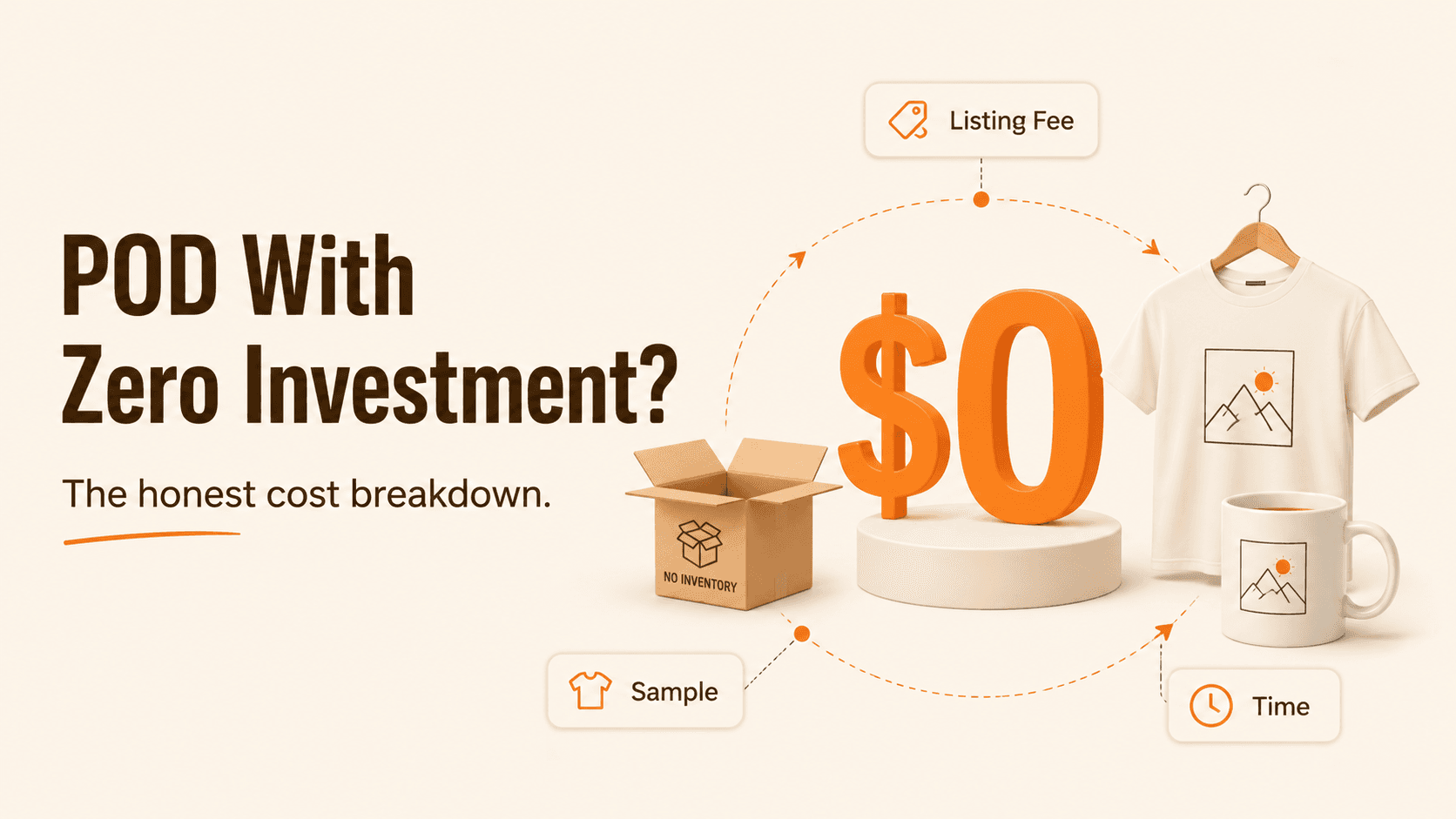
You can start print-on-demand with no upfront inventory cost, but "no money at all" is a myth. Listing fees, an optional sample order, and your own time are real costs that "completely free" promises tend to hide. The honest framing matters, because a beginner who expects zero cost and then meets a listing fee or a late-shipment problem feels cheated and gives up, when the business itself was working fine.
Here's what makes print-on-demand genuinely low-barrier. In a normal product business, you buy stock before you sell anything, so you're out hundreds or thousands of dollars before your first customer exists. Print-on-demand removes that. Nothing gets produced until a customer orders and pays, so you never buy inventory you might not sell. That's the real "no money" part, and it's a big deal. Everything else is small by comparison, but it isn't zero.
What's Genuinely Free When Starting Print-on-Demand
The design work, the marketplace account, and the fulfilment partner account can all be free. What you spend instead is time. You can get a real, listable product live without paying for tools or software, as long as you're willing to do the work yourself.
Here's the zero-budget launch stack, the three free pieces that get you to a live listing:
A Free Design Tool
You do not need paid design software to make sellable print-on-demand designs. Canva's free plan is genuinely free with no time limit, and it includes commercial-use rights on its free elements, which covers most beginner needs. For photo editing, Photopea runs free in your browser and handles the same core tasks as expensive editors, and GIMP is a free desktop option. For removing backgrounds, remove.bg gives you free credits.
One important limit to know, because it ties directly to staying compliant: free design tools let you use their elements commercially, but you generally cannot take an unmodified template and sell it as your own product. Your design needs to be genuinely your own creative work. That's not just a licensing technicality, it's also what marketplaces like Etsy require for originality. We cover finding design ideas worth making in our guide on how to find a profitable POD niche.
A Free Marketplace Account
Opening a seller account on the major marketplaces costs nothing upfront. Creating an Etsy shop is free to open, an eBay account is free, and an Amazon Individual selling plan has no monthly fee. You don't pay to exist on these platforms. You pay small fees only when you list or sell, which we break down in the next section. If you haven't opened one yet, our step-by-step guide on how to start an Etsy shop walks through the whole setup.
A Free Fulfilment Partner Account
Creating a Rabfy account is free, with no subscription and no minimum order. This is the piece that replaces inventory entirely. You design the product, list it yourself on your marketplace, and only when a customer buys do you place that order with Rabfy to produce and ship. You never pay for a product until a customer has already paid you for it. That's the mechanism that makes the whole low-budget model possible.
What Print-on-Demand Actually Costs (the Honest List)
The unavoidable costs of starting print-on-demand are small but real: marketplace listing fees, the per-order fees deducted when you sell, an optional but wise sample order, and your time. None of these require money before you make a sale except listing fees and samples, and both are modest. Here's the truthful breakdown.
Cost Free or paid? Roughly how much Design tool Genuinely free $0 (free tiers cover beginners) Marketplace account Free to open $0 Rabfy account Free, no minimum $0 Etsy listing fee Small, unavoidable on Etsy $0.20 per listing, renewed each sale eBay listing fee Free up to a monthly allowance ~250 free listings/month, then a small fee Per-order marketplace fees Only when you sell Deducted from each sale, not upfront Product + shipping cost Only when you sell Paid to your fulfilment partner per order, after the customer pays you Sample order Optional but recommended One product's cost plus shipping Your time The real investment Hours, not dollars
The pattern is worth seeing clearly. Almost every cost that isn't a listing fee happens only after a customer has paid you. You're not fronting money for products. The genuinely upfront costs are Etsy's $0.20 per listing (eBay gives you a monthly free-listing allowance) and, if you choose, a sample. Everything else comes out of money a customer has already handed you.
Should You Order a Sample if Money Is Tight?
If you can afford exactly one paid thing when starting, make it a sample of your own product. It's the single highest-value small spend in print-on-demand. A sample is one unit of your product, ordered for yourself, so you can see the real print quality, colour, placement, and packaging before a paying customer does.
Here's why it matters more than it seems when you're counting every dollar. Without a sample, your first paying customer becomes your quality-control test, and if something's wrong (a colour that printed muddy, a design placed too high), you find out through a bad review instead of privately. A sample also gives you real photos of the actual product for your listings, which convert far better than a generated mockup. If money is genuinely too tight for even one sample right now, you can list using mockups and order a sample from your first sale's earnings, but order one as soon as you possibly can. We explain why the printed result sometimes differs from the mockup in our guide on how print-on-demand actually works.
Do You Need Paid Ads to Get Your First Sale?
No. Your first sales in print-on-demand should come from organic marketplace search and free traffic, not paid ads. Ads are a scaling tool for later, not a starting requirement. Beginners who pour a tiny budget into ads before their listings convert usually just pay to show a product that wasn't going to sell yet.
The free path to early sales is straightforward. Marketplace search is your first traffic source, and it's free, so getting your titles, tags, and photos right matters far more at the start than any ad spend. Our Etsy SEO guide covers exactly how to earn that free search visibility. Beyond marketplace search, sharing your products organically on platforms like Pinterest, which is free and drives real traffic to listings, gets you in front of buyers without spending. Save ads for when you already have listings that convert and a margin that can absorb the cost, which we cover in our guide on POD pricing and profit margins.
Your 30-Day Zero-Budget Launch Plan
Here's a realistic path from nothing to a live product in a month, using only free tools and your time. It's paced for someone doing this alongside a job or studies.
Week 1: Pick a Direction and Learn the Basics
Spend the first week deciding what you'll sell and to whom. Explore niches with real demand rather than guessing, choose a product type to start with, and get familiar with your free design tool. Don't design yet. Aim your effort at picking a direction you can actually make designs for.
Week 2: Create Your First Designs
Make three to five genuine, original designs using your free tool. Not one, since a single-product shop gives you no data on what sells and gives the marketplace almost nothing to show. Keep them simple and original. Polished beats clever at this stage.
Week 3: Set Up Accounts and List
Open your free marketplace account, create your free Rabfy account, and publish your first listings. Write keyword-researched titles, complete every field, and use the best product photos you can, mockups for now if you can't afford a sample yet. Getting five to ten listings live beats obsessing over one perfect listing.
Week 4: Promote Free and Order Your First Sample
Share your listings organically on free channels, keep improving your titles and tags based on what gets views, and the moment you make a sale or can spare the cost, order a sample so your future listings use real photos. Then repeat: more designs, more listings, reinvest early earnings into samples and better products.
Time Is the Currency You Spend Instead of Money
When you start print-on-demand with almost no money, time becomes the resource you trade in place of cash, and spending it in the right places is what separates a shop that grows from one that stalls. Every free tool in the launch stack works by asking for your effort instead of your money, so where you put that effort decides your results.
For a student or someone doing this alongside a job, this is the real tradeoff to understand. A seller with money can buy premium design assets, order many samples, and test dozens of products quickly. A seller with time instead of money can reach the same place more slowly by doing the work by hand: making original designs in a free tool, researching which products people actually search for rather than guessing, and writing careful listings instead of rushing. The paid seller buys speed. The time-rich seller earns the same knowledge through effort, and often understands their own business better for it.
The trap is spending time on the wrong things. Hours spent redesigning a logo nobody will notice are hours not spent on niche research or listing quality, which are what actually drive sales. Put your free hours where they compound: finding demand before you design, which we cover in our guide on how to find a profitable POD niche, and getting your listings genuinely findable. Those two do more for a zero-budget shop than any amount of polish.
Where Your First Dollars Should Go
When you do have a little money to reinvest, spend it in this order: samples first, then better product photography, then more product designs, and only much later, paid ads. Reinvesting earnings wisely is how a zero-budget start becomes a real business, and the order matters.
Samples come first because they protect quality and give you real photos. Better photography comes next because it directly lifts conversion on listings you already have. More designs come after that, because a wider catalogue gives you more chances to find what sells. Paid ads come last, only once you have proven, converting listings and a margin that can afford them. Spending on ads before the first three is money poured into a funnel that isn't ready to convert.
Frequently Asked Questions
Is it really free to start print-on-demand? It's free of upfront inventory cost, which is the biggest barrier in most product businesses, but not entirely free. You can use free design tools, open marketplace accounts for free, and create a free Rabfy account. The small unavoidable costs are marketplace listing fees (like Etsy's $0.20 per listing) and, ideally, one sample order. Product and shipping costs are only paid after a customer has already paid you.
What are the unavoidable costs? The genuinely upfront ones are marketplace listing fees and an optional sample. Etsy charges $0.20 per listing; eBay gives you a monthly free-listing allowance before small fees apply. Everything else (per-order marketplace fees, product cost, shipping) comes out of money the customer has already paid you, so it isn't money you front. Your time is the real investment.
Should I order samples if money's tight? Yes, as soon as you possibly can. A sample is the highest-value small spend in print-on-demand because it lets you check real quality before a customer does and gives you real product photos for your listings. If you truly can't afford one at the start, list using mockups and order a sample from your first sale's earnings, but treat it as a priority, not an optional extra.
How long until my first sale? There's no guaranteed timeline, and anyone promising one is guessing. Realistically, following a steady plan, you can have listings live within a month, and first sales depend on your niche, your listing quality, and how much free promotion you do. Treat the first few weeks as learning and listing, not as a deadline for income.
Do I need paid ads? No. Your first sales should come from free marketplace search and organic sharing on platforms like Pinterest. Ads are a scaling tool for after you have listings that already convert, not a requirement for getting started. Spending on ads too early usually just pays to display a product that wasn't ready to sell.
Key Takeaways
 Print-on-demand removes the biggest cost of a product business, upfront inventory, but "completely free" is a myth. Listing fees, an optional sample, and your time are real.
- The zero-budget launch stack is a free design tool, a free marketplace account, and a free Rabfy account. What you spend instead is time.
- Almost every cost that isn't a small listing fee happens only after a customer has paid you, so you rarely front money for products.
- A sample is the single highest-value small spend. It protects quality and gives you real photos that convert better than mockups.
- You don't need paid ads to start. Free marketplace search and organic sharing drive your first sales; save ads for when your listings already convert.
How Rabfy Helps
Rabfy is the free fulfilment piece of the zero-budget launch stack. Creating an account costs nothing, there's no subscription, and there's no minimum order, so it fits a start-with-almost-nothing budget exactly. You design your product, list it yourself on Etsy, eBay, Amazon, or Shopify, and only when a customer buys do you place the order with Rabfy to produce and ship from our US or UK warehouse within 24 to 48 hours. You never pay for a product before a customer has paid you. Over 300 sellers currently fulfil through Rabfy across more than 50,000 orders, with a 0% return rate last Q4. It's free to start, which is exactly what a first-time seller on a tight budget needs.
Create Your Free Account and List Your First Product This Week
You've got the honest cost picture, the free launch stack, and a 30-day plan that doesn't pretend the small costs don't exist. The next step is small and free: set up the fulfilment piece so it's ready when your first sale comes in. Create your free Rabfy account and list your first product this week.
Khairul works on community and fulfilment at Rabfy and helps first-time sellers start on tight budgets without overspending before their first sale.