What Is Print-on-Demand? The Complete 2026 Guide for New Sellers
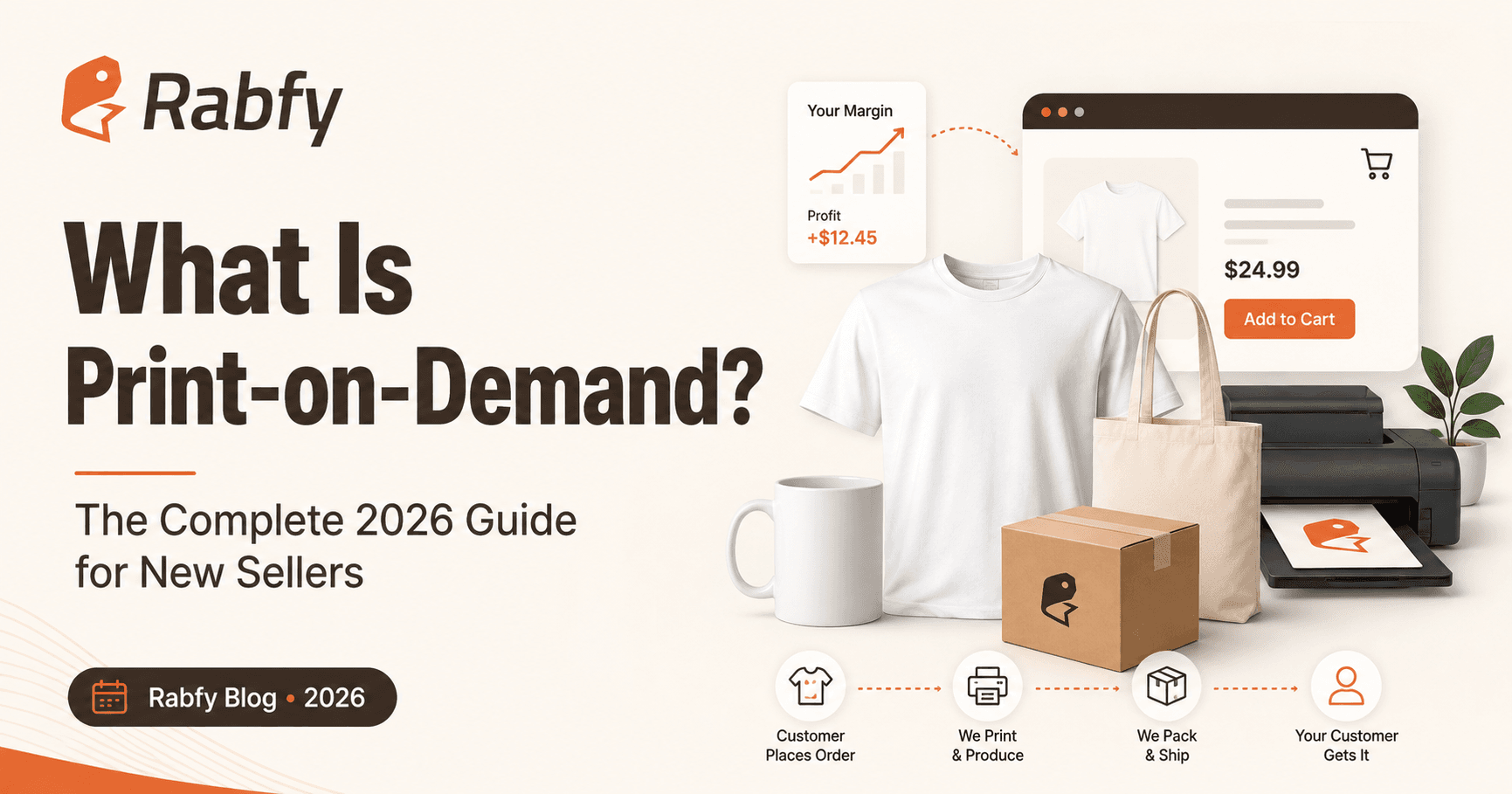
Print-on-demand (POD) is a retail model where the product gets made only after somebody buys it. A customer orders a t-shirt carrying your design, a production partner prints it, packs it and ships it directly to that customer, and you never hold stock or pay for a unit you did not sell. Your money goes into design and marketing instead of inventory.
That is the whole model, and it takes one paragraph to explain. Which is part of the problem: an idea this simple attracts an enormous amount of writing about it, most of it selling you something.
The part nobody wants to publish is that manufacturing is the easy half. The printing works. The shipping works. What breaks is the arithmetic and the marketing. So this guide covers what a $24.99 t-shirt actually pays you after fees, and what changed in 2025 and 2026 that makes where your products ship from more important than what you print on them.
If you are a student in Dhaka with 5,000 taka, a designer with a folder of unused artwork, or a freelancer looking for something that earns quietly in the background, this is written for you. Some of it is discouraging. All of it is checkable.
What print-on-demand actually means
In a traditional apparel business you buy 300 shirts, print them, store them, and hope you guessed the sizes right. Cash leaves first and comes back later, if it comes back.
POD inverts that order. The customer pays first. Production happens second. Nobody buys anything on faith except the customer.
Three parties are involved in almost every POD sale:
You. You choose the product, create or licence the design, write the listing, set the price and bring in the buyer. This is the job. Everything else is a service you rent.
The sales channel. Etsy, Amazon, eBay, Walmart, TikTok Shop, or your own Shopify store. This is where the buyer finds you. Marketplaces bring their own traffic and charge you for it. Your own store charges you nothing and brings you nothing.
The fulfilment partner. The company that holds blank products, prints your artwork onto them, packs the order and hands it to a carrier. They charge you a base cost per unit. What is left after that base cost and everybody's fees is your profit.
The term you will meet constantly is base cost: the price the fulfilment partner charges you for one finished, printed, packed unit. Retail price minus base cost minus fees equals margin. Almost every mistake in POD is a failure to respect that sentence.
You will also meet the printing methods, which matter more than beginners expect because they decide what your design can look like:
Method Best for Watch out for DTG (direct-to-garment) Detailed, full-colour artwork on cotton Softer colours on dark garments; poor on polyester DTF (direct-to-film) Bright colours on mixed fabrics Slight texture on the print surface Sublimation All-over prints, mugs, polyester Only works on light polyester and coated items Embroidery Hats, polos, premium apparel Small text and fine gradients do not survive
A design that looks perfect in a mockup generator can print badly if you built it for the wrong method. Order a sample. Every seller who skipped this step tells the same story about the first angry review.
Print-on-demand vs dropshipping, wholesale and private label
These four get used interchangeably and they are not the same business. Picking the wrong one for your stage is the most expensive mistake available to a beginner.
Print-on-demand Dropshipping Wholesale Private label Upfront cost None beyond design time None High (bulk purchase) High (MOQ plus branding) Product Made for each order Existing generic product Existing product, bought in bulk Manufactured to your spec What makes it yours The design Nothing Nothing The product and the brand Inventory risk Zero Zero Full Full Margin 15% to 30% typical 10% to 25% typical 30% to 50% 40% to 60% Speed to launch Days Days Weeks Months Defensibility Low to medium Very low Low High
The one people ask about most is POD versus dropshipping, and the difference is simpler than the internet suggests. A dropshipper sells a product that already exists, sourced from a supplier who also sells it to a hundred other dropshippers. A POD seller sells a product that did not exist until the order came in, carrying artwork that belongs to them. Dropshipping competes on price and speed. POD competes on design and audience.
That distinction is why POD survives and generic dropshipping keeps getting harder. Nobody can undercut you on a design only you own. Plenty of people can undercut you on a phone holder from the same factory.
Private label is the natural graduation, not a competitor. Sellers move there once POD has proved which products actually sell. If you want the full comparison including when to move between them, that is covered in choosing between white label, private label and print-on-demand.
The problem nobody warns beginners about
Here is the shape of a typical first year, and it is remarkably consistent.
Month one is exciting. You open a shop, upload twelve designs, tell your friends, and get two or three sales from people who know you. Month two is quiet. Month three you upload forty more designs because more listings must mean more sales. Month four you try ads, spend money, get sales that lose money, and stop. Month six the shop is still open and nothing has happened since March.
Nothing went wrong with the printing. The orders that came through were produced and delivered correctly. What failed was demand.
This is the thing the POD industry structurally cannot tell you, because the industry sells production. Printify, Printful, Gelato and every other supplier make money when you upload designs, not when you sell them. Their content is optimistic because optimism is their acquisition channel. Rabfy has the same incentive, which is exactly why this section exists.
The second problem is margin, and it is worse than the first because it is invisible until you do the arithmetic. A POD seller who does not model their cost stack before pricing will typically discover, somewhere around order thirty, that they have been working for about a dollar a shirt.
Why so many POD stores stall
Four reasons, in rough order of how often they show up.
They priced backwards. New sellers look at a competitor's listing, see $24.99, and set their price at $24.99 or a little under. That competitor may have a lower base cost, a different fee tier, or may be losing money. Price forward from your own costs, never backward from somebody else's retail.
They designed for themselves instead of for an audience. A design competes for attention against everything else on that marketplace. "I like this" is not a market signal. "Nurses working night shifts in Texas share a specific joke" is. The seller who understands one small group beats the seller with better artwork and no audience, consistently.
AI made generic design worthless. Anybody with Midjourney or Firefly can produce fifty print-ready files in an afternoon. The supply of adequate artwork is now effectively infinite, so adequate artwork earns nothing. What still earns is niche knowledge, personalisation, and the operational ability to deliver reliably. Personalised products are the fastest-growing segment in POD for exactly this reason: a custom name, a photo, a set of coordinates or a wedding date is something an AI image cannot mass-produce on speculation.
Cross-border friction quietly ate their margin. This is the change most 2026 guides still have not caught up with. The United States ended its $800 de minimis exemption in two stages, for China and Hong Kong on 2 May 2025 and for all remaining countries on 29 August 2025, with the suspension continued by executive order in February 2026. The One Big Beautiful Bill Act, passed in July 2025, terminates the exemption by statute from 1 July 2027, so it is not coming back. Reported sub-$800 parcel volume into the US fell by roughly 54% afterwards, according to Universal Postal Union figures.
In plain terms: a shirt posted from Dhaka to Ohio now attracts duty, brokerage handling and delay on every single unit. A shirt printed in a US warehouse and posted to Ohio is a domestic parcel and attracts none of that. If you sell to American buyers, where your product is produced is now a pricing decision, not a logistics detail.
What sellers are actually running into in 2026
Aggregated from public seller community threads, app store reviews for the major POD platforms, and published policy documentation. No individual posts are reproduced.
Etsy suspensions that sellers misdiagnose. Etsy updated its Seller Policy on 14 January 2026. POD is still explicitly allowed. What gets shops deactivated is nearly always one of three things: failing to disclose a production partner, listings that do not meet the "Designed by a seller" originality standard (purchased templates and clip art do not qualify, commercial licence or not), or undisclosed AI-generated design work. Sellers see a deactivation and conclude Etsy banned POD. Etsy did not. They tripped one of those three wires.
Payout and eligibility walls. If you are reading this from Bangladesh, Pakistan or several other South Asian countries, you will hit a hard fact quickly: Bangladesh does not appear on Etsy's list of countries eligible for Etsy Payments, and enrolment is mandatory for new shops. Payoneer operates in Bangladesh, including a withdrawal partnership with bKash, but does not support holding funds there, and PayPal receiving is restricted for Bangladesh-registered accounts. Amazon Global Selling is more practically reachable with the right documentation. This does not mean you are locked out of selling to US and UK buyers. It means the route is different from the one every American YouTube tutorial describes, and anybody telling you to just form a US LLC is skipping over questions you should ask a professional first.
Delivery promises that ignore production time. Production is not shipping. A three-day production window plus five-day shipping is an eight-day delivery, and a listing that promises five days will collect the review it deserves. Add the two together, then add a day.
Colour that does not match the mockup. Almost always an RGB file sent into a CMYK or DTG process, or a low-resolution image scaled up. The mockup generator will happily show you something the printer cannot produce.
Support that disappears in Q4. Peak season creates ticket backlogs at every large platform. The seller with a broken order on 3 December and a support queue measured in days is the seller whose Q4 is over.
How print-on-demand works, step by step
From your side, one order looks like this.
1. Choose the product and read the base cost first. Before you design anything, open the catalogue and write down what the finished unit costs you, including shipping to your buyer's country. If the arithmetic does not work at that base cost, no design will fix it. Apparel is still the largest category in POD by revenue, with home décor and drinkware growing fastest, so if apparel feels crowded there are adjacent categories worth checking.
2. Create the design to the printer's specification. Correct dimensions, 300 DPI, transparent background where required, colour profile matched to the print method. This step takes twenty minutes and prevents most quality complaints.
3. Build the listing. Title, images, description, attributes. On a marketplace, this is your SEO. On your own store, it is your entire sales pitch.
4. Connect your sales channel. The fulfilment platform links to Etsy, Amazon, eBay, Walmart or Shopify, so that a sale on the marketplace appears as a production job without you retyping anything. Test this with one real order before you trust it with fifty.
5. The order routes to production automatically. Customer buys, the order flows to the fulfilment partner, your account is charged the base cost, and the job enters the print queue. Nobody calls you.
6. Production, quality check, dispatch. The item is printed, checked, packed and handed to a carrier. Tracking is pushed back to the marketplace. If the product ships from a warehouse inside your buyer's country, this is a domestic parcel with domestic delivery times and no customs event.
7. You get paid. The marketplace settles with you on its own schedule, the fulfilment partner takes the base cost, and what remains is yours. Payout timing is the number nobody checks until it hurts, and it decides how fast you can reinvest.
The full version of this workflow, including the places it fails and how to catch them, is in how print-on-demand works from upload to doorstep.
The real arithmetic on a $24.99 t-shirt
This is the section the other guides skip. Figures below are illustrative. Replace them with your actual catalogue costs and current marketplace rates before you price anything.
Say you sell a t-shirt on Etsy at $24.99 with free shipping.
Line Amount Retail price $24.99 Base cost including shipping ($16.50) Listing fee ($0.20) Transaction fee at 6.5% ($1.62) Payment processing at 3% + $0.25 ($1.00) Your profit $5.67
That is a 22.7% margin, which is a normal, healthy POD outcome. Now run the same sale with Offsite Ads triggered at 15%:
Line Amount Profit before ads $5.67 Offsite Ads at 15% of $24.99 ($3.75) Your profit $1.92
7.7%. Still positive, but you are now doing meaningful work for under two dollars.
Now add the part beginners forget entirely: customer acquisition. If you run Meta or Google ads and it costs you $6 to produce that sale, this order lost money. Not "made less money". Lost money. A seller doing thirty of these a month is busy, feels like a business owner, and is subsidising strangers' t-shirts.
Three things follow from that table.
Your first lever is base cost, not retail price. Cutting $2 off the base cost adds $2 straight to profit with no effect on conversion. Raising retail by $2 costs you buyers.
Your second lever is average order value. The fixed fees do not scale, so a $45 sweatshirt or a two-item order carries far better margin than a $24.99 tee.
Your third lever is organic traffic, which is why marketplace SEO matters more than ad budget in year one. Free traffic is the difference between the first table and the second.
Work your own numbers properly before committing to a product line. The honest arithmetic on POD pricing and margins goes through the full cost stack for each marketplace, including returns and chargebacks.
Best practices for your first 90 days
Start narrow. One product type, one audience, ten to fifteen designs. Sellers who launch with five product categories learn nothing from their data because no single line gets enough traffic to tell them anything.
Order a sample of your best design before you list twenty more. It costs one base cost and it is the cheapest quality assurance you will ever buy.
Write listings for search, not for yourself. On marketplaces, buyers arrive by typing words, and your title is the only thing standing between your design and invisibility.
Price from your cost stack upward, with a target margin decided in advance. If a product cannot clear that target after fees, do not list it.
Add production time to shipping time in every delivery promise, then add a buffer day. Under-promising is free. Over-promising costs you the review.
Choose a fulfilment partner that produces inside your buyer's market. Since the de minimis change this is a margin decision, not a convenience.
Test personalisation early. Custom text, photo uploads, dates and coordinates carry the highest average order values, and they are the formats AI-generated competition cannot replicate on speculation.
Track profit per order after all fees, weekly. Revenue is a vanity metric in POD.
Common mistakes
Uploading a hundred designs before selling one. Volume without validation just multiplies a bad hypothesis. Fifteen designs aimed at one audience beats a hundred aimed at nobody.
Skipping the sample. You are selling a physical object you have never held.
Using purchased templates or clip art on Etsy. The "Designed by a seller" standard is about originality, not licensing. Holding a commercial licence does not make artwork yours for Etsy's purposes.
Not disclosing your production partner. On Etsy this is a required setting, it takes two minutes, and skipping it is one of the most common causes of deactivation. The Etsy Seller Handbook documents exactly how to add one.
Ignoring AI disclosure requirements. If AI generated part of your design, the 2026 rules expect you to say so. Sellers who assume nobody checks are gambling their shop against two minutes of admin.
Pricing against a competitor instead of a cost sheet. Covered above. It is the single most common financial error in POD.
Treating your own Shopify store as easier than a marketplace. It is not easier, it is different. A marketplace lends you traffic and charges rent. Your own store charges no rent and lends you nothing. Most beginners are better served borrowing traffic first.
Building a business on one channel. Policy changes, algorithm shifts and account suspensions all arrive without warning. Sellers spreading across two or three channels sleep better.
What sellers say after their first fifty orders
The advice from people past the beginner stage is unglamorous and fairly uniform.
Pick the audience before the product. Every seller who found traction describes it the same way, and it is never "I made a really nice design."
Reuse what works. When one design sells, put it on four more product types rather than starting a new concept. The audience has already told you what they want.
Watch dispatch speed, because marketplaces do. eBay's Cassini and Etsy's ranking both weight service performance, and a supplier who takes six days to ship is quietly costing you search visibility on top of reviews.
Sell into Q4 all year. The sellers who have a good Black Friday are the ones whose listings were indexed and reviewed by September, not the ones who launched in November. The Q4 product and margin guide covers which categories carry the season.
Keep a spreadsheet from order one. Product, base cost, retail, fees, profit, channel. In six months this file is worth more than any course.
Start where the barrier is lowest. If a marketplace will not accept your country, do not spend three months fighting it. Sell to those buyers through a route that is actually open to you, and revisit later.
Your print-on-demand starting checklist
 [ ] Chosen one audience you understand well
- [ ] Chosen one to two product types for launch
- [ ] Written down the base cost including shipping to your target market
- [ ] Set a target margin percentage before pricing anything
- [ ] Confirmed your fulfilment partner produces inside your buyer's country
- [ ] Confirmed you can actually receive payouts from your chosen channel
- [ ] Created designs at correct size, 300 DPI, correct colour profile
- [ ] Ordered and inspected a physical sample
- [ ] Written keyword-researched titles and filled every listing attribute
- [ ] Added production time plus shipping time to the delivery promise
- [ ] Disclosed your production partner where the marketplace requires it
- [ ] Disclosed AI involvement in designs where required
- [ ] Set up a profit-per-order tracker
- [ ] Placed one live test order through the full workflow yourself
Fourteen items. Most people skip four of them and lose three months.
Frequently asked questions
What is the difference between print-on-demand and dropshipping? A dropshipper sells an existing generic product sourced from a supplier who sells the same item to many other sellers. A POD seller sells a product manufactured after the order, carrying artwork the seller owns. Dropshipping competes on price. POD competes on design and audience, which is more defensible.
How much money do I actually need to start print-on-demand? You can open a POD account and list products with no upfront cost on most platforms, because you are only charged when an order is placed. Realistically, budget for a marketplace's listing fees and two or three product samples. That is usually somewhere between $30 and $60, or roughly 3,500 to 7,000 taka.
Do I need design skills to sell print-on-demand? No, but you need design judgement. Plenty of successful sellers use typography, simple layouts or licensed elements rather than illustration. What you cannot skip is knowing what your audience wants and meeting the printer's file requirements. Weak artwork aimed at the right people outsells beautiful artwork aimed at nobody.
Who owns the designs I upload? You retain the copyright in original artwork you create. Uploading it grants your fulfilment partner a limited licence to reproduce it for the purpose of filling your orders, and nothing more. Read the terms of any platform before uploading, and speak to a lawyer for trademark questions or anything involving third-party characters and brands.
How long does print-on-demand delivery take? Production usually takes one to three business days, then shipping is added on top. A domestic US or UK order commonly lands within three to seven days total. Cross-border orders take longer and, since the de minimis change, may also incur duty. Always publish production time and shipping time added together.
Is print-on-demand saturated in 2026? Generic print-on-demand is saturated. Specific print-on-demand is not. AI made adequate design free, so undifferentiated products no longer earn, while niche depth, personalisation and reliable fulfilment still do. The POD sector itself is still growing quickly, with published forecasts putting compound annual growth in the 23% to 25% range through the early 2030s.
Do I need a registered business to sell print-on-demand? It depends on your country and your marketplace. Some platforms allow individual sellers and collect tax information rather than business registration; others require a registered entity or a local bank account. Check your chosen marketplace's requirements for your country specifically, and confirm your local tax obligations with an accountant before scaling.
So, is print-on-demand worth starting in 2026?
Yes, with a correction to your expectations.
It is worth starting because the downside is genuinely small. You risk time, a few samples and some listing fees. Compared with any other way of entering physical products, that is close to free, and the model still works: the growth forecasts are real, personalised products are expanding faster than the sector overall, and marketplaces continue to send buyers to sellers who show up properly.
The correction is this. Print-on-demand is not a passive income business and never was. It is a marketing business with the manufacturing removed. The production side is genuinely solved, which is precisely why it is not where you compete. You compete on knowing an audience, pricing against your own costs, and delivering reliably enough that buyers come back.
Sellers who understand that build something durable. Sellers who think the design is the business upload two hundred files and quit in month six.
If you want the version with a budget attached, read how to start a print-on-demand business with almost no money, which turns everything above into a thirty-day plan.
How Rabfy helps
Rabfy handles production so you can spend your time on the part that decides whether this works: finding buyers.
Products are printed and dispatched from warehouses in the US and UK, so orders to American and British buyers travel as domestic parcels rather than crossing a customs border per unit. Processing runs in 24 to 48 hours. Integrations cover Amazon, Etsy, eBay, Walmart and Shopify. There is no monthly fee and no minimum order, payouts are released 15 days after fulfilment, and Rabfy is a disclosable production partner where marketplaces require one.
To date, 300+ sellers have processed 50,000+ orders through the platform, generating $1.2M+ in seller revenue, with a 0% return rate last Q4. You can read the full Rabfy workflow from design to delivered order, or more on how Rabfy is built and who it is for.
Start free, no credit card, no minimum order
You do not need inventory, a registered company or a foreign bank account to test whether a product sells. You need one good idea about one specific audience, and a production partner that ships from inside your buyer's country.
Create your free Rabfy account and list your first product this week.
Want the condensed version to work from? Download the POD Starter Checklist, a one-page PDF covering the fourteen items above plus a blank cost-stack worksheet.
Sources: Grand View Research and Precedence Research print-on-demand market sizing; Universal Postal Union parcel volume data on the US de minimis suspension; Etsy Seller Policy, updated 14 January 2026; Etsy Seller Handbook guidance on production partners; Shopify's guide to print-on-demand companies; Payoneer documentation on Bangladesh.
Marketplace fees, policy rules and payout terms change. Everything above was verified on 3 August 2026. Confirm current rates with your marketplace before pricing. This article is general information, not legal, tax or financial advice.