If you want your own branded online store for print-on-demand, Shopify is the name everyone reaches for first. It's powerful, and for the right seller it's the right choice. But Shopify was built to run any kind of online store, from a single-product brand to a global retailer, which means a print-on-demand seller has to bolt fulfilment on top, pay a monthly fee before making a sale, and sort out payments themselves. For a lot of POD sellers, especially those starting out, that's more machine than the job needs.
This is an honest comparison, not a sales pitch. We'll look at where Rabfy Storefront genuinely fits a POD seller better, where Shopify is still the stronger tool, and how to decide which one matches where your business actually is. If you're brand new to the model, our guide on what print-on-demand is covers the fundamentals first.
What Is Rabfy Storefront?
Rabfy Storefront is a store builder made specifically for print-on-demand sellers, with product fulfilment built directly into the platform rather than added on afterwards. You design products, build a branded store, and Rabfy produces and ships each order when a customer buys, all inside one system.
The difference from a general ecommerce platform is the starting point. Shopify starts as an empty store and expects you to add products, connect a fulfilment method, and configure payments. Rabfy Storefront starts as a POD business: the product catalogue, the store builder, and the fulfilment are already one connected thing. For a seller whose whole business is print-on-demand, that removes several separate setup steps and monthly costs before the first sale.
What Is Shopify?
Shopify is a general-purpose ecommerce platform for building and running any kind of online store, from print-on-demand to physical inventory to digital goods. It's mature, powerful, and backed by a huge ecosystem of apps and themes, which is exactly why it's the default choice for serious online stores.
That generality is Shopify's strength and its cost. Because it's built to run every kind of store, it doesn't include print-on-demand fulfilment itself. You add that through a separate app or partner, you pay a monthly subscription whether or not you've sold anything, and in many countries you have to arrange your own third-party payment gateway. None of that is a flaw. It's the trade-off of a platform designed to be everything to everyone.
Rabfy Storefront vs Shopify: The Honest Comparison
For a print-on-demand seller, Rabfy Storefront tends to win on simplicity, upfront cost, and built-in fulfilment, while Shopify wins on ecosystem breadth, app selection, and scale for large or complex businesses. The right answer depends entirely on which of those things your business actually needs right now.
Here's the side-by-side on the dimensions that matter most to a POD seller:
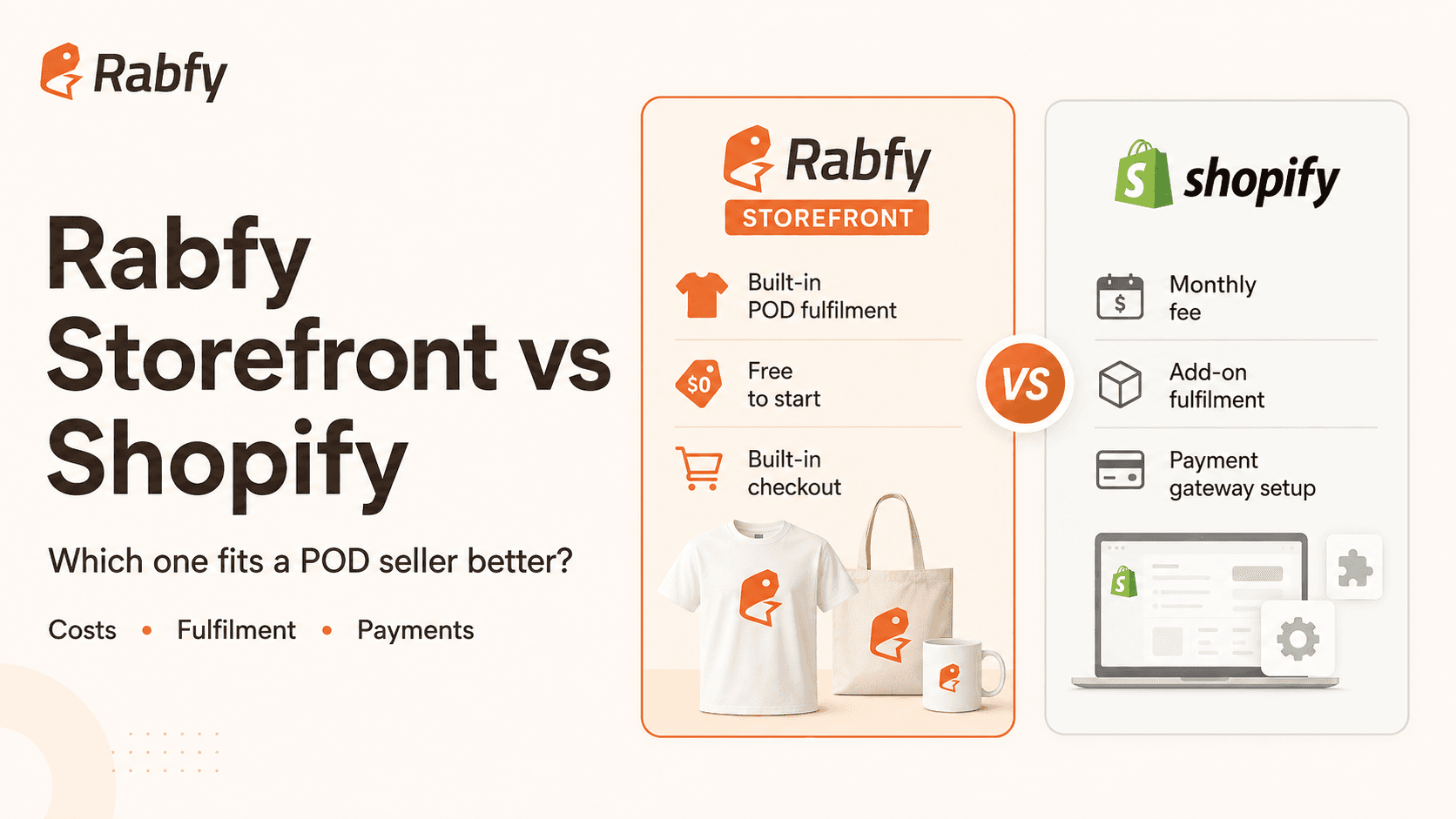
Dimension Rabfy Storefront Shopify Built for Print-on-demand specifically Any online store Cost to start Free plan, $0 forever No permanent free plan; ~$39/mo Basic POD fulfilment Built in Added via separate app/partner Monthly fee before first sale None (Free plan) Yes, the subscription Payments Built-in checkout Shopify Payments, or third-party gateway where unavailable Per-sale cost 6% + $0.50 (Free), down to 4% + $0.50 (Business) 2.9% + $0.30 processing, +2% gateway fee on Basic if no Shopify Payments App ecosystem Focused POD toolset Very large third-party app store Best for POD sellers, beginners to scaling Any store, including large/complex brands
Read that table carefully, because the fee lines are easy to misread. Rabfy's percentage is its all-in platform cost per sale, with no separate monthly subscription on the Free plan. Shopify's 2.9% is only card processing; on top of it you pay the monthly subscription, and if Shopify Payments isn't available in your country, an extra 2% gateway fee. Comparing a single percentage from each is misleading. What matters is the total cost to run your store, and for a low-volume or beginner POD seller, Rabfy Storefront's zero monthly fee often makes it cheaper to operate until volume is high, while Shopify's structure can become competitive at larger scale.
Where Rabfy Storefront Is Better for POD Sellers
Rabfy Storefront is the better fit when your business is print-on-demand and you want fulfilment, store building, and payments in one place without a monthly fee to begin. These are the specific advantages that matter to a POD seller.
Fulfilment Is Built In, Not Bolted On
On Shopify, print-on-demand fulfilment is something you add and connect yourself. On Rabfy Storefront, it's already part of the platform: when a customer orders, the product is produced and shipped from Rabfy's US or UK warehouse, with order processing in 1 to 4 days on the Free and Pro plans and 1 to 3 days on Business. There's no separate fulfilment integration to configure, because fulfilment is the platform. Our guide on how print-on-demand actually works explains why reliable, warehouse-close fulfilment matters so much for delivery speed and reviews.
You Can Start for Free
Rabfy Storefront has a genuinely free plan: $0 forever, with 500 product listings, the store builder, a custom domain, basic personalisation, and community support. Shopify has no permanent free plan, only a short trial before the monthly subscription begins. For a seller starting with almost nothing, that difference is the gap between launching now and waiting until you can justify a monthly bill. We cover the whole low-budget launch path in our guide on starting a print-on-demand business with almost no money.
Payments Are Built In, Not a Separate Hurdle
One of Shopify's real friction points for international sellers is payments. In countries where Shopify Payments isn't available, including Bangladesh, you have to find and get approved by a third-party gateway, pay an extra fee, and hope your store is accepted. Rabfy Storefront includes its own checkout, which removes that hurdle entirely for sellers in regions Shopify Payments doesn't reach. For many sellers outside the main supported countries, this alone is decisive.
The Toolset Is Aimed at POD, Not Everything
Rabfy Storefront's features are chosen for print-on-demand: product personalisation, a POD catalogue, abandoned-cart recovery and upsell tools on paid plans, white-label branding on Pro and Business, and 3PL and prep-centre support plus FBA/FBM channels on Business. You're not paying for or navigating features built for businesses unlike yours. Everything is pointed at the job you're actually doing.
Where Shopify Is Still the Better Choice
Shopify is the better choice when you need a very large app ecosystem, deep third-party theme selection, or the scale and customisation a large or complex business demands. An honest comparison has to say this plainly, because for some sellers Shopify genuinely is the right tool.
If your ambitions go well beyond print-on-demand, if you'll sell physical inventory alongside POD, need highly specific integrations, want to choose from thousands of third-party themes, or you're running at a scale where enterprise features and a mature ecosystem matter, Shopify's breadth is a real advantage that a focused POD platform doesn't try to match. Shopify has spent years building that ecosystem, and it shows. The question isn't whether Shopify is capable. It clearly is. The question is whether a POD seller needs all of that, or whether it's paying for and managing power the business won't use.
The Traffic Truth That Applies to Both
Neither Rabfy Storefront nor Shopify comes with built-in shoppers. Any standalone store, on either platform, requires you to bring your own traffic, which is the hardest part of running one. This is the honest point most "build your store" content skips, and it's true no matter which platform you pick.
A marketplace like Etsy or eBay brings you buyers who are already searching to shop. A standalone store, whoever builds it, does not. Every visitor to your Rabfy Storefront or your Shopify store has to be brought there by you, through social media, search, content, or an audience you already have. That's why, for many beginners, the smart path is to start on a marketplace where the buyers already are, build products that convert and a small following, and add a branded store once you have an audience to point at it. Our guides on starting an Etsy shop and reaching US buyers from Bangladesh are good starting points if you're not established yet. A store is where you build a brand. It usually isn't where you make your very first sale.
Three Seller Scenarios, Two Platforms
The right platform is easiest to see through concrete examples, because the same comparison points to different answers depending on who's asking. Here are three common sellers and where each honestly lands.
The first is a beginner with almost no budget who wants to try print-on-demand. For them, Rabfy Storefront's free plan is the clear fit: no monthly fee to justify before a first sale, fulfilment and checkout already built in, and 500 listings to test what sells. Asking this seller to pay a Shopify subscription and separately configure fulfilment and payments before earning anything adds cost and friction they don't need yet.
The second is an established POD seller in a country where Shopify Payments isn't available, such as Bangladesh, selling to US and UK buyers. For them, the deciding factor is often payments. Rabfy Storefront's built-in checkout removes the third-party gateway hunt and the risk of being rejected by one, which can otherwise stall a launch for weeks. The built-in US and UK warehouse fulfilment also shortens delivery to their actual customers.
The third is a growing brand that sells print-on-demand alongside physical inventory, wants a specific set of third-party integrations, and is already comfortable paying for tools. For them, Shopify's ecosystem genuinely earns its cost. The breadth that's overkill for a pure POD beginner is exactly what a multi-category brand needs. This is the seller Shopify was built for, and pretending otherwise would be dishonest.
The pattern across all three: match the platform to the business you actually have, not the one you imagine. Most POD sellers, especially early on, are closer to the first two scenarios than the third.
How to Decide Which One Fits You
Choose Rabfy Storefront if your business is print-on-demand and you want simplicity, a free start, and built-in fulfilment and payments. Choose Shopify if you need its large ecosystem, sell beyond POD, or operate at a scale that justifies its cost and complexity. Work through it in this order.
First, ask what your business actually is. If it's print-on-demand, full stop, a platform built for POD removes steps and cost a general platform can't. Second, ask about budget. If you're starting lean and can't justify a monthly fee before your first sale, Rabfy Storefront's free plan starts you today. Third, ask about payments. If Shopify Payments isn't available where you are, a platform with built-in checkout sidesteps a real hurdle. Fourth, ask about scale and scope. If you're running a large, multi-category, or highly custom operation, Shopify's ecosystem earns its cost. And whichever you choose, plan for the traffic work, because neither one brings buyers on its own.
Frequently Asked Questions
Is Rabfy Storefront a Shopify alternative? Yes, for print-on-demand sellers specifically. Rabfy Storefront is a store builder with POD fulfilment, payments, and a POD-focused toolset built in, whereas Shopify is a general ecommerce platform where you add fulfilment and often arrange payments separately. For a seller whose business is print-on-demand, Rabfy Storefront covers the same "own branded store" need with fewer separate pieces to set up and no monthly fee to start.
Is Rabfy Storefront cheaper than Shopify? For low-volume and beginner sellers, usually yes, because Rabfy Storefront has a free plan with no monthly fee, while Shopify charges a subscription (around $39/month on Basic) before you sell anything. Rabfy's per-sale cost is 6% + $0.50 on the Free plan, dropping to 4% + $0.50 on Business. Shopify's card processing looks lower at 2.9% + $0.30, but that's separate from its monthly fee and any third-party gateway surcharge, so total cost depends on your sales volume.
Does Rabfy Storefront include print-on-demand fulfilment? Yes. Fulfilment is built into the platform rather than added through a separate app. When a customer orders, the product is produced and shipped from Rabfy's US or UK warehouse, with order processing in 1 to 4 days on Free and Pro plans and 1 to 3 days on Business. This is the main structural difference from Shopify, where POD fulfilment is connected separately.
Can I use Rabfy Storefront if Shopify Payments isn't available in my country? Yes. Rabfy Storefront includes its own checkout, so you don't need to find and get approved by a third-party payment gateway the way you would on Shopify in countries where Shopify Payments isn't offered, such as Bangladesh. For sellers in those regions, built-in payments remove a significant setup hurdle.
Which is better for a beginner, Rabfy Storefront or Shopify? For a beginner whose business is print-on-demand, Rabfy Storefront is usually the easier and cheaper start: a free plan, built-in fulfilment, and built-in payments, with fewer separate pieces to configure. Shopify becomes the better choice as you scale into a larger or more complex operation, or if you sell well beyond print-on-demand. Either way, remember that a standalone store needs you to bring its traffic.
Key Takeaways
 Rabfy Storefront is built specifically for print-on-demand, with fulfilment, payments, and a POD toolset in one platform. Shopify is a general ecommerce platform where those pieces are added separately.
- Rabfy Storefront starts free ($0 forever, 500 listings), while Shopify has no permanent free plan and charges roughly $39/month before your first sale.
- Compare total cost, not single fees. Rabfy's per-sale percentage is all-in with no monthly fee on Free; Shopify's lower processing rate sits on top of its subscription and possible gateway surcharge.
- Rabfy Storefront's built-in checkout removes the third-party payment-gateway hurdle that Shopify creates for sellers in countries like Bangladesh where Shopify Payments isn't available.
- Shopify still wins on ecosystem, app selection, and large-scale flexibility. And neither platform brings built-in traffic, so any standalone store needs you to bring the buyers.
How Rabfy Helps
Rabfy Storefront exists so a print-on-demand seller doesn't have to assemble a store, a fulfilment integration, and a payment gateway as three separate projects. It's one platform: build your branded store, list up to 500 products on the free plan, and let Rabfy produce and ship each order from our US or UK warehouse when a customer buys, with processing in as little as 1 to 3 days on the Business plan. There's no monthly fee to start, the checkout is built in, and pricing is transparent at 6% + $0.50 per sale on Free, dropping to 4% + $0.50 on Business. Over 300 sellers currently fulfil through Rabfy across more than 50,000 orders, with a 0% return rate last Q4. See the full plan breakdown on our pricing page.
Start Your Rabfy Storefront Free
You've got the honest comparison, the real costs, and a clear way to decide. If your business is print-on-demand and you want a branded store without a monthly fee, a separate fulfilment setup, or a payment-gateway hunt, Rabfy Storefront starts free today. Create your free Rabfy account and build your store this week.
Khairul works on community and fulfilment at Rabfy and helps sellers choose the right store setup for where their business actually is.