You've been running print-on-demand for a while, a few products are selling steadily, and someone tells you the "real money" is in private label, buying inventory in bulk and building a proper brand. Maybe it is, eventually. But switching too early is one of the most expensive mistakes a growing seller can make, tying up thousands of dollars in stock for a product whose demand you haven't truly proven. The three models, print-on-demand, white label, and private label, aren't a ladder where higher is always better. They're different tools for different stages, and the skill is knowing which one fits where you are right now.
This guide compares all three honestly, on capital, margin, control, speed, and risk, and gives you a clear rule for when to graduate from one to the next. Here's the part most guides won't tell you, because most guides are written by companies that only sell one model: print-on-demand is the right choice until a specific product proves repeatable demand. Switching before that isn't ambition, it's risk. If you're new to the model itself, our guide on what print-on-demand is covers the fundamentals first.
What's the Actual Difference Between These Models?
Print-on-demand produces each item only after it sells, with no inventory. White label puts your branding on an existing generic product the manufacturer already makes. Private label has a manufacturer produce a product to your custom specifications, which you buy in bulk and own as your brand. The core difference is how much of the product is truly yours, and how much you commit before a single sale.
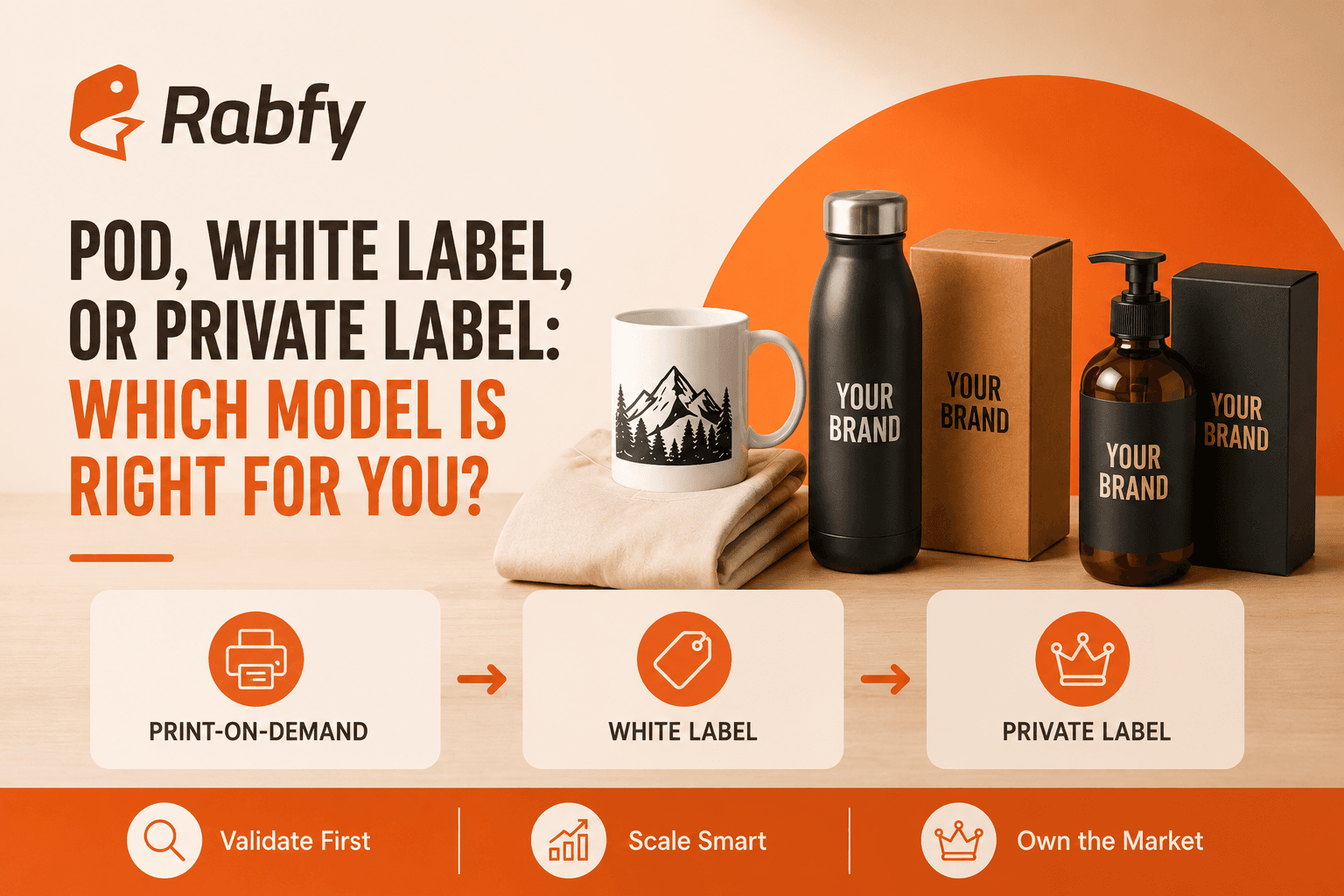
Here's each model in plain terms. Print-on-demand means you upload a design, and when a customer orders, the product is made and shipped, so you never hold stock and never buy anything before you've sold it. White label means a manufacturer makes a standard product (say, a generic water bottle or notebook) that many brands sell, and you add your logo and branding to it, so it's faster and cheaper but not unique to you. Private label means a manufacturer builds a product to your own specifications, your materials, your design choices, your packaging, which you order in bulk, so it's genuinely your brand and more exclusive, but you carry the inventory and the risk. The spectrum runs from POD (nothing owned upfront, nothing unique) through white label (branded but shared) to private label (owned and exclusive, but bought in bulk).
How Do the Three Models Compare?
Across the five factors that matter, capital, margin, control, speed, and risk, print-on-demand is lowest on capital and risk but also on per-unit margin and control, while private label is highest on margin, control, and exclusivity but demands the most capital and carries the most risk. White label sits in between. Seeing them side by side makes the trade-offs concrete.
Factor Print-on-demand White label Private label Upfront capital None (pay per order) Low to moderate (small bulk order) High (large bulk order) Minimum order None Often 50 to 500 units Commonly 500 to 5,000+ units Per-unit margin Lower Better Best Product uniqueness Design only Your brand, shared product Fully your own Speed to launch Fastest Fast Slowest (often 90 to 150 days for a first run) Inventory risk None Some High Best for Validating demand Scaling a proven winner Owning a category
Read the table as a story about trade-offs, not a ranking. Print-on-demand's "weakness," lower per-unit margin, is the price you pay for its enormous strength: zero inventory risk and instant launch, which is exactly what you want while you're still finding out what sells. Private label's high margin comes bundled with high capital and the real risk of ordering thousands of units of something that doesn't sell as well as you hoped. There is no best model in the abstract. There's only the best model for a specific product at a specific stage.
Which Model Has the Best Margins?
Private label typically has the best per-unit margins, because buying in bulk drives down the cost per item and owning the product lets you command a brand premium. But the highest per-unit margin isn't the same as the most profit, since private label's margin only pays off if you actually sell the inventory you bought. Margin on paper and money in the bank are different things.
Here's the honest arithmetic. On a per-unit basis, private label wins: bulk manufacturing lowers your cost, and a distinctive branded product can be priced higher. White label improves on POD margins too, since a small bulk order costs less per unit than on-demand production. Print-on-demand has the thinnest per-unit margin because each item is produced individually. But per-unit margin is only half the picture. Private label's superior margin assumes you sell the stock, and if you ordered 1,000 units and sell 400, your real economics are far worse than POD's would have been, because the unsold 600 are money spent for nothing. So the model with the best margin on a spreadsheet can be the worst for your actual profit if demand doesn't match your order. This is exactly why the full margin arithmetic, covered in our guide on POD pricing and profit margins, has to include the risk of unsold inventory, not just the per-unit gap.
What MOQ Should You Expect for Private Label?
Private label minimum order quantities commonly run from 500 to several thousand units per product, though they vary widely by category and manufacturer. White label MOQs are lower, often 50 to 500 units, and print-on-demand has no minimum at all. The MOQ is the single biggest reason not to jump to private label before you're ready, because it forces you to buy inventory in bulk before you've sold it.
The number matters because it defines your commitment. A private-label MOQ of, say, 1,000 units means you're buying and paying for a thousand of something before a single customer has bought one, plus the lead time, often 90 to 150 days for a first private-label run once you count sampling, artwork, production, and quality control. White label softens this with smaller minimums, sometimes as low as a few dozen units, which is why it's a gentler step up from POD. MOQs are also frequently negotiable, and quoted minimums are rarely final, but even a negotiated private-label MOQ represents real capital tied up in stock. Print-on-demand's zero MOQ is precisely what makes it the right validation tool: you can prove demand with no minimum commitment at all, then use that proof to justify a bulk order later.
The Graduation Path: When to Move Up
The right sequence for most sellers is a graduation path: use print-on-demand to validate which products actually sell, move a proven winner to white label to improve margins at moderate scale, and graduate a category-defining product to private label to own the brand. Each step should be earned by real sales data, not ambition. This is the framework that keeps you from over-committing at the wrong time.
Here's how the path works, gate by gate:
Stage 1, Print-on-demand: validate. Start here for every new product. With no inventory and no MOQ, POD lets you test designs and niches cheaply and find out what genuinely sells before you risk any capital. Stay here until a specific product proves repeatable, reliable demand, meaning it's not a one-off spike but a consistent seller over time. Until a product clears that bar, POD is not a stepping stone you're impatient to leave, it's the correct model.
Stage 2, White label: scale a winner. Once a product proves consistent demand, white label can improve your margins by letting you order that proven winner in modest bulk with your branding, at a lower per-unit cost than POD. The lower MOQ means the risk is contained, and you're ordering something you already know sells. This is the natural next step for a validated bestseller.
Stage 3, Private label: own the brand. When a product is a genuine, sustained category winner and you want a fully distinctive, exclusive version that competitors can't copy, private label is the graduation. You commit real capital and lead time to build the product to your own specification, but you do it on the back of proven, substantial demand, not a hunch. At this stage you'll also need somewhere to store and ship your bulk inventory, which is where a fulfilment partner comes in, explained in our guide on what 3PL is. This is where you build lasting brand equity, covered further in our guide on building a real brand on Amazon.
The thresholds between stages aren't fixed dollar figures, they're evidence. Move up when a product's sales prove it can carry the added commitment, and not before. The seller who graduates a product on data outperforms the one who jumps on excitement, every time.
Can You Run POD and Private Label Together?
Yes, and most smart sellers do. Running print-on-demand and private label side by side lets you keep validating new products with zero risk through POD while scaling your proven winners through white or private label. The models complement each other rather than competing. This is often the healthiest structure for a growing business.
There's no rule that says you must pick one model for your whole catalogue. In fact, the strongest sellers usually run a portfolio: their proven, high-volume products in white or private label for the better margins, and a constant stream of new POD products testing fresh niches and designs at no risk. This way, your established winners fund the business while POD keeps feeding the pipeline with the next potential winner, which you'll only scale once it proves itself. The two models working together give you both stability and continuous, low-risk experimentation. You don't graduate your whole business from POD; you graduate individual products, while POD keeps doing what it does best, finding the next one. Scaling the winners into a real brand is its own subject, covered in our guide on growing a Shopify POD business past $10K a month.
Frequently Asked Questions
What's the actual difference between the three models? Print-on-demand produces each item only after a sale, so you hold no inventory. White label adds your branding to an existing generic product the manufacturer already makes for many brands. Private label has a manufacturer produce a product to your own custom specifications, which you buy in bulk and own as a distinctive brand. The difference comes down to how unique the product is and how much you commit before selling anything, rising from POD (nothing upfront) to private label (bulk inventory owned).
Which has the best margins? Private label usually has the best per-unit margins, because bulk production lowers cost and an exclusive branded product can be priced higher, with white label in the middle and POD lowest per unit. But the best per-unit margin only becomes the best actual profit if you sell the inventory you bought. Order 1,000 units and sell 400, and private label's paper margin becomes a real loss on the unsold stock, whereas POD never carries that risk.
What MOQ should I expect for private label? Private label minimum order quantities commonly run from around 500 to several thousand units per product, varying widely by category and manufacturer, and are often negotiable. White label MOQs are lower, frequently 50 to 500 units, and print-on-demand has no minimum at all. The MOQ is why you shouldn't move to private label before proving demand, since it forces you to buy and pay for bulk inventory, plus a lead time often around 90 to 150 days for a first run, before any of it sells.
Can I run POD and private label together? Yes, and it's often the smartest structure. Keep validating new products and designs with zero-risk print-on-demand while scaling your proven winners through white or private label for better margins. The models complement each other: your established products earn the stronger margins, and POD continuously tests the next potential winner at no risk. You graduate individual proven products, not your whole business at once.
When should I switch? Switch a specific product up a stage only when its sales prove it can carry the added commitment, never on ambition alone. Keep a product on POD until it shows repeatable, consistent demand over time, then white label lets you scale that proven winner in modest bulk, and private label is for a sustained category winner you want to own exclusively. The trigger at every gate is real sales evidence, because moving up too early ties capital into stock whose demand you haven't confirmed.
Key Takeaways
 The three models aren't a ladder where higher is always better. POD, white label, and private label are different tools for different stages of a product's life.
- POD is lowest on capital, risk, and per-unit margin but fastest and safest; private label is highest on margin, control, and exclusivity but demands the most capital and carries the most risk; white label sits between.
- The best per-unit margin (private label) isn't the best profit unless you sell the stock. Unsold bulk inventory can make a high-margin model a real-money loss.
- Follow the graduation path: POD to validate, white label to scale a proven winner, private label to own a category winner, moving up only on real sales evidence.
- Run POD and label models together. Validate new products with zero-risk POD while scaling proven winners in bulk, and graduate individual products, not your whole business.
How Rabfy Helps
Most companies writing about these three models can only recommend the one they sell, which is exactly why their advice is worth doubting. Rabfy's honest position is the one this guide takes: print-on-demand is the right choice until a specific product proves repeatable demand, and rushing past it costs sellers real money. Rabfy supports you across that path rather than pushing you up it prematurely, with POD to validate at zero risk, and on the Business plan, 3PL and prep-centre support for when your proven winners are ready to scale into held inventory. You produce on demand while you're testing, and you have a partner ready for the next stage when your sales data, not a sales pitch, says it's time. Over 300 sellers currently fulfil through Rabfy across more than 50,000 orders, with a 0% return rate last Q4. That's the value of a partner whose recommendation isn't tied to selling you one model. Learn more on our features page.
Find the Right Model for Where You Are Now
You've got the honest comparison, the graduation path, and the rule that keeps you from over-committing: move up only on proven demand. The next step is matching your current products to the right model for their stage. Create your free Rabfy account and start with zero-risk validation, with a partner ready to grow when your sales prove it's time.
Khairul works on community and fulfilment at Rabfy and helps sellers choose the right model for each product's stage, rather than graduating too early. Figures reflect typical industry ranges as of August 2026; MOQs and lead times vary by category and manufacturer.