At some point, every growing ecommerce seller hits the same wall: the orders are coming in, but packing and shipping them yourself has eaten your evenings, your spare room, and your patience. That's usually when someone mentions a "3PL," and you nod along without being entirely sure what it means. This guide fixes that. No jargon, no assumptions, just a plain explanation of what a 3PL does, what it costs, and when it actually starts making financial sense.
There's also a 2026 twist that makes this more relevant than it used to be, and it's about arithmetic, not marketing. The customs rules that let cheap parcels enter the US duty-free have ended, which changes the maths of shipping goods across borders and pushes more sellers toward domestic warehousing. We'll get to that clearly. If you're weighing whether to stop packing orders yourself, our guide on when to stop self-fulfilling pairs well with this one.
What Is 3PL?
A 3PL, or third-party logistics provider, is a company you hire to store your products, pack your orders, and ship them to your customers for you. Instead of holding inventory and fulfilling orders yourself, you send your stock to the 3PL, and it handles the physical work of getting each order out the door. In plain terms, it's outsourced warehousing and shipping.
Think of it as renting both a warehouse and the staff to run it, without signing a lease or hiring anyone. You keep doing what grows your business, choosing products, marketing, serving customers, and the 3PL takes over the parts that don't scale well from your kitchen table. The relationship is simple: your inventory lives in their warehouse, and every time a customer orders, they pick it, pack it, and ship it. The name "third-party" just means they're the third party in the deal, sitting between you (the seller) and your customer.
What Does a 3PL Actually Do?
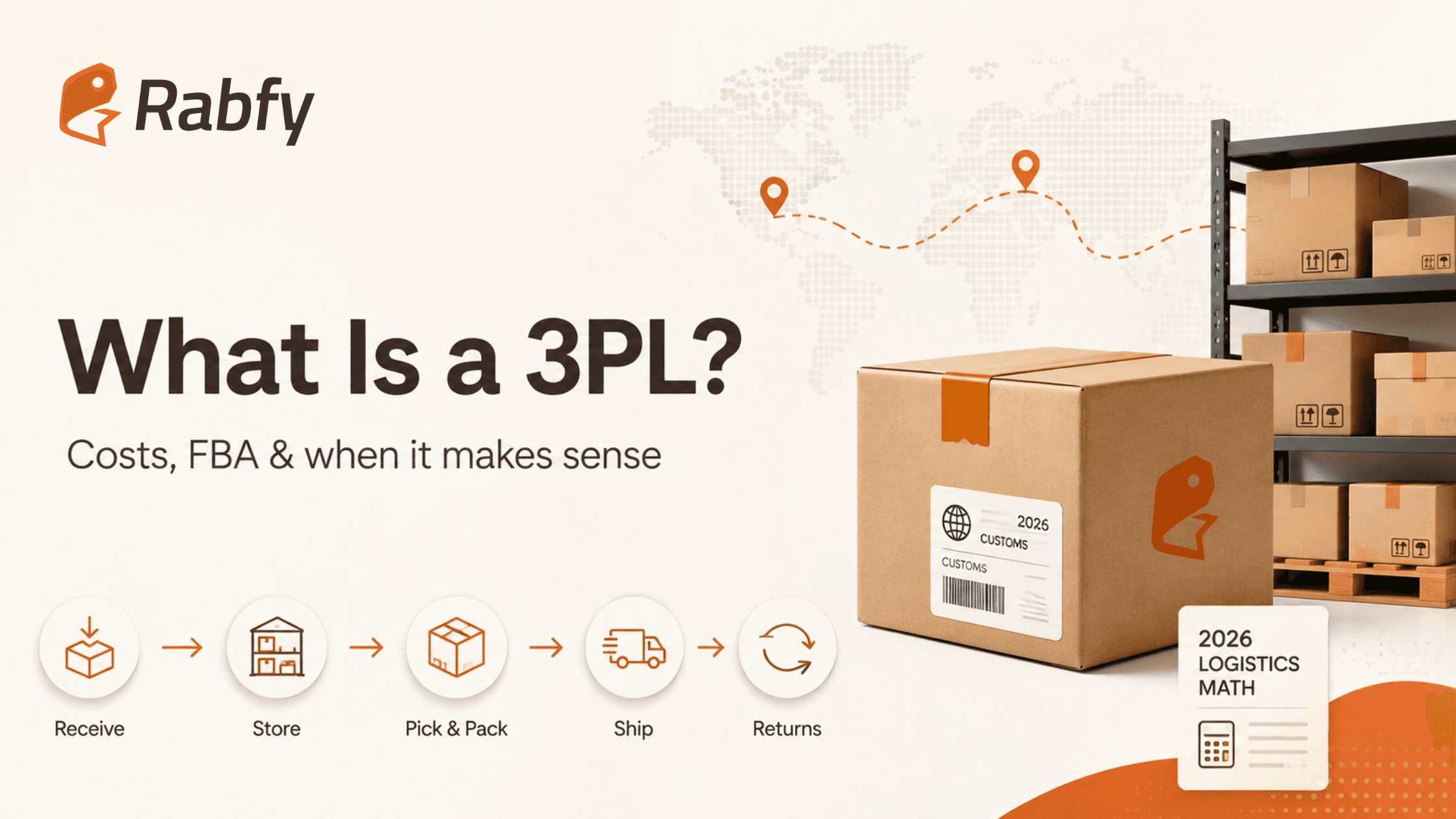
A 3PL handles the full physical journey of your inventory: receiving your stock, storing it, picking and packing each order when a sale comes in, shipping it, and processing returns. These are the core services, and understanding them is the key to understanding both what you're paying for and how the pricing works.
Here's what each step means in practice, in the order it happens:
 Receiving. Your inventory arrives at the warehouse, and the 3PL unloads it, checks it against what you said you sent, and puts it away in a known location. This is the intake step, and getting it right is what makes everything after it accurate.
- Storage. Your products sit in the warehouse, taking up space, until they sell. You pay for that space, usually by the pallet or by volume, which is why slow-moving stock quietly costs you money.
- Pick and pack. When a customer orders, a worker locates ("picks") the right items, brings them to a packing station, and packs them into a parcel with a shipping label. This is the core fulfilment work and the biggest variable cost.
- Shipping. The packed parcel is handed to a carrier and sent to your customer. 3PLs often get better shipping rates than a small seller could on their own, because of their volume.
- Returns processing. When a customer sends something back, the 3PL receives it, inspects it, and restocks or disposes of it, then updates your inventory records.
Some 3PLs also offer extras like kitting (bundling items together into a set) and, importantly for marketplace sellers, prep work for programs like Amazon FBA. We come back to that below, because it's a common reason sellers choose one.
How Is 3PL Pricing Structured?
3PL pricing is not one flat fee. It's a stack of separate charges: a one-time setup fee, then ongoing fees for receiving, storage, pick and pack, shipping, and returns, often with a monthly minimum. Understanding the stack is what stops you being surprised by your first invoice, because a low headline "per order" rate can hide a much higher total.
Here's where your money actually goes on a typical 3PL invoice, with realistic 2026 ranges to reason with (your actual rates depend on the provider, your product, and your volume):
Fee What it pays for Typical 2026 range Setup / onboarding One-time account and system setup $150 to $1,500+ Receiving Unloading and shelving your incoming stock $5 to $15 per pallet, or ~$0.30 to $0.60 per unit Storage The warehouse space your stock occupies $15 to $45 per pallet per month Pick and pack Fulfilling each order $2 to $5 base per order, plus ~$0.20 to $1 per extra item Shipping Carrier cost to the customer Varies by weight, size, and destination Returns Receiving, inspecting, restocking a return $2 to $5 per return Monthly minimum A floor you pay even in a slow month Often around $500
The single most important thing to understand about this stack is that comparing one line item between providers is misleading. A 3PL with a cheap pick-and-pack rate might have high storage fees or a steep monthly minimum. The only fair comparison is your fully loaded cost per order: your total monthly 3PL bill divided by the orders they shipped that month. Always compare that number, not the headline rate. Watch especially for long-term storage surcharges (extra fees when stock sits unsold past 90 or 180 days), which quietly punish slow inventory.
3PL vs FBA: Which Should You Use?
FBA (Fulfilment by Amazon) is a 3PL that only serves Amazon and gives you the Prime badge, while an independent 3PL fulfils orders across all your sales channels. The choice depends on whether your sales are Amazon-only or spread across marketplaces and your own store. Both store and ship your stock; the difference is reach and lock-in.
FBA is, in effect, Amazon's own logistics service. Its big advantage is the Prime badge and the conversion lift that comes with it, but it only fulfils Amazon orders, and its storage fees spike in Q4. An independent 3PL, by contrast, can fulfil orders from Amazon, eBay, Etsy, Shopify, and your own website all from the same inventory pool, which suits sellers who sell in more than one place. Many growing sellers use both: FBA for their Amazon bestsellers to capture Prime, and a 3PL for everything else. If you're deciding between Amazon's own fulfilment models first, our guide on Amazon FBA vs FBM vs Merch on Demand covers that, and the strict rules for getting stock into FBA are in Amazon FBA prep requirements.
At What Order Volume Does a 3PL Make Sense?
A 3PL generally starts making financial sense once you're consistently shipping enough orders that the time you spend fulfilling them is worth more than the 3PL's fees, often somewhere in the range of a few hundred orders a month, though the real trigger is your own capacity and cost, not a fixed number. There's no universal threshold, but there are clear signals.
The honest way to decide is to weigh two things. First, cost: at low volume (under roughly 200 orders a month) sellers often pay $4 to $6 per order at a 3PL, which drops toward $2.50 to $4 in the 500-to-2,000 range and lower still above that, because volume earns better rates. Second, and more important, your own time and capacity: if packing orders yourself is capping your growth, causing mistakes, or costing you evenings you'd spend better on marketing, the 3PL's fee can be worth it even before pure cost math says so. The clearest signals that it's time are covered in detail in our guide on the seven signs you need a fulfilment partner. Below a handful of orders a week, self-fulfilment is usually still fine. The decision point is where the pain and the volume rise together.
Who Handles Customs, and Why 2026 Changed the Maths
With international shipping, either you, your carrier, or your 3PL arranges customs clearance, and 2026 made this far more significant, because the US removed the rule that let low-value parcels enter duty-free. Now every commercial import needs a formal customs entry and pays duty, which changes the economics of cross-border shipping. This is the twist that makes domestic warehousing more attractive than it was, and the argument is pure arithmetic.
Here's what changed. For years, the US "de minimis" rule let shipments valued under $800 enter duty-free with minimal paperwork. That rule ended: for goods from China and Hong Kong in May 2025, and for all other countries in August 2025, and it was made permanent by regulation in June 2026. In its final year the exemption covered more than 1.36 billion packages, over ninety percent of all cargo entering the US by volume. Now, every one of those parcels needs a customs entry, a proper tariff classification, and duty paid.
Do the arithmetic and the consequence is obvious. If you ship a thousand individual orders from overseas directly to US customers, that's now potentially a thousand separate dutiable customs events, each with paperwork, duty, and delay. But if you import that same inventory in one consolidated bulk shipment into a US warehouse, that's a single formal customs entry, and from then on every customer order ships domestically, no border to cross, no per-parcel duty, fast delivery. One entry instead of a thousand. That shift, from hundreds of individual dutiable parcels to one bulk import plus domestic fulfilment, is the core reason more sellers are moving to US-based warehousing in 2026. The cross-border consumer experience also got worse (buyers now face surprise duty bills on delivery), which we cover from the seller's side in our guide on eBay international shipping after de minimis. Because customs rules keep shifting, confirm the current requirements before building an import plan.
Do You Need a 3PL for Print-on-Demand?
No, and this is a common point of confusion. Print-on-demand and a 3PL solve different problems. A 3PL stores and ships inventory you already own, while print-on-demand produces each item only after it sells, so there's no inventory to store in the first place. Knowing the difference saves you from paying for warehousing you don't need.
The distinction is simple once you see it. A 3PL is for sellers who hold stock: you've bought or made inventory, and you need somewhere to keep it and someone to ship it. Print-on-demand is for sellers who don't want to hold stock at all: nothing is produced until a customer orders, so there's no warehouse full of inventory to manage, and no risk of unsold stock. If your whole model is POD, you don't need a separate 3PL, because production and fulfilment already happen on demand. Where the two meet is a seller who does both, some POD products and some held inventory, or a POD seller who later adds inventory-based products and then needs storage for those. The right question isn't "3PL or POD," it's "do I hold inventory or not?"
Frequently Asked Questions
What does a 3PL do? A 3PL stores your products, and when a customer orders, it picks, packs, and ships that order for you, then handles any returns. It takes the physical work of warehousing and fulfilment off your plate so you don't have to store inventory or pack orders yourself. Core services are receiving, storage, pick and pack, shipping, and returns processing, with some 3PLs adding extras like kitting and Amazon FBA prep.
How is 3PL pricing structured? 3PL pricing is a stack of separate fees, not one flat rate: a one-time setup fee, then ongoing charges for receiving, storage, pick and pack, shipping, and returns, often with a monthly minimum. Because a low rate on one line can hide a high total, the fair way to compare providers is your fully loaded cost per order, meaning your total monthly bill divided by the orders shipped, rather than any single headline rate.
3PL vs FBA, which should I use? FBA is Amazon's own fulfilment service and gives you the Prime badge, but it only fulfils Amazon orders. An independent 3PL fulfils orders across all your channels (Amazon, eBay, Etsy, Shopify, your own store) from one inventory pool. If you sell only on Amazon and want Prime, FBA fits; if you sell in multiple places, a 3PL is more flexible. Many sellers use both, FBA for Amazon bestsellers and a 3PL for everything else.
At what order volume does a 3PL make sense? There's no fixed number, but a 3PL often makes sense once you're consistently shipping enough that your own time fulfilling orders is worth more than the fees, frequently around a few hundred orders a month. Cost per order drops as volume rises (from roughly $4 to $6 under 200 orders a month toward $2.50 to $4 higher up). The real trigger is usually your own capacity: when self-fulfilment caps your growth or causes errors, a 3PL earns its cost.
Can a 3PL handle FBA prep? Yes, many 3PLs offer Amazon FBA prep as a service, meaning they label, polybag, and pack your inventory to Amazon's strict requirements before sending it into FBA warehouses. This is valuable because Amazon's prep rules are exacting, and shipments that don't meet them get rejected or charged extra prep fees. If you use FBA, a 3PL that handles prep correctly can save you rejections and headaches.
Who handles customs on international shipments? On cross-border shipments, customs clearance is arranged by you, your carrier, or your 3PL, depending on the arrangement. Since the US removed the de minimis duty-free exemption in 2025, every commercial import needs a formal customs entry and pays duty, which is why importing inventory in one bulk shipment to a US warehouse (one customs entry) and then shipping domestically has become far more economical than sending many individual parcels across the border.
Key Takeaways
- A 3PL is a company that stores your inventory and picks, packs, and ships your orders for you, plus handles returns. It's outsourced warehousing and fulfilment.
- 3PL pricing is a stack of fees (setup, receiving, storage, pick and pack, shipping, returns) with a monthly minimum, so compare providers on fully loaded cost per order, not the headline rate.
- FBA is a 3PL that only serves Amazon and gives you Prime; an independent 3PL serves all your channels. Many sellers use both.
- The de minimis change means importing in one bulk shipment to a US warehouse (one customs entry, then domestic shipping) now beats sending hundreds of individual dutiable parcels across the border.
- You don't need a 3PL for print-on-demand. A 3PL stores inventory you own; POD produces on demand with no inventory to store. The real question is whether you hold stock or not.
How Rabfy Helps
Most of this guide is about a problem print-on-demand sellers don't have: storing inventory. Because Rabfy produces each item only after a customer orders, there's no stock to warehouse, no receiving fees, no storage bill, and no unsold inventory risk. Production and fulfilment happen on demand from our US and UK warehouses, which also sidesteps the cross-border customs problem entirely, since items are produced close to your customers rather than shipped across a border on every order. For sellers who do reach the scale where they hold inventory or need FBA prep, Rabfy's Business plan adds 3PL and prep-centre support, so the same partner can grow with you from pure POD into inventory-based fulfilment. Over 300 sellers currently fulfil through Rabfy across more than 50,000 orders, with a 0% return rate last Q4. See what's included on our features page.
Get a Fulfilment Setup That Fits Your Volume
You understand what a 3PL does, how its pricing stacks up, and why 2026's customs changes push toward domestic fulfilment. Whether you're running pure print-on-demand or growing into held inventory, the right setup depends on your volume. Create your free Rabfy account and find the fulfilment approach that fits where your business is now.
Khairul works on community and fulfilment at Rabfy and helps sellers understand the logistics side of scaling without the jargon. Figures reflect typical industry ranges and customs rules as of August 2026; confirm current rates and requirements before building an import or fulfilment plan.