For years, the quiet engine behind cheap cross-border selling was a rule most sellers never thought about: the US $800 de minimis exemption, which let low-value parcels enter the country duty-free with almost no paperwork. That engine is gone. If you ship products from overseas directly to US buyers, the parcel that used to sail through customs untouched now faces duty, a customs entry, and delays, and your buyer may be the one hit with a surprise bill on delivery. This changes the economics of cross-border selling, and pretending it hasn't is how sellers watch their margins and their reviews collapse together.
This guide lays out exactly what changed, on what dates, what it costs now, and, most importantly, how to restructure so your business survives it. One firm note before we start: this is a fast-moving policy area, the details below reflect the situation as of August 2026, and none of this is tax or legal advice. For how duty applies to your specific products, confirm the classification with a licensed customs broker. If you sell on eBay, our guide on how to start selling on eBay covers the platform basics; this is about the shipping reality underneath them.
Is the $800 De Minimis Exemption Really Gone?
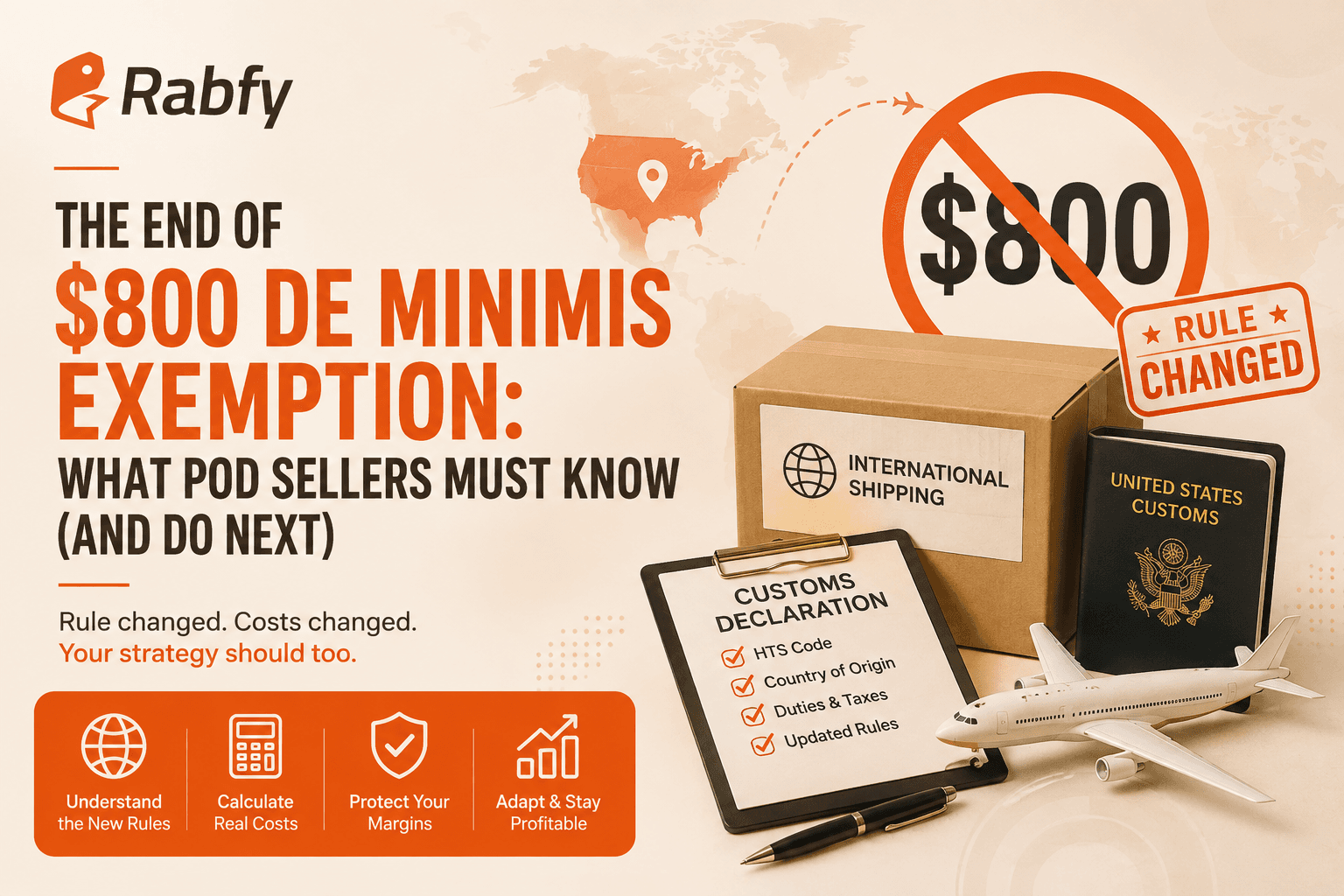
Yes. The US $800 de minimis duty-free exemption has been suspended for all countries since 29 August 2025, was codified into regulation on 24 June 2026, and is scheduled for permanent statutory repeal on 1 July 2027. Low-value parcels entering the US are now generally dutiable regardless of how small the order is. This is not a temporary blip or a rumour, it's the settled state of cross-border shipping into the US.
Here's the timeline, because the dates matter and sellers keep getting them muddled:
Date What happened 2 May 2025 Exemption suspended for China and Hong Kong 29 August 2025 Suspension extended to all countries 4 July 2025 One Big Beautiful Bill Act signed, setting statutory repeal for 1 July 2027 February 2026 Administration reaffirmed and continued the suspension 24 June 2026 CBP codified the suspension into regulation, all shipping modes 1 July 2027 Permanent statutory termination takes effect
The practical upshot is simple. Since late August 2025, a sub-$800 parcel shipped into the US from any country no longer enters duty-free. It began as an executive action, but it has since been written into regulation and backed by statute, which is why the next question, whether it might come back, has a clearer answer than most sellers hope.
Who Pays the Duty Now, You or the Buyer?
By default, unless you arrange otherwise, the buyer typically pays the duty and any brokerage fees when the parcel arrives, often as a surprise charge on their doorstep. You can instead pay it upfront (a DDP arrangement), but either way the cost now exists and someone bears it. This is the change that damages seller reputations fastest, because an unexpected charge turns a happy buyer into an angry one.
Picture what happens under the old system versus now. Before, your US buyer ordered a $28 item, paid $28, and it arrived. Now, that same parcel can be held at customs until duty and a brokerage or handling fee are paid, and if you haven't prepaid, the carrier collects it from your buyer before delivery. From the buyer's side, they paid $28 and are now being asked for more money to receive something they already bought, which feels like a scam even though it isn't. The result is refused parcels, chargebacks, angry messages, and negative feedback, none of which is really your fault, but all of which lands on you. Understanding who pays, and deciding it deliberately rather than by default, is now part of selling internationally.
What Is an HTS Code and Do You Need One?
An HTS (Harmonized Tariff Schedule) code is the classification number that determines the duty rate on a product. Cross-border commercial shipments now need correct classification to clear customs and be charged the right duty, so yes, it matters, and getting it wrong causes delays or penalties. This is paperwork that used to be optional for tiny parcels and now isn't.
In plain terms, every type of product has a code that customs uses to decide how much duty applies, based on what the item is and where it was made (its country of origin). Under de minimis, small parcels skipped most of this. Now that low-value shipments are dutiable, correct classification becomes necessary, because the wrong code means the wrong duty, which means held shipments, corrections, or penalties. This is exactly where the "not legal advice" caution matters most: classifying products correctly is genuinely technical, and the right HTS code for your specific product should be confirmed with a licensed customs broker rather than guessed. For sellers moving real volume, a broker isn't an expense, it's insurance against far costlier customs problems.
Should You Use DDP?
DDP (Delivered Duty Paid) means you, the seller, pay the duty and import costs upfront so the parcel arrives at your buyer with nothing more to pay. For cross-border ecommerce, DDP generally protects the customer experience far better than the alternative, DDU, where the buyer is billed on delivery. Choosing DDP is often the difference between a smooth delivery and a refused parcel.
The two models are straightforward. Under DDU (Delivered Duty Unpaid), the buyer is responsible for duty on arrival, which produces the surprise-bill problem described above. Under DDP, you handle and pay those costs before the parcel reaches the customer, so their experience matches what they expect: they paid at checkout, and the item simply arrives. DDP costs you more per parcel and adds complexity, but it protects the buyer experience, your reviews, and your feedback score, which for a marketplace seller are worth protecting. The catch is that DDP on individual cross-border parcels is operationally heavy and eats into already-thin margins. That difficulty is exactly why many sellers are rethinking the whole cross-border model, which brings us to the real solution.
Is Domestic Fulfilment Cheaper Now?
For sellers targeting US buyers, fulfilling domestically, producing or holding stock inside the US and shipping locally, is now often dramatically cheaper and faster than shipping each order across the border, because it converts hundreds of individual dutiable parcels into one bulk import plus cheap domestic delivery. This is the single most important strategic response to the end of de minimis, and it's pure arithmetic.
Consider the two routes for reaching a US customer, side by side:
Factor Ship direct from overseas Fulfil from inside the US Duty On every parcel Once, on a bulk import (or none, if produced in-US) Customs paperwork Per parcel Once, at bulk import Delivery time Often 10 to 15+ days Typically 2 to 4 days Buyer surprise charges Likely under DDU None Per-order cost Duty + international shipping + brokerage Domestic shipping rate
The logic is the same one reshaping the whole industry. If you ship a thousand orders individually from overseas, that's a thousand dutiable customs events, each with cost and delay. If you instead hold or produce that inventory inside the US, you cross customs once (or not at all, if the product is made in-country), and every customer order then ships domestically, fast and cheap, with no per-parcel duty and no surprise charge for the buyer. For the mechanics of holding inventory domestically, see our guide on what 3PL is, and for when it's time to hand fulfilment to a partner, when to stop self-fulfilling. Print-on-demand takes this further by producing each item inside the US only when it sells, which we come back to at the end.
How This Connects to eBay Selling Specifically
On eBay, the end of de minimis hits your seller metrics as well as your costs, because delayed cross-border parcels and buyer duty disputes translate directly into late-delivery marks, cases, and negative feedback, all of which suppress your listings in Cassini search. For an eBay seller, the customs change isn't just a cost problem, it's a ranking problem.
Recall how eBay's search works: dispatch speed, delivery time, and case rate all feed your seller performance, which feeds your ranking, as covered in our guide on eBay listing optimisation. Now layer the customs reality on top. A cross-border parcel held at customs is a late delivery. A buyer refusing a duty charge is a case or a refund. A surprise fee is negative feedback. Each of these damages the exact metrics eBay uses to decide whether to show your listings, so the end of de minimis can quietly sink your search visibility even for sellers who never think about customs. Fast, reliable, duty-free-to-the-buyer domestic delivery isn't just better service now, it's protection for your eBay ranking.
Will the Exemption Come Back?
Almost certainly not. The suspension has moved beyond a reversible executive order: it was codified into federal regulation in June 2026 and is backed by a statutory repeal effective July 2027 under the One Big Beautiful Bill Act. A statute is far harder to undo than an executive order, so the sensible planning assumption is that de minimis is permanently gone. Building your business around its return would be building on sand.
Sellers keep hoping for a reversal because the change began as an executive action, and executive orders can be revoked. But two things closed that door. First, in June 2026 the policy was written into the regulatory code, not just an order. Second, and decisively, separate legislation set a permanent statutory end date of 1 July 2027, and a law passed by Congress can't be undone by a change of executive mind. Even legal challenges to related tariff authority haven't restored it, because the de minimis suspension rests on different legal ground. The honest planning answer, and it's worth confirming the current status yourself given how fast this area moves, is to treat US import duty on low-value parcels as permanent and structure your business accordingly, rather than waiting for a rescue that the law has effectively ruled out.
Frequently Asked Questions
Is the $800 exemption really gone? Yes. The US $800 de minimis duty-free exemption was suspended for China and Hong Kong on 2 May 2025, extended to all countries on 29 August 2025, codified into federal regulation on 24 June 2026, and is scheduled for permanent statutory repeal on 1 July 2027 under the One Big Beautiful Bill Act. Low-value parcels entering the US are now generally dutiable regardless of order size. This is the settled current state, not a temporary measure.
Who pays the duty now, me or the buyer? By default, the buyer usually pays duty and any brokerage or handling fees when the parcel arrives, which produces the surprise-charge problem that leads to refused parcels and negative feedback. You can instead pay these costs upfront through a DDP (Delivered Duty Paid) arrangement, so the parcel arrives with nothing more owed. Either way the cost now exists, so decide deliberately who bears it rather than leaving it to default.
What is an HTS code and do I need one? An HTS (Harmonized Tariff Schedule) code is the classification number that determines a product's duty rate based on what it is and where it was made. Now that low-value shipments are dutiable, commercial cross-border shipments need correct classification to clear customs and be charged correctly, so yes, it matters. Because classification is technical and getting it wrong causes delays or penalties, confirm the right code for your specific products with a licensed customs broker rather than guessing.
Should I use DDP? For cross-border ecommerce, DDP (where you pay duty and import costs upfront so the buyer owes nothing on delivery) generally protects the customer experience much better than DDU (where the buyer is billed on arrival). DDP costs more per parcel and adds complexity, but it prevents the surprise charges that cause refused parcels, disputes, and bad feedback. The operational weight of DDP on individual parcels is a big reason many sellers move to domestic fulfilment instead.
Is domestic fulfilment cheaper now? For sellers targeting US buyers, usually yes, and often dramatically so. Shipping each order across the border now means per-parcel duty, customs paperwork, brokerage, and long delivery times. Fulfilling from inside the US, holding or producing stock domestically, converts that into a single bulk import (or no border crossing at all, if the product is made in-country) plus fast, cheap domestic shipping with no per-parcel duty and no buyer surprise charges. For many sellers this is now the most economical structure.
Will the exemption come back? Almost certainly not. What began as an executive order was codified into federal regulation in June 2026 and is backed by a statutory repeal effective 1 July 2027. Because a statute is far harder to reverse than an executive order, and related legal challenges haven't restored the exemption, the sensible assumption is that de minimis is permanently gone. Plan your business around US import duty being here to stay rather than waiting for a reversal.
Key Takeaways
 The US $800 de minimis exemption is gone: suspended for all countries since 29 August 2025, codified into regulation in June 2026, and set for permanent statutory repeal on 1 July 2027.
- Low-value parcels into the US are now dutiable regardless of size, and by default the buyer gets hit with a surprise duty charge on delivery, which drives refusals, disputes, and negative feedback.
- Correct HTS classification now matters for cross-border commercial shipments, and it's technical enough that you should confirm your products' codes with a licensed customs broker.
- DDP (you prepay duty) protects the buyer experience far better than DDU (buyer billed on arrival), but it's operationally heavy on individual parcels.
- Domestic fulfilment, one bulk import or in-US production plus local shipping, is now often dramatically cheaper and faster, and for eBay sellers it also protects the delivery and case metrics that feed search ranking.
How Rabfy Helps
The end of de minimis makes one strategy stand out above every workaround: don't ship across the border on every order at all. Rabfy produces each item inside the US (and the UK) only when a customer buys, so there's no per-order customs event, no duty on each parcel, and no surprise charge landing on your buyer's doorstep. When your eBay order sells, you place it with Rabfy, it's produced and dispatched domestically, and it reaches your US customer in days rather than the weeks cross-border freight now takes, in neutral packaging that also keeps you compliant with eBay's sourcing rules. That fast, duty-free-to-the-buyer delivery protects the seller metrics that drive your eBay ranking, and it sidesteps the entire de minimis problem rather than merely managing it. Over 300 sellers currently fulfil through Rabfy across more than 50,000 orders, with a 0% return rate last Q4. For overseas sellers reaching US buyers, this is covered further in our guide on selling to US buyers from overseas. Learn more on our features page.
Ship Domestically to US and UK Buyers With Rabfy
You know what changed, what it costs, and why domestic fulfilment now beats shipping across the border on every order. The cleanest way to sidestep the whole duty problem is to produce inside the market you're selling to. Create your free Rabfy account and ship to your US and UK buyers domestically, with no per-parcel duty and no surprise charges landing on your customers.
Khairul works on community and fulfilment at Rabfy and helps sellers restructure cross-border operations around the end of de minimis. This article is informational, not tax or legal advice, and reflects the policy situation as of August 2026; confirm current rules and your products' classification with a licensed customs broker before acting.