eBay gets overlooked. Newer sellers gravitate toward Etsy for its handmade audience or Amazon for its sheer scale, and eBay quietly gets filed under "the place people sell used electronics." That's a mistake. eBay moves an enormous volume of new, fixed-price products every day, the buyer base is huge, and for print-on-demand sellers specifically, it's one of the more forgiving platforms to get established on, provided you understand two things going in: how the fees actually work, and where eBay draws its hard line on sourcing.
This guide covers the full setup, from account to first listing, with the real 2026 numbers rather than vague estimates. More importantly, it covers the sourcing rule that trips up new sellers and gets accounts restricted, and exactly where print-on-demand sits on the right side of that line. If you're still deciding whether the whole no-inventory model is for you, our guide to print-on-demand covers the fundamentals. This one is about making eBay specifically work.
Why eBay Is Worth a Print-on-Demand Seller's Attention
A quick case for the platform before the setup steps, because most POD content skips eBay entirely.
The buyer pool is enormous and skews toward people actively searching for a specific item rather than browsing a feed. That search-driven behaviour suits POD products with clear, keyword-friendly titles. There's no design-marketplace gatekeeping the way there can be elsewhere, and the barrier to listing your first product is genuinely low. eBay also has decades of buyer-protection infrastructure, which cuts both ways: buyers trust it, and sellers who hold up their end of the bargain benefit from that trust.
The catch is that eBay expects you to behave like a real merchant from day one: dispatch on time, upload tracking, and stand behind every sale. Get that right and it rewards you with rising limits and better visibility. Get it wrong and it tightens the screws fast.
What eBay Actually Allows: The Sourcing Rule That Matters Most
This is the single most important thing a new POD seller needs to understand about eBay, so it comes before the setup steps rather than buried at the end.
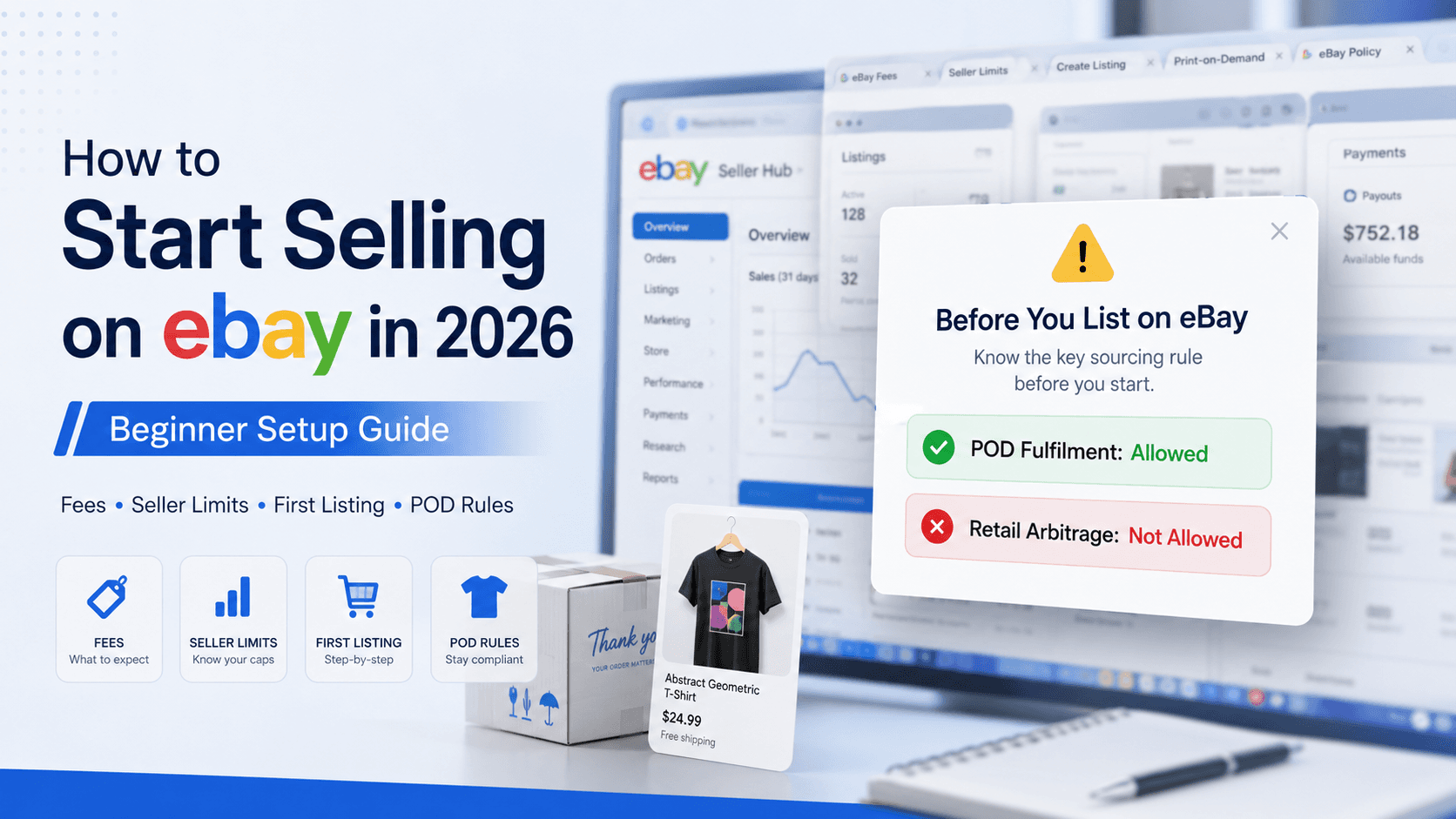
eBay permits dropshipping and fulfilment from a wholesale supplier or manufacturer. When you list a product, a customer buys it, and your supplier or fulfilment partner ships it directly to that customer, you are compliant, as long as that parcel arrives in neutral, unbranded packaging and you remain the seller responsible for the whole experience. Print-on-demand fits squarely inside this. A POD platform is your production and fulfilment partner, the product ships in white-label packaging with no third-party branding, and you're the seller of record. That's exactly the model eBay allows, and it's worth reading eBay's own dropshipping policy directly so you've seen the source rather than a summary of it.
What eBay explicitly bans is retail arbitrage: listing an item on eBay, then buying it from another retailer or marketplace, Amazon, Walmart, Target, AliExpress, another eBay seller, and having that retailer ship it to your buyer. The giveaway is a customer receiving an Amazon-branded box with someone else's packing slip inside. eBay's detection for this has gotten sharper, and the consequences run from hidden listings and lowered search placement to full account suspension.
Here's the distinction in plain terms:
Allowed on eBay Not allowed on eBay Fulfilment from a wholesale supplier or manufacturer Buying from a retailer and having them ship to your buyer Print-on-demand via a fulfilment partner Retail arbitrage from Amazon, Walmart, AliExpress, etc. White-label, unbranded packaging Third-party retailer's boxes, invoices, or branding You remain the seller of record for returns and service Passing off another retailer's fulfilment as your own
The reason this matters so much: the banned version was a huge cottage industry for years, and a lot of outdated advice still teaches it. If a guide tells you to list Amazon products on eBay and let Amazon Prime handle shipping, that guide is describing the exact model that gets accounts banned. POD through a genuine fulfilment partner is a different thing entirely, and it's fine.
Setting Up Your eBay Seller Account, Step by Step
Step 1: Create Your Account
Register at eBay's seller registration page. You can start with a personal account, but if you're building a POD business, register as a business account from the start. It's the honest classification, it unlocks business-appropriate features, and it saves you from reclassifying later.
Step 2: Verify Your Identity and Set Up Payments
eBay manages payments directly, which means your earnings are paid into a linked bank account rather than a third-party processor. You'll verify your identity and connect that bank account during setup. This step also determines where and how you get paid, so make sure the details match your actual banking information.
Step 3: Understand Your New-Seller Limits Before You List
This surprises almost every new seller, so know it going in. New eBay accounts start with a selling limit, typically around 10 items or $500 in total value per month, whichever ceiling you hit first. These two limits work independently, so it's worth understanding which one you'll bump into. List ten $5 items and you've used your entire item count while barely touching the value cap. List one $500 item and you've maxed the value limit with nine item slots unused.
eBay reviews accounts monthly and raises these limits automatically for sellers with clean performance. The fastest way to grow them isn't listing more, it's selling through what you've listed and keeping your metrics spotless. An account that lists 10 items and sells 8 looks far stronger to eBay's review than one that lists 10 and sells 1.
Step 4: Set Your Handling Time and Policies
Your handling time (also called dispatch time) is the promise for how fast you'll get an order moving after it sells. For POD, this has to reflect your fulfilment partner's real production speed, not an optimistic guess. Set your return policy here too. Under eBay's buyer protection, you're responsible for returns per your stated policy even when a supplier is involved, so write a policy you can actually honour.
Step 5: Create Your First Listing
Choose fixed-price format for POD products (more on auction versus fixed price below). Fill in a keyword-rich title, complete the item specifics as thoroughly as possible, add clear photos of your actual product, write an honest description, and set your price with fees factored in. eBay's search rewards complete listings with fully filled item specifics, so don't leave those blank. We go deeper on ranking in eBay Listing Optimisation: How Cassini Decides What Buyers See, which is worth reading before you assume a quiet first week means your product isn't wanted.
What eBay Charges: The Fees, With a Real Example
eBay's fees are simpler to reason about than some marketplaces because payment processing is baked into the main fee rather than charged separately. There's no separate PayPal or card-processing line.
The two fees that matter:
Insertion (listing) fees. Most sellers get around 250 zero-insertion-fee listings per month without a Store subscription. Beyond that allowance, additional listings cost roughly $0.35 each. For a new seller capped at 10 items a month, you'll almost never touch this.
Final value fee. This is the main one. For most categories in 2026, it's about 13.6% of the total sale amount plus a per-order fee of $0.30 on orders of $10 or less, or $0.40 on orders above $10. Note "total sale amount": the fee is calculated on the item price plus shipping plus tax, not the item price alone. Percentages vary by category, so always check your specific category against eBay's official selling fees page rather than assuming the standard rate.
Here's what a $22 mug with $5 shipping actually costs:
Line Amount Sale total (item + shipping) $27.00 Final value fee (~13.6% of $27) ~$3.67 Per-order fee (order over $10) $0.40 Total eBay fees ~$4.07 (about 15% of the item price)
So on a $22 item, budget roughly 15% for eBay's cut once the per-order fee is included, then subtract your product and fulfilment cost on top of that to find your real margin. The mistake beginners make is pricing against a competitor's sticker price without running this math first. We cover full pricing arithmetic, including how fees stack against product cost and shipping, in POD Pricing and Profit Margins: The Honest Arithmetic.
Auction or Fixed Price for POD?
Auctions are eBay's heritage format, and they're the wrong tool for print-on-demand. Auctions suit scarce, collectible, or single-quantity items where competitive bidding can push the price up. POD products are the opposite: you can fulfil the same design an unlimited number of times, so there's no scarcity to auction against. Fixed-price (Buy It Now) listings let a product sell repeatedly at a set price, which is exactly what a POD catalogue needs. Use fixed price.
Handling Time: The Metric That Makes or Breaks New Sellers
Dispatch speed and valid tracking are among the strongest signals eBay uses to decide whether to raise your limits and how to rank you. This is also where POD sellers stumble, because they set a handling time that ignores production.
If your fulfilment partner needs a day or two to produce a POD item before it ships, your handling time has to account for that. Promising same-day dispatch on a product that takes two days to make sets you up for late-dispatch flags in your first month, which is precisely when you're trying to prove reliability and grow your limits. Set an honest handling time, then as soon as your fulfilment partner gives you the tracking number, add it to the eBay order so the dispatch registers on time. Uploading valid tracking promptly is one of the clean metrics that does the work of raising your ceiling, so build the habit of updating each order the moment tracking comes back to you.
Common Mistakes New eBay Sellers Make
Following outdated retail-arbitrage advice. Covered above, and the most dangerous mistake on this list. Sourcing from Amazon or Walmart to fulfil eBay orders gets accounts restricted. POD via a fulfilment partner does not.
Setting handling time faster than production allows. Late dispatch on your first handful of orders damages the exact metrics you need to grow your selling limits.
Leaving item specifics blank. eBay's search leans heavily on complete item specifics. A listing with half its fields empty is harder to find than a fully completed one at the same price.
Pricing without the full fee stack. Roughly 15% to eBay on a small item, plus your product and fulfilment cost, is the real math. Matching a competitor's price blind is how sellers end up with margins that don't survive.
Ignoring returns responsibility. You're the seller of record. "My supplier wouldn't take it back" isn't a valid answer to eBay under its buyer protection. Price and plan for the occasional return.
Listing in auction format. For repeatable POD products, fixed price is almost always the right call.
Your eBay Launch Checklist
Before you publish your first listing, run through this:
 [ ] Registered as a business account, not personal, if you're building a POD business
- [ ] Identity verified and bank account connected for eBay-managed payments
- [ ] Understood your starting selling limit (item count and value cap) and which you'll hit first
- [ ] Handling time set to match your fulfilment partner's real production speed
- [ ] Return policy written to something you can actually honour as seller of record
- [ ] Confirmed your sourcing is compliant: fulfilment partner with white-label packaging, not retail arbitrage
- [ ] First listing set to fixed price, with a keyword-rich title and complete item specifics
- [ ] Price calculated with the ~15% fee stack plus your product and fulfilment cost
- [ ] Photos taken from your actual product, not just a mockup
Frequently Asked Questions
Is print-on-demand allowed on eBay? Yes. eBay permits fulfilment from a wholesale supplier or manufacturer, and print-on-demand through a fulfilment partner fits that model, as long as the product ships in neutral, unbranded packaging and you remain the seller responsible for delivery and returns. What eBay bans is retail arbitrage, buying from a retailer like Amazon or Walmart and having them ship to your buyer, which is a different thing entirely.
What are eBay's new-seller limits? New accounts typically start capped at around 10 items or $500 in total value per month, whichever you reach first. eBay sets the exact figure per account and reviews it monthly, raising limits automatically for sellers with strong sales performance and clean service metrics. Selling through what you list, rather than just listing more, is what grows the limit fastest.
How much are eBay's fees? For most categories in 2026, the final value fee is about 13.6% of the total sale amount (item price plus shipping plus tax) plus a per-order fee of $0.30 on orders of $10 or less or $0.40 on orders above $10. Payment processing is included in that fee rather than charged separately. Most sellers also get around 250 free listings per month before insertion fees apply. Rates vary by category, so check yours.
How fast do I have to dispatch an order? As fast as the handling time you set on your listing. eBay treats on-time dispatch and valid tracking as key performance signals, so your handling time needs to match your fulfilment partner's real production and shipping speed. Setting it faster than you can deliver leads to late-dispatch flags that hurt your metrics and slow your limit increases.
Should I use auction or fixed price for POD products? Fixed price. Auctions suit scarce or collectible single items where bidding drives the price up. Print-on-demand products can be fulfilled repeatedly with no scarcity, so a fixed-price (Buy It Now) listing that sells the same design over and over is the right format.
Key Takeaways
- eBay is an underrated platform for POD sellers: huge search-driven buyer base and a low barrier to listing, provided you play by its rules.
- The sourcing rule is everything. Fulfilment from a supplier or POD partner with white-label packaging is allowed; retail arbitrage from other retailers is banned and actively detected.
- Budget roughly 15% of a small item's price for eBay's final value fee plus per-order fee, then add your product and fulfilment cost to find real margin.
- New-seller limits (around 10 items or $500 a month) grow fastest through strong sell-through and clean service metrics, not through listing more.
- Set an honest handling time that matches production, use fixed-price format, and remember you're the seller of record for every return.
How Rabfy Helps
Everything eBay expects from a compliant POD seller, white-label packaging, a real fulfilment partner, fast dispatch, and tracking uploaded on time, is exactly what Rabfy is built to support. You list on eBay, place each order with Rabfy when it sells, and we produce and ship it from our US and UK warehouses within 24 to 48 hours in neutral, unbranded packaging, then give you the tracking to add to your eBay order. There's no inventory to buy and no minimum order, and you're paid out 15 days after fulfilment. Over 300 sellers currently fulfil this way across more than 50,000 orders, with a 0% return rate last Q4. It's free to start, and it keeps your eBay account on the right side of every rule in this article.
Dispatch From a US Warehouse With Rabfy
You've got the setup steps, the real fees, the sourcing rule, and the handling-time discipline that grows your limits. The last piece is a fulfilment operation that dispatches fast and keeps your packaging neutral. Create your free Rabfy account and dispatch from a US warehouse while you focus on listings and products that actually sell.
Khairul mentors eBay sellers inside Rabfy's community and works on the community and fulfilment side of the platform.