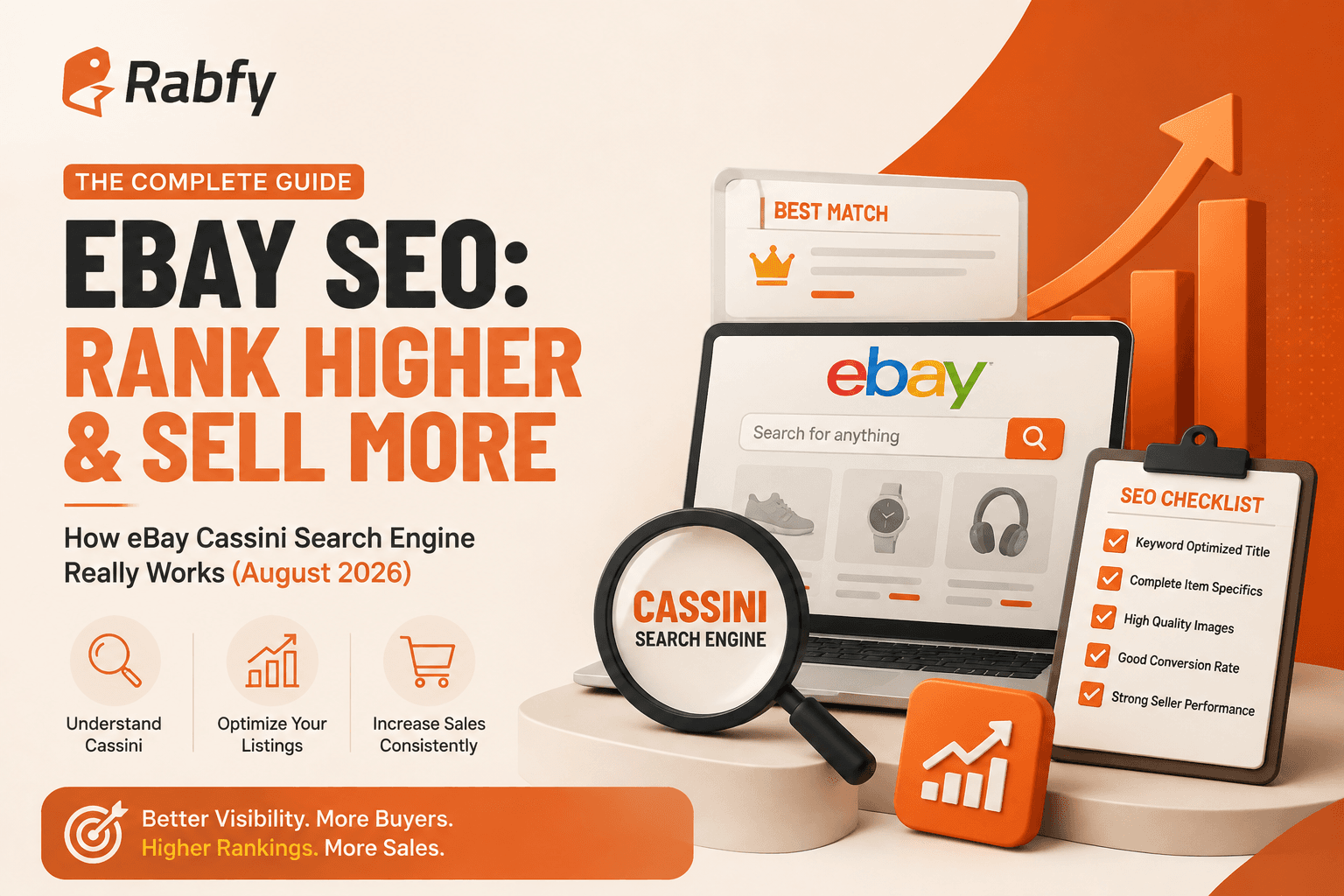
You've listed a product, filled in a title packed with keywords, and it still sits where no buyer will ever scroll. The instinct is to add more keywords, and it's the wrong instinct. eBay's search engine, Cassini, stopped rewarding keyword stuffing a long time ago. What it rewards now is a listing that proves it will sell and a seller who proves they'll deliver. Those are different things from "has the right words in the title," and confusing the two is why so many listings stay invisible.
This guide explains what Cassini actually measures, in the order it weighs it, and gives you a repeatable way to fix an underperforming listing. It also covers the factor most eBay guides skip: your service performance. Dispatch speed, defect rate, and cases feed directly into ranking, which means fulfilment and visibility are the same problem. A quick note: eBay's search behaviour evolves, so the details here reflect August 2026, and it's worth confirming current specifics in eBay's own Seller Hub guidance. If you're just getting started on eBay, our guide on how to start selling on eBay covers setup first.
What Is Cassini?
Cassini is eBay's search engine, the system that decides which listings appear in Best Match, the default order buyers see for almost every search. It replaced eBay's older search engine years ago, and its guiding principle is simple: show buyers the listings most likely to make them click, buy, and stay happy.
That principle is the key to everything else. Cassini is not trying to reward the seller who worked hardest on keywords. It's trying to give the buyer the best outcome, so every ranking factor folds back into one question: if we show this listing to this buyer, will they buy it and be satisfied? Once you see Cassini as a buyer-outcome engine rather than a keyword-matching one, its behaviour stops feeling random. A listing ranks well when it signals a good buyer outcome, and poorly when it doesn't, regardless of how many keywords you crammed into the title.
How Does eBay Best Match Work?
Best Match works by weighing three kinds of signal: relevance (does the listing match the search), listing quality and engagement (do buyers click and buy it), and seller performance (does the seller deliver reliably). A listing needs all three, not just good keywords. Understanding which of the three your problem lives in is the fastest way to fix a listing that won't rank.
Here's what sits in each bucket, roughly in order of how much it moves your ranking:
Signal bucket What it covers Examples Relevance Does the listing match the query? Title keywords, item specifics, category, condition Listing quality and engagement Do buyers respond to it? Click-through rate, watches, conversion, photos Seller performance Does the seller deliver? Defect rate, on-time dispatch, cases, feedback, seller level
Most sellers pour all their effort into the first bucket and ignore the other two, and that imbalance quietly costs them rankings. A keyword-perfect listing from a seller with a poor dispatch record and no proof of sales will lose to a plainer listing that converts and ships on time. The rest of this guide works through all three, because winning Best Match means satisfying all three, not maxing out one.
How Do You Write an eBay Title That Ranks?
Your title is Cassini's single strongest relevance signal, and the first five to seven words carry the most weight. Lead with the exact keyword a buyer would type, follow a Brand, Model, Spec, Condition structure, and use all 80 characters without gimmicks. The title is where relevance is won or lost, so it deserves more care than any other single field.
The structure that works is descriptive and front-loaded. Put your most important keyword, the words a buyer actually searches, in the opening of the title, then build outward with brand, model or type, key specifications, and condition. A title like "Retro Surf Sunset T-Shirt Men's Cotton Graphic Tee Beach Vintage Black L" reads the way buyers search and fills the available space with real, searchable terms. Avoid gimmicks entirely: no "WOW", no "L@@K", no strings of exclamation marks. Those waste your most valuable characters and signal a low-quality listing. Every word in your title should be a term a real buyer might type.
Why Item Specifics Matter More Than You Think
Item specifics are structured product attributes (brand, size, colour, material, type) that Cassini weights heavily and increasingly, and leaving them incomplete can filter your listing out of searches entirely. Filling every recommended field is the single highest-return task per listing. This is where most sellers quietly lose visibility without ever realising it.
Here's why they matter so much. eBay lets buyers narrow search results by clicking attributes, filtering to a specific brand, size, or colour. If your listing hasn't filled in that attribute, it simply doesn't appear when a buyer filters by it, no matter how good your title is. You're not ranked low; you're absent. And eBay has been steadily increasing how much item specifics weigh in ranking, so the gap between a fully completed listing and a half-filled one keeps widening. The fix takes two minutes: open your listing, find every recommended item specific eBay offers for your category, and fill all of them accurately. Completing item specifics is genuinely the highest-return two minutes you can spend on any listing.
How Sell-Through Rate Drives Your Ranking
Sell-through rate, the percentage of your listed inventory that actually sells, is a core signal Cassini uses to judge listing quality, and a high rate (above around 80% is considered strong) tells eBay your listings convert and deserve visibility. This is the engagement signal that separates listings that rank from listings that just exist.
The logic is straightforward. Cassini watches whether the buyers who see your listing actually buy, and it favours listings and shops with a strong track record of converting views into sales. A listing that gets shown repeatedly but rarely sells signals a poor buyer outcome, and Cassini shows it less. This is also why listing the same item across ten near-identical duplicate listings backfires: it dilutes your sales history across all of them and Cassini can suppress the lot as low quality. Focus your effort on fewer, stronger listings that actually convert, rather than flooding search with duplicates that each sell rarely. Getting the price competitive is part of this too, since price competitiveness is one of the buyer-outcome factors Cassini weighs.
Does Handling Time Affect eBay Ranking?
Yes. Handling time, how fast you dispatch after a sale, directly affects ranking. Cassini favours fast, reliable dispatch, and listings with long handling times (five or more days) can rank below identical listings that ship faster. This is the service signal that connects your fulfilment directly to your visibility, and it's the factor this guide exists to highlight.
Here's the trap, and it catches sellers coming and going. Set your handling time too long, and Cassini ranks you below faster competitors. But set it shorter than you can actually deliver, and you trigger late-shipment defects when you miss it, which are more damaging to your ranking than the slower handling time would have been. The winning move is honest speed: dispatch genuinely fast, and set a handling time you can hit every single time. This is exactly where a slow or unreliable fulfilment process quietly destroys rankings, because every late dispatch is both a defect and a signal to Cassini that you're a riskier listing to show. When self-fulfilment starts causing late dispatches, that's often the signal it's time for a fulfilment partner, which we cover in our guide on when to stop self-fulfilling. Cross-border sellers face an extra dispatch-speed challenge since the customs changes of 2025, covered in our guide on eBay international shipping after de minimis. We come back to what fast dispatch means for print-on-demand sellers at the end.
How Seller Performance and Top Rated Status Affect Visibility
Cassini factors your seller performance directly into ranking: your defect rate, late-dispatch rate, cases closed without resolution, and feedback all feed in, and Top Rated Seller status earns a visibility boost while slipping below standard can get your listings suppressed. Your account health is a ranking factor, not just a badge.
Think of it as eBay deciding how much to trust you with buyer attention. A seller with a clean record (low defects, on-time dispatch, few unresolved cases, strong feedback) is a safer bet to show, so Cassini shows them more. Top Rated Seller status, earned by consistently hitting eBay's performance standards, comes with a genuine search boost. The reverse is also true and more dangerous: if your metrics fall below eBay's minimum standards, your listings can be actively suppressed across your whole account, not just penalised individually. This is why protecting your service metrics matters for every listing you have, not just the order in front of you. One late dispatch or unresolved case can drag on visibility well beyond the single transaction.
Do Promoted Listings Help Organic Ranking?
Promoted Listings are eBay's paid advertising, sitting in sponsored slots separate from organic Best Match results. They don't directly buy you organic rank, but the extra visibility and sales they generate can feed the engagement and sell-through signals that do influence organic ranking. Understanding the indirect connection stops you from either over-relying on ads or dismissing them entirely.
The honest picture is nuanced. Promoted Listings put your item in paid placements, and paying for those does not directly raise your free organic position. However, the clicks, watches, and especially sales that promotion generates are real engagement, and that engagement improves the sell-through and conversion signals Cassini uses for organic ranking. So promotion can indirectly help your organic position by kick-starting the very signals that drive it, particularly for a new listing with no sales history yet. The catch is the same as everywhere else: if the listing itself doesn't convert, promoting it just pays to show something buyers still don't buy. Fix the listing first, then consider promotion to build early momentum. We cover promoted listings alongside the other levers for scaling a store in our guide on how to grow an eBay store.
How to Optimise an eBay Listing, Step by Step
Here's the repeatable process. Run any underperforming listing through it in this order, because the order follows how Cassini evaluates it.
Step 1: Front-Load a Descriptive Title
Put the exact keyword buyers search in the first few words, then build out Brand, Model, Spec, Condition, using all 80 characters with real terms and no gimmicks.
Step 2: Complete Every Item Specific
Fill every recommended item specific eBay offers for your category, accurately. This is what keeps you in filtered searches, and skipping it is the most common invisible ranking killer.
Step 3: List in the Right Category
Choose the most accurate category, and take eBay's category suggestions seriously, since they're based on where buyers actually search. The wrong category hides you from the buyers looking for exactly your item.
Step 4: Add Strong Photos
Use multiple high-resolution images, a clean main image on a white background, then detail and lifestyle shots. Better images lift click-through and time on the listing, both engagement signals.
Step 5: Price Competitively
Check what similar listings sell for and price within a competitive range, since price competitiveness is a buyer-outcome factor Cassini weighs. Run your fee math first so a competitive price still leaves margin.
Step 6: Set an Honest, Fast Handling Time
Set the fastest handling time you can genuinely hit every time, and offer a clear returns policy. Fast, reliable dispatch is a ranking signal; overpromising and missing it is a defect that hurts more.
Step 7: Protect Your Seller Metrics
Dispatch on time, upload tracking promptly, respond to buyers fast, and resolve issues before they become cases. These protect the seller-performance signals that feed every listing's ranking.
Why Did My eBay Listing Lose Visibility?
A sudden drop in eBay visibility usually comes from a new-listing boost ending, slipping seller metrics, increased competition, a listing edit being re-evaluated, or duplicate listings diluting your sales history, rather than anything permanently broken. Diagnosing the real cause beats panic-editing every listing at once.
New eBay listings get a temporary visibility boost, often around seven to ten days, while Cassini tests them with some exposure. If your traffic fell after a strong first week or two, that boost likely ended and you're now ranking on the listing's actual engagement during that window, so a listing that didn't convert early drops. Other common causes: your seller metrics slipped below standard and suppressed your listings, new competitors entered your niche, you edited the listing and it's being re-evaluated, or you have duplicate listings splitting your sales signal. Work through those before rewriting anything, and change one variable at a time so you can see what actually moves.
Frequently Asked Questions
How does Best Match work? Best Match is eBay's default search sort, powered by the Cassini algorithm. It ranks listings by weighing three kinds of signal: relevance (whether your title, item specifics, and category match the search), listing quality and engagement (whether buyers click, watch, and buy), and seller performance (whether you dispatch reliably and keep defects low). A listing needs all three, so strong keywords alone won't rank a listing that doesn't convert or ships late.
How many item specifics should I complete? All of them. Fill every recommended item specific eBay offers for your category, accurately. eBay lets buyers filter searches by these attributes, so any specific you leave blank can remove your listing from that filtered search entirely, regardless of your title. Item specifics carry growing weight in ranking, which makes completing them the single highest-return task per listing, and it takes about two minutes.
Does handling time affect ranking? Yes. Cassini favours fast, reliable dispatch, and listings with long handling times (around five or more days) can rank below identical faster-shipping listings. The key is honesty: set the fastest handling time you can actually hit every time, because promising fast dispatch and then missing it creates late-shipment defects that hurt your ranking more than a slower, reliable handling time would.
Do promoted listings help organic ranking? Not directly. Promoted Listings are paid placements separate from organic Best Match, so paying doesn't buy organic position. However, the clicks and sales that promotion generates are real engagement, which can improve the sell-through and conversion signals Cassini uses for organic ranking, especially for a new listing building its first sales. Promotion helps only if the listing already converts; otherwise it just pays to show something buyers don't buy.
Why did my listing lose visibility? Common causes include a new-listing visibility boost ending after its first week or two, your seller metrics slipping below eBay's standards and suppressing your listings, new competitors entering your niche, a recent listing edit being re-evaluated, or duplicate listings diluting your sales history. Work through these before making drastic changes, and adjust one thing at a time so you can tell what actually affected your ranking.
Key Takeaways
 Cassini ranks for buyer outcomes, not keyword density. It weighs relevance, listing quality and engagement, and seller performance together.
- Your title is the strongest relevance signal, with the first five to seven words carrying the most weight. Lead with the exact keyword and skip gimmicks.
- Complete every item specific. Blank ones remove you from filtered searches entirely, making this the highest-return two minutes per listing.
- Handling time and seller metrics are ranking factors. Fast, reliable dispatch lifts you; long handling times and defects suppress you, sometimes across your whole account.
- Promoted Listings don't directly buy organic rank, but the engagement they create can feed the signals that do. Fix the listing to convert first, then promote.
How Rabfy Helps
Two of Cassini's three signal buckets, listing quality and seller performance, are shaped by whether you dispatch fast and reliably, and that's exactly what Rabfy protects. When one of your eBay listings sells, you place the order with Rabfy, and it's produced and shipped from our US or UK warehouse within 24 to 48 hours, which lets you set a genuinely fast handling time and actually hit it every time. Fast, reliable dispatch and near-zero defects are precisely the seller-performance signals Cassini rewards, and they're the ones a slow or unreliable fulfilment process quietly destroys. Because items ship in neutral, unbranded packaging, this also keeps you compliant with eBay's sourcing rules. Over 300 sellers currently fulfil through Rabfy across more than 50,000 orders, with a 0% return rate last Q4. Your title and item specifics get you found; reliable dispatch helps keep you ranked. Learn more on our features page.
Cut Your Dispatch Time With US-Based Fulfilment
You've got the three-bucket model, the title and item-specifics fixes, and the service signals that quietly decide your ranking. The fastest lever most sellers ignore is dispatch speed. Create your free Rabfy account and dispatch from a US or UK warehouse, so handling time becomes a ranking advantage instead of a liability.
Khairul works on community and fulfilment at Rabfy and helps eBay sellers connect their fulfilment performance to their search visibility. This article reflects Cassini's behaviour as of August 2026; confirm current specifics in eBay's Seller Hub guidance.