If you have ever made a sale and then wondered where the money went, this guide is for you. Learning how to price print on demand products is mostly about adding up every cost before you pick a number, not after. Below you'll find one simple formula, a worked example using a real Rabfy product, and a clear look at how marketplace fees reduce your margin. By the end, you'll be able to check any product's price in about 15 minutes.
Key takeaways

Price = (Total costs per order + Target profit) ÷ (1 − Percentage fees).
Include product cost, shipping, fixed fees and percentage fees in every calculation.
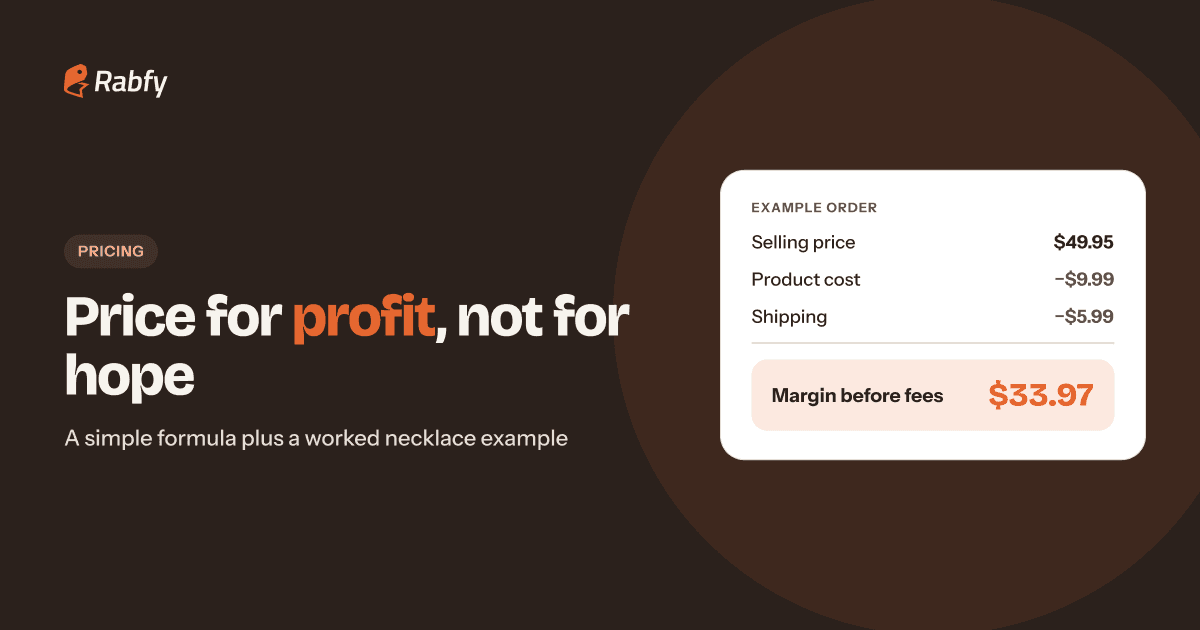
Example from the Rabfy homepage: a $49.95 necklace leaves a $33.97 margin before fees.
Marketplace fees come out of that margin. On Etsy, standard fees on this example are about $5.20.
Set your target profit in dollars, and make sure it covers ad costs and the occasional remake.
The pricing formula you need
Most pricing mistakes come from one habit: picking a price first and checking costs later. This pricing formula for ecommerce does it the other way around.
 Total costs per order: product cost + shipping + fixed fees (for example, a listing fee or a fixed payment fee).
- Target profit: the dollar amount you want to keep from each order.
- Percentage fees: marketplace and payment fees that grow with the price, written as a decimal (9.5% = 0.095).
Why divide instead of adding? Because percentage fees are charged on the final price, including your profit. If you add them as a fixed number, you will always come up a little short.

Percentage margin or dollar profit?
A 50% margin sounds great, but on a $20 item it leaves $10, and on a $50 item it leaves $25. Your bills, ads and time are paid in dollars, not percentages. That is why the formula starts from a target profit in dollars.
Worked example: one necklace, every cost
Here is the example from the Rabfy homepage, using the Soul Spark Necklace. It shows what is left after the two biggest costs, before fees that depend on your channel.

$49.95 − $9.99 − $5.99 = $33.97 margin before fees. That looks healthy, but it is not your profit yet. Two things still come out: the processing fee and tax on your Rabfy order (these vary), and the fees charged by the marketplace where you sold.
Now use the formula in reverse to see where $49.95 came from. Say you sell on Etsy and want $25 profit per order. Your costs per order are $9.99 + $5.99 + $0.45 in fixed Etsy fees = $16.43. Etsy percentage fees are 9.5% (0.095). So: ($16.43 + $25) ÷ (1 − 0.095) = $41.43 ÷ 0.905 = $45.78. Round up to a clean price point like $46.95 or $49.95.
How marketplace fees reduce your margin
Every marketplace takes its share, and the share changes with your price. Here is how it works on Etsy, using fees that are correct at the time of writing (always confirm on Etsy's Fees & Payments Policy page).
| Etsy fee | Rate at the time of writing | On a $49.95 sale |
|---|---|---|
| Listing fee | $0.20 per listing | $0.20 |
| Transaction fee | 6.5% of item price, shipping and gift wrap | $3.25 |
| Payment processing (US) | 3% + $0.25 of the order total | $1.75 |
| Offsite Ads (only on ad sales) | 15%, or 12% for larger shops | $7.49 at 15% |
In this example the buyer pays no separate shipping, because it is built into the price, and we leave out sales tax to keep the math simple. In real orders, the payment processing fee is charged on the full order total, including shipping and tax, so it will be slightly higher.

So the $33.97 margin becomes about $28.77 after standard Etsy fees, before the Rabfy processing fee and tax. If the same sale came through Etsy Offsite Ads at 15%, another $7.49 comes out, leaving about $21.28. That is why ad-driven sales need a higher price or a smaller ad budget.
Other channels, same formula
The formula works everywhere; only the fee inputs change. On Shopify, payment processing fees depend on your plan and payment provider. On Amazon, you pay a referral fee that varies by category. On eBay, the final value fee also depends on the category. On the Rabfy Store, the customer pays Rabfy, and Rabfy deducts costs and pays you the rest on Net 15 terms.
You can use one price everywhere or set a slightly higher price on channels with higher fees. Either way, run the formula once for each channel so you know your real profit in each place.
What is a good print on demand profit margin?
There is no single right percentage for print on demand profit margin, and you should be careful with anyone who promises one. A better question is: how many dollars do I keep per order, and is that enough to grow?
Use this test. Your profit per order must cover three things: your advertising cost per sale, the occasional remake or refund, and something for you. If you spend $15 on ads to get one sale, a $12 profit means you lose money on every ad-driven order, even though the product itself looks profitable.
If you plan to run ads, read our beginner budget plan for Facebook ads for jewelry before you set your target profit.
Jewelry pricing tips that raise perceived value
With jewelry pricing, buyers judge value by how the gift will feel, not by the metal weight. These small changes let you charge a fair price without looking expensive:
- Add a message card. A short, personal card turns a necklace into a complete gift and supports a higher price.
- Offer a premium finish. For example, an 18K yellow gold finish option can be priced above the standard version.
- Sell sets and bundles. A mother-daughter pair or a necklace-and-mug gift set raises the order value and spreads shipping over more items.
- Use clean price points. Prices like $39.95 or $49.95 look familiar and easy to compare.
- Don't race to the bottom. A lower price than everyone else rarely wins if your photos and story are weaker.
Hidden costs most sellers forget
The formula only works if your cost list is complete. Before you finalize a price, check that you have included these:

Discounts deserve special attention in Q4. A 20% Black Friday discount on $49.95 takes $9.99 off the price, and all of it comes out of your margin, while your product and shipping costs stay the same. Run the formula at the discounted price before you promise a sale.
Timing matters too. You pay for production when the order comes in, but marketplaces may pay you later. Our guide to cash flow for print-on-demand sellers shows how to stay funded through the busy season.
Your 15-minute pricing check
- 1Pick your best-selling product and write down its product cost and shipping.
- 2Add the fixed and percentage fees for the channel where it sells most.
- 3Decide your target profit in dollars, including your ad cost per sale.
- 4Run the formula and compare the result with your current price.
- 5If your current price is lower, raise it, improve the offer with a card or bundle, or cut costs.
Frequently asked questions
What is a good profit margin for print on demand?
There is no single right number. A practical test: after all costs and fees, your profit per order should cover your ad cost per sale and remakes, and still leave money for you.
How do I calculate my selling price?
Use Price = (Total costs per order + Target profit) ÷ (1 − Percentage fees). Add product, shipping and fixed fees, choose a target profit, then divide by what is left after percentage fees.
How much does Etsy take from a $49.95 sale?
In our example, about $5.20 in listing, transaction and payment processing fees at the time of writing, before tax, or more if the sale came through Offsite Ads. Check Etsy's fee pages for current rates.
Should I offer free shipping?
Many buyers like it, and you can build shipping into your price. Etsy's transaction fee applies to shipping either way, so include shipping in your math whichever option you choose.
How often should I review my prices?
Whenever a cost changes, and at least once before Q4. Fees, shipping rates and ad costs change, and a price that worked in spring can lose money in December.
Know your margin before you list
Create a free Rabfy account, check product and shipping costs, then set your own price and keep the margin. No subscription, and you pay only when you get an order.
Start selling free