Facebook ads for jewelry can work on a small budget, if you test in a structured way. Jewelry is visual, giftable and easy to show in a short video, which suits Facebook and Instagram feeds. But many beginners spend money without a plan and stop after a week with no clear answer. This guide gives you a simple beginner plan: how to work out what you can pay per sale, how to set up one test campaign, which creative angles to try, what example budgets look like, and when to stop or scale.
Key takeaways

Know your break-even cost per purchase before you spend anything. It defines what "working" means for you.
Start with one campaign, one broad ad set and 3–4 ads, each with a different creative angle.
Give each test at least 7 days without constant changes, then decide based on cost per purchase.
Budgets in this guide are examples. No one can promise a specific return on ad spend.
Before you spend: know your numbers
The most important number in any ad test is your break-even CPA (cost per acquisition). It is the most you can pay for one sale before you start losing money. If an ad brings sales below this number, it is profitable. If sales cost more, it is not.
Here is how to calculate it, using Rabfy’s homepage pricing example for one necklace sold on your own store:

The math: $49.95 − $9.99 − $5.99 − $1.75 (an example card payment fee) = $32.22. That is your break-even CPA before the processing fee and tax on your fulfillment costs.
 Break-even ROAS (return on ad spend) = $49.95 ÷ $32.22 ≈ 1.55. Below that, you lose money on each sale.
- Target CPA: if you want $10 profit per order, your target CPA is $22.22, which means a target ROAS of about 2.25.
- Raise what you can afford: bundles, a message card upgrade or a second item raise your order value, so you can pay more per sale.
Our guide on how to price print on demand products shows how to build ad costs into your price from the start.
Get ready: tracking, product and store
Ads send people to your store. If the store is not ready, even a great ad will fail. Check these before launch:
- Tracking is on. Install the Meta pixel and, if possible, the Conversions API. On Shopify, Meta’s Facebook and Instagram app can help you connect them.
- One clear product. Pick a product with some proof of demand. Our guide to print on demand product research shows seven ways to find one.
- A product page that answers questions. Clear photos, the price, personalization options, delivery time and your return policy.
- A test order. Buy your own product once, so you know checkout, emails and tracking all work.
If your store has no sales yet, get the first few from people you know before you pay for traffic. Our plan for your first 10 sales on Shopify explains how.
A simple jewelry ads strategy for beginners
Keep your first campaign simple. Complex setups split a small budget into pieces that are too small to learn from.
- 1One campaign with the Sales objective, optimized for purchases.
- 2One ad set with a broad audience in the country you ship to. Let Meta’s delivery system find buyers, instead of stacking narrow interests.
- 3Three or four ads, each with a different creative angle, so you learn which message works.
Meta’s help center explains that new ad sets go through a "learning phase". Meta has said an ad set needs about 50 optimization events in the 7 days after its last significant edit to exit it. With a small budget you may not reach that, and that is normal. Just avoid big changes to targeting, budget or ads in the first week, because significant edits can restart learning.
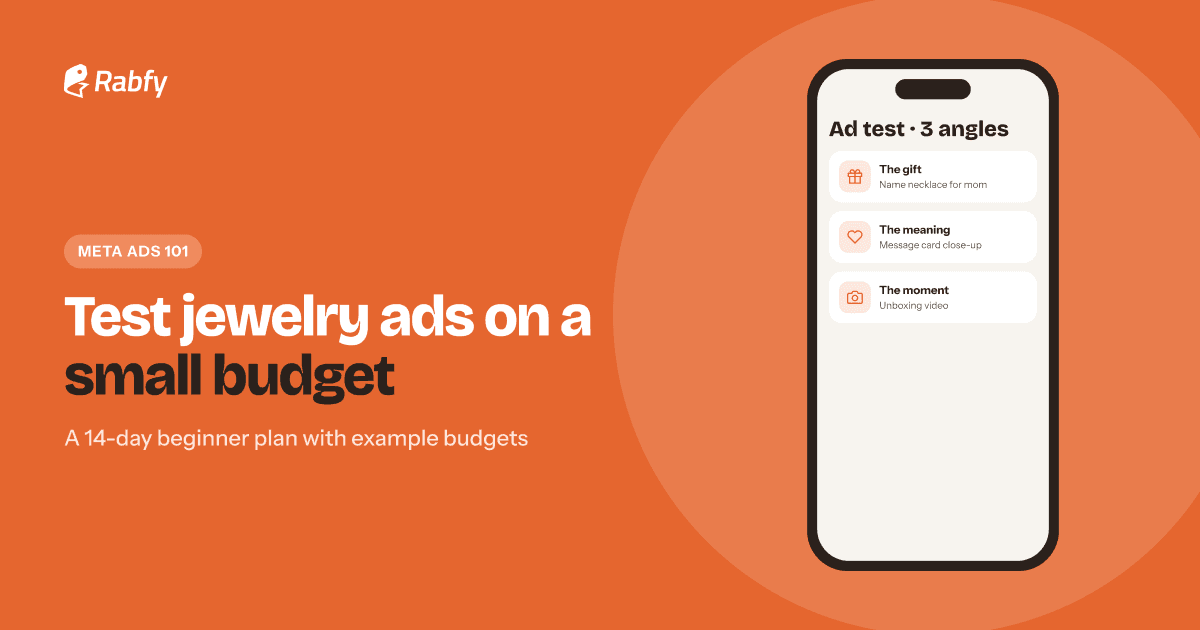
4 jewelry ad creative angles to test
The creative (the image or video) often does most of the work in Facebook ads today. Test different ideas, not small color changes.

- The gift: make the occasion and the person clear. Example hook: "A necklace with her kids’ names, for Mother’s Day."
- The meaning: close-up of the message card, then the necklace. Words sell the emotion.
- The personalization: a short screen recording of typing a name, then the finished piece.
- The unboxing: open the gift box on camera, read the card, show the necklace on. Film it yourself or with a friend, and never present it as a customer review unless it is one.
Example budgets for a beginner test
There is no single right budget. These three plans are examples to help you think about scale. Choose one you can afford without stress.
| Example plan | Daily budget | Length | Total spend |
|---|---|---|---|
| Starter test | $15/day | 7 days | $105 |
| Standard test | $30/day | 10 days | $300 |
| Faster learning | $50/day | 7 days | $350 |
A simple rule of thumb many advertisers use: before you judge an ad, let it spend about two to three times your break-even CPA. With a $32 break-even CPA, that is roughly $65–$100 per ad. With the Starter budget, test fewer ads (two or three) so each one gets enough spend.
Keep a simple spreadsheet for every test: date, spend, clicks, add to carts, purchases and cost per purchase. Writing the numbers down each day helps you make calm decisions based on data, not on one good or bad day.
Your 14-day test plan

- 1Day 1: launch everything at once, so all ads start on equal terms.
- 2Day 3: check only the basics. Is the budget spending? Do links work? Do not judge results yet.
- 3Day 7: pause ads that spent two to three times your break-even CPA with no sales.
- 4Day 8: add one new ad based on the angle that is working best.
- 5Day 14: decide. Scale what is profitable, and stop or rework what is not.
How to read your results
Each step of the funnel tells you something different. Use this table to find where the problem is.

When and how to scale
- Raise budgets in small steps, for example about 20% every few days. Large jumps count as significant edits and can restart learning.
- Feed the winner. Make new versions of your best angle: a new hook, a new person wearing it, a new format.
- Watch the calendar. Ad costs often rise in November and December as more brands advertise, so test early and have winners ready before Q4 peaks.
- Protect your margin. Keep checking cost per purchase against your break-even CPA as you spend more.
Add retargeting as a second step
Once your store gets steady traffic, add a small retargeting ad set for people who viewed a product or added it to their cart but did not buy. Show a close-up of the message card or remind them of your delivery dates. Keep this budget small compared with your main campaign, because the audience is small too.
Frequently asked questions
How much should I spend on Facebook ads for jewelry?
Start with an amount you can afford to lose while learning. As an example, $15 to $30 a day for 7 to 10 days gives a simple test enough data to make a first decision.
What is a good ROAS for jewelry ads?
It depends on your margin. Calculate your break-even ROAS: selling price divided by break-even CPA. In our example that is about 1.55. Anything above your break-even ROAS is profitable.
How long should I run a Facebook ad test?
Plan for at least 7 days without major edits. Meta’s delivery system needs time to learn, and daily results can jump up and down.
What kind of jewelry ad creative works best?
There is no single winner. Test different angles, such as the gift, the meaning, the personalization and the unboxing, and let your cost per purchase decide.
Can my ad say "Are you a new mom?"
No. Meta’s advertising standards do not allow ads that assert or imply personal attributes of the viewer. Write about the gift or the buyer instead, such as "A gift for new moms".
Test products without buying stock
Create your free Rabfy account, add personalized jewelry to your store and put your budget into testing ads, not inventory.
Start selling free