You optimised your listings, your titles are sharp, your tags are full, and your shop grew, then flattened. This is the plateau almost every Etsy seller hits, and it happens because Etsy search has a ceiling. There are only so many people searching your keywords, and once you've captured your share of them, search alone can't take you further. Growing past the plateau means bringing buyers to your shop from beyond Etsy search: through ads, off-platform traffic, and, most valuable of all, getting the buyers you already have to come back.
This guide covers the full picture, what marketing actually moves the needle for a small Etsy shop on a small budget, and it does so carefully, because one part of Etsy marketing, contacting buyers, is where sellers get into real trouble by following bad advice. We'll be precise about what Etsy permits. If you haven't nailed the search foundation yet, start with our guide on Etsy SEO, because marketing amplifies a shop that already converts and wastes money on one that doesn't. And if you're still setting up, our guide on how to start an Etsy shop covers the basics first.
Why Isn't Etsy Search Enough to Grow a Shop?
Etsy search is finite: only a limited number of buyers search your keywords each month, so once your listings rank well and capture their share of that demand, search-driven growth stalls. Scaling past that ceiling requires traffic sources beyond Etsy search. Recognising this is what separates sellers who plateau from those who break through.
Think of Etsy search as a well. It's a genuinely good well, and optimising your listings draws more water from it, but the well only holds so much. When your shop is new, there's plenty of untapped demand to capture by ranking better. Once you rank well across your catalogue, you've drawn most of what that search demand can give you, and further growth has to come from somewhere else: paid promotion that extends your reach, traffic you drive from outside Etsy, and repeat purchases from buyers you've already won. The sellers stuck on the plateau are usually the ones still trying to squeeze more from search alone. The way forward is to build a stack of traffic sources on top of search, which is exactly what the rest of this guide lays out.
The Etsy Traffic Stack
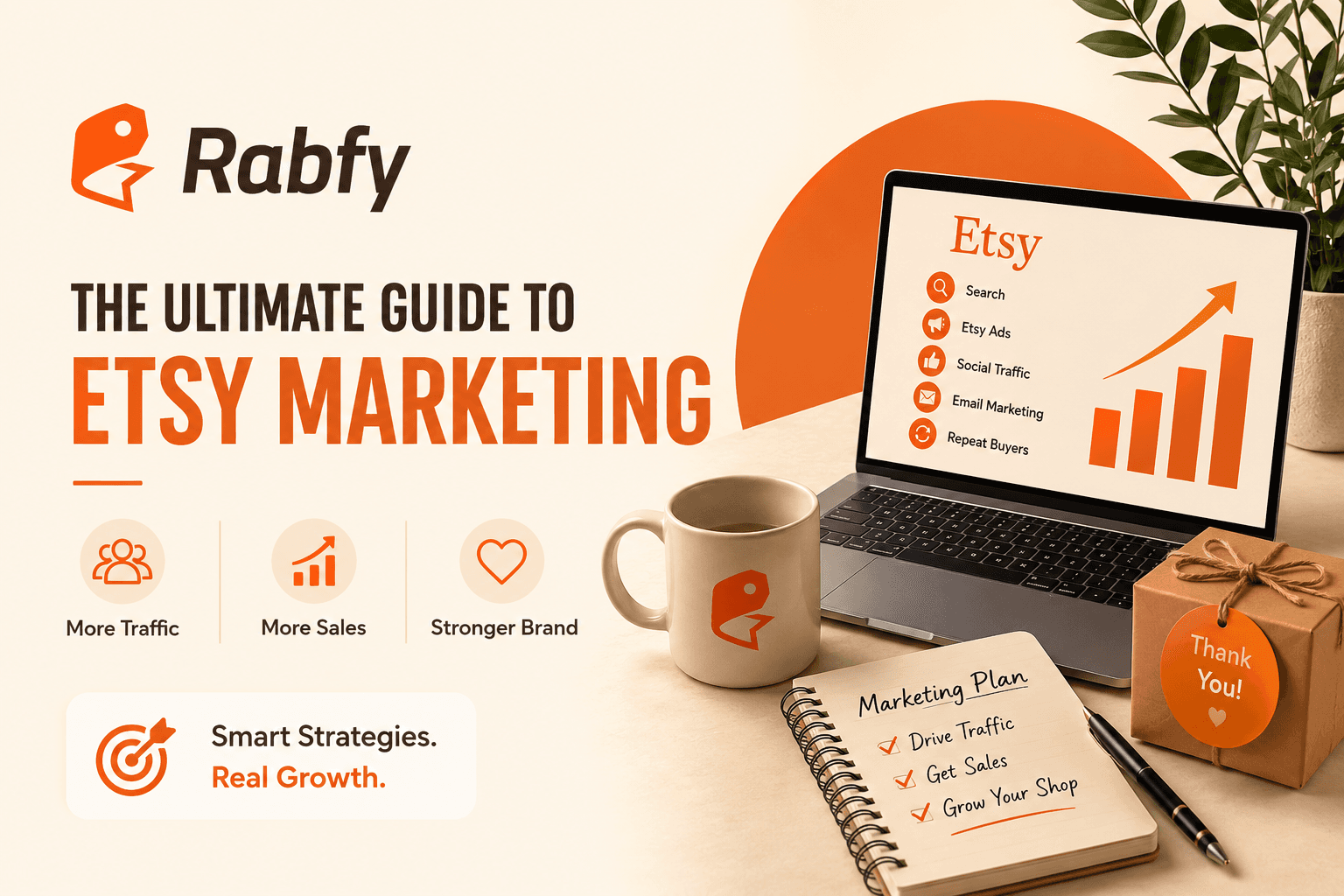
The Etsy traffic stack is five layers of demand, from the foundation upward: search, Etsy Ads, off-platform social traffic, email, and repeat buyers. Each layer adds reach the one below can't, and the higher layers are cheaper and more durable because they build on relationships rather than paid clicks. Building them in order is how a small shop grows steadily without a big budget.
Here's the stack, from foundation to peak:
Layer What it is Cost Durability Search Organic Etsy search ranking Free High, but capped Etsy Ads Paid promotion inside Etsy Pay per click Ends when you stop paying Social Traffic you drive from off-platform Time, mostly free Builds over time Email A list of buyers who opted in Very low High, you own it Repeat buyers Past customers buying again Lowest of all Highest
The logic of the stack is that each layer up is cheaper per sale and more durable than the one below. Paid clicks stop the moment you stop paying. A repeat buyer costs you almost nothing and may buy for years. So while most sellers obsess over the bottom two layers, the real opportunity for a small shop is climbing toward the top, turning one-time buyers into an audience you can reach again. We'll take each layer in turn.
Are Etsy Ads Worth It?
Etsy Ads (the on-platform paid promotion) are worth running once your listings already convert organically, but not before. Ads amplify a listing that sells; they only waste money on a listing that doesn't. Start small, watch your ACOS, and scale only what's profitable. The most common Etsy Ads mistake is using them to rescue a listing that was never going to convert.
Etsy Ads put your listings in promoted slots within Etsy search and browsing, and you pay per click. The key principle: ads don't fix a conversion problem, they multiply whatever your listing already does. If a listing converts well organically, putting ad spend behind it pours more traffic onto something that turns visitors into buyers, which is profitable. If a listing gets clicks but few sales organically, ads just pay for more clicks that also don't buy. So the sequence matters: get the listing converting first, then advertise it. Watch your ACOS (advertising cost of sales, the percentage of ad-driven revenue eaten by ad spend) and keep spending only where the return justifies it.
What Daily Budget Should You Start With?
Start with a small daily budget, enough to gather data without risking much, often just a dollar or a few dollars a day. The goal at first isn't sales volume, it's learning which listings respond profitably. Run a small budget for a couple of weeks, see which listings return more than they cost, then shift budget toward those winners and cut the ones losing money. Scaling a small, proven budget beats starting big and hoping.
Can You Opt Out of Etsy Offsite Ads?
You can opt out of Offsite Ads only if your shop has made under $10,000 in the trailing 365 days. Once you cross $10,000 in any 365-day period, participation becomes mandatory for the lifetime of the shop and cannot be turned off, though your fee drops from 15% to 12%. This is one of the most misunderstood, and most expensive to misunderstand, parts of Etsy marketing.
Offsite Ads are different from Etsy Ads. Etsy runs them on external platforms (Google, Facebook, Instagram, Pinterest, Bing), you don't set them up, and you pay only when someone clicks one and buys from your shop within 30 days. The fee is 15% of the order for shops under $10,000 in trailing sales, or 12% for shops above that, capped at $100 per order. Here's the part sellers must understand: below $10,000 you can opt out in Shop Manager under Settings, then Offsite Ads. But the moment you cross $10,000 in any 365-day window, you're locked in permanently, even if your sales later fall back below that line, and even prior opt-outs stop applying. For thin-margin products, that unavoidable 12% on attributed sales has to be priced in, which is one more reason to know your true margins, covered in our guide on POD pricing and profit margins.
Which Social Platform Works Best for Etsy Sellers?
Pinterest is generally the strongest social platform for Etsy sellers, because it functions as a visual search engine where people actively look for products and ideas to buy, and pins keep driving traffic for months. Instagram and short video help too, but Pinterest's buying intent and long content life make it the best fit. Choosing the right platform matters more than being on all of them.
The reason Pinterest fits Etsy so well is intent. People on Pinterest are searching and planning purchases (gifts, home decor, style), which is exactly the mindset of an Etsy buyer, and a single pin can keep sending traffic to your listing for months or years, unlike a social post that disappears in a day. Instagram and short-form video (Reels, TikTok) can work too, especially for showing your products in use or behind-the-scenes making, but they demand constant posting and content fades fast. For a small shop with limited time, concentrating on Pinterest usually returns more than spreading thin across every platform. Pick the one platform that fits your products and your time, do it consistently, and drive that traffic to your listings. This off-platform traffic has a bonus: sales you bring yourself from social aren't subject to Offsite Ads fees the way Etsy-driven external clicks are. Where audiences and buying behaviour are heading is worth tracking too, which we cover in our look at print-on-demand trends for 2026.
Can You Collect Customer Emails From Etsy? (Read This Carefully)
You may only add an Etsy buyer to your email list if they explicitly opt in and consent. Etsy's Seller Policy prohibits using the email address you receive for fulfilling an order to send unsolicited marketing, and bans using Etsy Messages for promotional spam. The compliant path is inviting buyers to join your list voluntarily, never harvesting their transaction email. This is where sellers following bad advice get into genuine trouble, so it's worth being exact.
Here's what Etsy's policy actually says, and it's stricter than a lot of "grow your email list" advice admits. When you fulfil an order, you receive the buyer's email address, but Etsy explicitly states that this information may only be used for Etsy-related communications about that transaction. You may not add that buyer to your marketing list without their consent, use Etsy Messages to send them promotions, or send them unsolicited commercial messages. Doing so violates Etsy's Seller Policy and can get your shop suspended. Etsy's updated policy also specifically prohibits offering discounts or incentives to buy through another website or channel, and directing off-platform transactions.
So what can you do? Build your list with genuine opt-in consent. The clean, compliant method is a thank-you insert card in the parcel, or a note, that invites the buyer to join your email list or follow you, so they choose to give you their email through your own signup, not through Etsy's transaction data. That's consent, and it's the difference between a legitimate email list and a policy violation. When in doubt, the rule is simple: the buyer must actively choose to hear from you off Etsy. Never assume the email Etsy gave you for shipping is yours to market to.
The Most Valuable Layer: Repeat Buyers
Repeat buyers are the cheapest and most durable growth a shop has, because a customer who already trusts you costs almost nothing to sell to again, unlike a new customer you pay to acquire. Turning first-time buyers into repeat buyers is the highest-return marketing most small shops ignore. It's the top of the traffic stack for a reason.
Every other layer is about reaching new people, which costs money or time. Repeat buyers flip that: someone who bought once, liked what they got, and had a good experience is far more likely to buy again, and far cheaper to reach, especially if they've opted into your list. The foundations of repeat business are unglamorous but powerful: a genuinely good product, reliable and fast delivery, and a smooth experience that makes buying from you again feel safe. A thank-you insert that invites a compliant opt-in, an occasional email to those who consented, and consistent quality do more for durable growth than any amount of ad spend. The deeper mechanics of retention, email flows, and lifetime value are covered in our guide on customer retention for POD brands, and it's worth reading once your shop has enough buyers to build on.
Frequently Asked Questions
Are Etsy Ads worth it? Yes, but only for listings that already convert well organically. Etsy Ads amplify whatever a listing already does, so putting spend behind a proven converter is profitable, while advertising a listing that gets clicks but few sales just pays for more non-buyers. Get the listing converting first, then advertise it, start with a small daily budget to learn which listings respond profitably, and scale only the winners while watching your ACOS.
What daily budget should I start with? Start small, often just a dollar or a few dollars a day, because the first goal is learning, not volume. A small budget over a couple of weeks shows you which listings return more than they cost. Then move budget toward those profitable listings and cut the ones losing money. Scaling a small proven budget is far safer than starting big and hoping it works out.
Can I opt out of Offsite Ads? Only if your shop has made under $10,000 in the trailing 365 days, in which case you can opt out in Shop Manager under Settings, then Offsite Ads. Once you cross $10,000 in any 365-day period, participation is mandatory for the lifetime of your shop and can't be turned off, though the fee drops from 15% to 12% (capped at $100 per order). Because crossing the threshold locks you in permanently, factor that unavoidable fee into your pricing as you grow.
Can I collect customer emails from Etsy? Only with the buyer's explicit opt-in consent. Etsy's Seller Policy says the email address you receive to fulfil an order may only be used for Etsy-related communication about that transaction, so you cannot add buyers to a marketing list or send them promotions without their consent, and you cannot use Etsy Messages for promotional spam. The compliant way to build a list is inviting buyers to join voluntarily, such as with a thank-you insert, so they choose to give you their email.
Which social platform works best for Etsy sellers? Pinterest is usually the strongest, because it works like a visual search engine where people actively look for products and gift ideas to buy, and a pin keeps driving traffic for months. Instagram and short-form video help for showing products in use, but they need constant posting and fade fast. For a small shop with limited time, focusing consistently on Pinterest generally returns more than spreading across every platform, and social traffic you drive yourself isn't charged Offsite Ads fees.
Key Takeaways
 Etsy search has a ceiling. Once you rank well and capture your share of keyword demand, growth requires traffic from beyond search.
- Build the traffic stack in order: search, Etsy Ads, social, email, repeat buyers. Each layer up is cheaper per sale and more durable than the one below.
- Run Etsy Ads only on listings that already convert, start with a small daily budget, and scale only what's profitable by ACOS.
- Offsite Ads are optional only under $10,000 in trailing sales; crossing that threshold locks you in permanently at a 12% fee, so price for it.
- Be strict about buyer contact: you may only email buyers who explicitly opt in, never the transaction email Etsy gives you, and never promotional spam through Etsy Messages. Repeat buyers, won through quality and consent, are your cheapest and most durable growth.
How Rabfy Helps
The top of the traffic stack, repeat buyers, rests entirely on something a fulfilment partner controls: whether the product and delivery are good enough that a buyer wants to come back. Rabfy protects that foundation. When your Etsy order sells, you place it with Rabfy, and it's produced and shipped from our US or UK warehouse fast, so the buyer gets a quality product quickly, which is exactly what earns the repeat purchase and the positive review that fuels every layer of the stack. A reliable product and fast delivery also mean fewer problems to resolve, so your marketing builds on trust rather than fighting complaints. Over 300 sellers currently fulfil through Rabfy across more than 50,000 orders, with a 0% return rate last Q4. Great marketing brings buyers once; a great product and delivery bring them back. Learn more on our features page.
Build a Shop Buyers Come Back To
You've got the traffic stack, the honest rules on ads and buyer contact, and the reason repeat buyers matter most. All of it rests on a product and delivery worth returning for. Create your free Rabfy account and build your shop on fast, reliable fulfilment, so your marketing earns repeat buyers instead of chasing new ones forever.
Abul Bashar Suman mentors Etsy sellers inside Rabfy's community and helps sellers grow past the search plateau without breaking Etsy's buyer-contact rules. This article reflects Etsy's policies as of August 2026; confirm current rules in Etsy's Seller Policy and Seller Handbook before acting.