Most struggling Etsy sellers have the process backwards. They spend hours creating a design they love, list it, and then wait for buyers who never come, because nobody was searching for it in the first place. The design was fine. The problem was that no demand existed for it, and no amount of design skill can sell a product that nobody wants. Product research flips the order: you confirm real demand first, then design for it. The good news is you can do this using Etsy's own free data, no paid tools required.
This guide gives you a five-signal framework for reading whether a product will sell, straight from what's visible on any Etsy search results page, plus a repeatable validation process and a way to test cheaply before committing. If you've read our guide on finding a profitable POD niche, this is the Etsy-specific, product-level companion to it: narrower, more concrete, and focused on Etsy's own signals. And if you haven't opened your shop yet, our guide on how to start an Etsy shop covers that setup first.
What Is Etsy Product Research?
Etsy product research is the practice of checking whether real demand exists for a product before you spend time designing it, by reading the demand and competition signals visible on Etsy itself. It's the difference between designing on a hunch and designing on evidence. Skipping it is the single most common reason new Etsy shops stall: they're full of lovingly made products that nobody was ever searching for.
The mindset shift is from "I'll make what I like and hope it sells" to "I'll find what sells and make my version of it." That doesn't mean abandoning your creativity. It means pointing your creativity at demand that already exists, so your effort has somewhere to land. Etsy quietly shows you an enormous amount about what's selling if you know what to look at, and the rest of this guide is about reading those signals. Research first, design second, and you stop pouring hours into products that were never going to find a buyer.
Can You Do Etsy Product Research Without Paid Tools?
Yes. You can validate demand using only Etsy's free, built-in signals: the search bar autocomplete, the "Most Popular" sort, the Bestseller badge, review counts, favourites, and your own Etsy Search Analytics. Paid tools speed this up, but they aren't required to start. This matters most for new sellers on a tight budget, who often assume real research needs a subscription. It doesn't.
Here's what Etsy gives you for free. The search bar's autocomplete shows real, popular searches as you type. The "Most Popular" sort and the orange Bestseller badge reveal which listings are actually selling. Review counts and favourites on each listing hint at sales history and interest. And inside your own Shop Manager, Etsy Search Analytics shows the exact queries bringing you impressions and clicks. Optional paid tools like the free tiers of EverBee or eRank can overlay estimated sales figures to speed things up, and they're worth trying, but the manual method using Etsy's own data is enough to validate a product properly. You are not blocked from good research by a lack of budget.
The Five Signals That a Product Will Sell
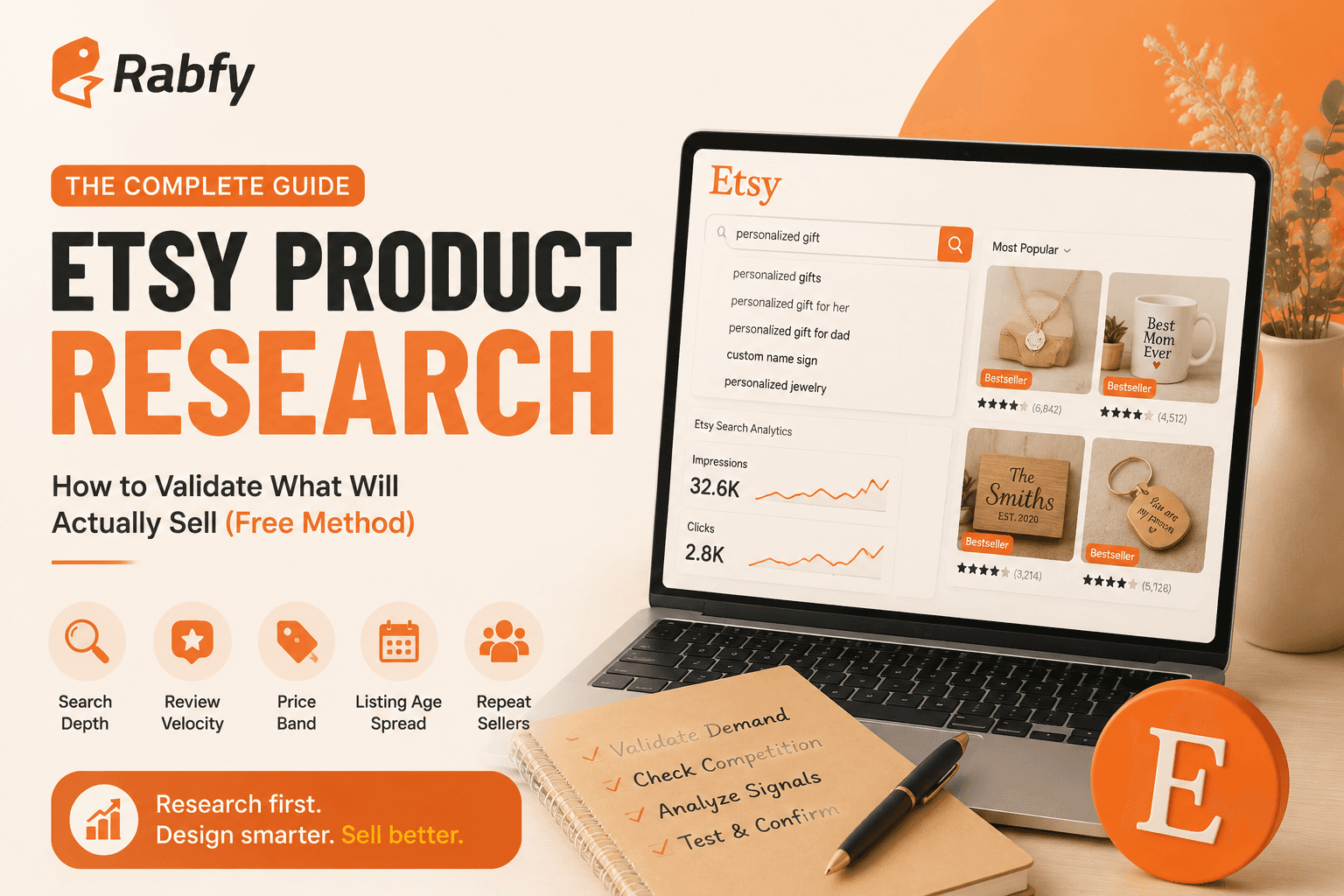
Five signals, all readable on a single Etsy search results page, tell you whether a product has real, winnable demand: search depth, review velocity, price band, listing age spread, and repeat sellers. Read together, they separate genuine demand from noise. No single signal is enough on its own, but together they give you a reliable picture before you design anything.
Here's each signal and what it tells you:
Signal What to look at What it tells you Search depth Autocomplete suggestions, results count Whether people actually search for this Review velocity Review counts and how recent they are Whether listings are genuinely selling now Price band The range similar products sell at What buyers will pay, and your margin room Listing age spread Mix of old and new listings ranking Whether the niche is stable or newly viable Repeat sellers Same shops appearing across results Whether a proven, workable market exists
Signal 1: Search Depth
Search depth tells you whether real people look for this product. Type your product idea into Etsy's search bar and watch the autocomplete: those suggestions are real, popular searches, so if Etsy suggests specific variations of your idea, demand exists. Then look at how many results the search returns. The autocomplete confirming your phrase is a strong early green light; an idea Etsy doesn't even suggest is a warning that few people search for it.
Signal 2: Review Velocity
Review velocity is the clearest free signal of genuine, current sales. A listing's review count reflects its history, but recent reviews matter more, because they show the listing is selling now, not that it sold two years ago. Etsy hides exact sales numbers, so reviews are your best public proxy. A niche where top listings show steady recent reviews has proven, active buyers. A niche where the top listings' reviews are all old may be fading.
Signal 3: Price Band
The price band shows you what buyers actually pay and whether there's room for your margin. Scan the prices of the well-selling listings in your niche and note the range. This tells you two things: the price buyers accept for this product, and whether you can produce and sell it profitably inside that band. If everything sells at $18 and your costs won't allow a profit there, that's a red flag worth knowing before you design, not after. Our guide on POD products that sell lists realistic base-cost and retail ranges by product type to check your margin against.
Signal 4: Listing Age Spread
Listing age spread reveals whether a niche is stable or freshly opening up. Look at the mix of listings ranking well: are they mostly long-established, or is there a spread including newer shops that have broken in? A healthy niche shows that newer listings can still rank and sell, which means there's room for you. A niche where only years-old listings dominate, with no newcomers succeeding, is harder to enter.
Signal 5: Repeat Sellers
Repeat sellers, the same shops appearing again and again across your search, tell you a real, workable market exists. When several shops have built their businesses around a niche, that's proof the niche sustains sellers, not just occasional sales. It also shows you your real competition and lets you study what the successful shops do well. Some strong repeat sellers is a healthy sign; a niche with no established sellers at all sometimes means no real demand.
How Do You Judge Etsy Competition?
Judge competition by looking at both how many listings compete and how strong they are, not just the raw count. A niche with proven sales but beatable listings (where you can clearly do better on design, photos, or specificity) is an opportunity, while one dominated by many excellent established listings is harder. The goal isn't zero competition, which usually signals no demand, but competition you can realistically win against.
Raw listing count alone misleads. A search returning tens of thousands of results sounds saturated, but if those listings are mostly generic and none serve a specific sub-audience well, there's an opening for a sharper, more specific product. Conversely, a niche with fewer listings that are all excellent and highly reviewed is genuinely tough. So look past the number and ask: are the top listings actually good, or just early? Is anyone serving a specific slice of this audience, or are they all generic? Category context matters too, since a "bestseller" in one category might mean hundreds of monthly sales and in another just a handful. Reading competition well is a skill our guide on finding a profitable niche develops further.
What Does a Healthy Listing Look Like?
A healthy Etsy listing, the kind worth learning from, shows steady recent reviews, a complete and keyword-rich title and tags, multiple strong photos, a competitive price, and often a Bestseller badge or "Most Popular" placement. These signals together mean the listing is genuinely selling. Learning to spot one teaches you both what demand looks like and what standard you'll need to match.
When you find a listing hitting these marks, study it. Recent reviews prove current sales. A thorough, searchable title shows it's optimised to be found, which our guide on Etsy SEO explains in depth. Multiple clear photos and a price in line with the niche show it's built to convert. A Bestseller badge or top placement under "Most Popular" confirms Etsy itself sees it selling well. A healthy listing isn't just a competitor; it's a free lesson in exactly what it takes to sell in that niche, and a benchmark for the product you're about to design.
Your Five-Step Validation Process
Here's the repeatable process, using only Etsy's free data. Run every product idea through it before you design.
Step 1: Confirm the Search Exists
Type your idea into Etsy's search bar and read the autocomplete. If Etsy suggests your phrase and specific variations of it, real demand exists. If it suggests nothing close, rethink the idea.
Step 2: Check for Proven, Recent Sales
Sort results by "Most Popular" and look for recent reviews and Bestseller badges on the top listings. Recent review activity is your proof that products in this niche are selling now, not just historically.
Step 3: Read the Price Band and Your Margin
Note the price range of the well-selling listings, and check that you can produce and sell your version profitably inside it. If the margin isn't there, find out now.
Step 4: Judge the Competition Honestly
Look past the raw listing count. Are the top listings beatable on design, photos, or specificity? Is any sub-audience underserved? Decide whether you can realistically win a place in the results.
Step 5: Test Small With Real Listings
Once a niche passes, put a few real listings live and let Etsy tell you the truth. Views, favourites, and sales on real listings are the final validation, and because print-on-demand has no inventory cost, this test is nearly free.
How Many Products Should You Test at Once?
Test a small batch of several products at once, typically three to five, rather than betting everything on one or spreading across dozens. A small batch gives you enough data to compare while keeping each product properly made and the workload manageable. The right number balances real signal against spreading yourself too thin.
One product gives you no comparison and no fallback if it flops. Twenty products means none get your full attention, and you can't tell what's working. A focused batch of three to five, each validated through the five signals and made properly, lets you see which gains traction and double down on the winner. Because POD carries no inventory cost, testing several is cheap: you invest design time, not stock. Launch the batch, watch the data for a few weeks, keep what sells, and drop or rework what doesn't.
How Long Should a Test Run?
Give a test batch a few weeks before judging it, long enough for Etsy's new-listing visibility boost to run its course and for real search traffic to find your listings. Judging in the first few days measures nothing, because new listings behave differently from settled ones. Patience here prevents you from killing a good product too early or trusting a temporary spike.
New Etsy listings get a temporary visibility boost that then fades, so a listing's first few days aren't representative of how it'll perform long-term. Give each test a few weeks so you can see how it does once the boost ends and it ranks on its own merits. Watch the sequence: are you getting impressions (people seeing it), then clicks (people interested), then favourites and sales (people buying)? Where the drop-off happens tells you what to fix. A product getting impressions but no clicks may need better photos or price; clicks but no sales may need a stronger listing. Give it time, read the funnel, then decide.
Frequently Asked Questions
Can I do product research without paid tools? Yes. Etsy's own free signals are enough to validate a product: the search bar autocomplete shows real searches, the "Most Popular" sort and Bestseller badge reveal what's selling, review counts and favourites indicate sales history and interest, and your Shop Manager's Etsy Search Analytics shows the queries bringing you traffic. Paid tools like the free tiers of EverBee or eRank speed things up by estimating sales figures, but they're optional, not required to research properly.
How do I judge competition? Look at both how many listings compete and how strong they are, not just the count. A high number of generic listings with no one serving a specific sub-audience is an opportunity; a smaller number of excellent, heavily reviewed listings is tougher. Ask whether the top listings are actually good or just early, and whether any specific slice of the audience is underserved. You want beatable competition, not zero competition, since no competition often means no demand.
What does a healthy listing look like? A healthy, genuinely selling listing shows steady recent reviews, a complete keyword-rich title and tags, multiple strong photos, a price competitive for its niche, and often a Bestseller badge or top "Most Popular" placement. When you find one, study it, since it teaches you both what demand looks like and the standard your product will need to meet to compete.
How many products should I test at once? Test a focused batch of about three to five products rather than one alone or dozens at once. That range gives you enough to compare and a fallback if one flops, while keeping each product properly made. Because print-on-demand has no inventory cost, testing several is cheap, so you invest design time rather than money, then double down on whichever gains traction.
How long should a test run? Give each test a few weeks. New Etsy listings get a temporary visibility boost that fades, so the first few days don't reflect long-term performance. A few weeks lets you see how a listing does once it's ranking on its own merits, and lets you read the funnel from impressions to clicks to sales, so you can tell whether a product needs fixing or dropping rather than judging it too early.
Key Takeaways
 Research before you design. Most stalled Etsy shops are full of well-made products nobody was searching for, which no design skill can fix.
- You can validate demand with Etsy's free data alone: autocomplete, "Most Popular" sort, Bestseller badges, reviews, favourites, and Etsy Search Analytics. Paid tools are optional.
- Read five signals together: search depth, review velocity, price band, listing age spread, and repeat sellers. No single one is enough alone.
- Judge competition by quality, not just count. Many generic listings with no specific sub-audience served is an opportunity; a few excellent ones is harder.
- Test three to five validated products for a few weeks each, since POD makes testing nearly free, and let real impressions, clicks, and sales decide what to keep.
How Rabfy Helps
The final step of validation, testing real listings, only works cheaply because print-on-demand carries no inventory cost, and that's exactly what Rabfy provides. You validate a product with Etsy's free signals, design your version, list it, and only when a customer buys do you place the order with Rabfy to produce and ship from our US or UK warehouse. Testing five validated products costs you design time, not stock, so a product that flops costs you nothing but hours, and a winner scales with no inventory to catch up on. Fast, reliable fulfilment also protects the recent-review velocity that signals a healthy listing, since happy buyers leave the reviews that prove your product sells. Over 300 sellers currently fulfil through Rabfy across more than 50,000 orders, with a 0% return rate last Q4. Learn more on our features page.
Test Five Products Free, No Inventory Required
You've got the five signals, the validation process, and the free Etsy data to run it. The last step is testing your validated ideas for real, which costs nothing but design time when there's no inventory to buy. Create your free Rabfy account and turn your validated products into live listings this week.
Abul Bashar Suman mentors Etsy sellers inside Rabfy's community and helps sellers validate demand before they spend hours designing products the market was never searching for.