Opening an Etsy shop takes about twenty minutes. Understanding what you actually signed up for takes a lot longer, and that gap is where most first-time sellers get stuck. They open a shop, list a few products, watch a fee they didn't expect eat into their first sale, and lose momentum before they've even found out whether their products can sell.
This guide walks through the setup itself, but more importantly, it covers the parts that don't show up in Etsy's own onboarding flow: which countries can actually get paid, what a $25 sale really costs once every fee lands, and the one compliance step that causes most new print-on-demand shops to get flagged in their first month. If you're still deciding whether print-on-demand is the right model for you at all, our complete guide to print-on-demand covers that decision from the ground up. This one assumes you've made the call and picked Etsy.
Check Your Country's Eligibility Before You Do Anything Else
This is the step Etsy's own setup wizard buries, and it's the one that wastes the most time. Etsy Payments, the platform's built-in payment processor, is mandatory for new shops. You can't opt out of it and use PayPal instead the way sellers could years ago. If your country isn't on Etsy's eligible list, you cannot enroll in Etsy Payments, and without that enrollment, you cannot open a new shop.
Etsy Payments currently covers most of North America, the EU, the UK, Australia, and a growing list of countries where Etsy has partnered with Payoneer to handle payouts, including Pakistan, Egypt, Brazil, and several others added over the past two years. Bangladesh is not on that list. If you're building this shop from Dhaka, Chattogram, or anywhere else in Bangladesh, the honest answer is that a direct Etsy shop isn't something you can open right now, regardless of how good your designs are. We've written a full breakdown of what that actually means and which routes to US and UK buyers are still realistic in Can't Open an Etsy Shop From Bangladesh? Here Are Your Real Options. Read that before you invest more time here if eligibility is a question mark for you.
If your country is supported, or you're setting this up through an entity that qualifies, the rest of this guide is your roadmap.
What You Need Before You Start
Etsy's signup form itself asks for almost nothing. What actually determines whether your first week goes smoothly is what you have ready before you touch the form:
 A clear idea of what you're selling and to whom, even if it's a rough draft
- Product photos or design files, or a plan for how you'll get them (a POD platform like Rabfy handles this for physical mockups)
- A bank account or Payoneer account in an eligible country
- Basic identity documents for verification (Etsy asks for these before releasing your first payout)
- A shop name, or a shortlist of three or four options in case your first choice is taken
None of this needs to be perfect. It needs to exist, because half-finished shops with no policies and one blurry listing are exactly what struggles to convert.
Setting Up Your Etsy Shop, Step by Step
Step 1: Create Your Etsy Account
Sign up at etsy.com with an email address, Google account, or Apple account. This creates your buyer-facing Etsy identity first. Selling comes next.
Step 2: Start Your Shop and Set Your Preferences
From your account, select "Sell on Etsy" and choose your shop language, country, and currency. Your shop's country is tied to where you'll receive payments, so this has to match your actual eligible location, not where you'd like to be based.
Step 3: Choose Your Shop Name
Etsy shop names are four to twenty characters, no spaces, and must be unique across the entire platform. Popular words are usually taken, so have backups ready. Your shop name matters less for search ranking than most new sellers assume. Etsy's algorithm weighs your listing titles and tags far more heavily, so don't spend a week agonizing over this one decision.
Step 4: Set Up Billing and Etsy Payments
This is where the eligibility check from earlier becomes real. You'll enter your bank details (or connect Payoneer, if that's your route) and provide the identity verification Etsy requires before it releases funds. Etsy also asks for a backup card on file to cover fees if your shop balance runs negative, which can happen in a slow month if you're running Etsy Ads.
Step 5: Write Your Shop Policies
Shipping times, processing times, returns, and exchanges. If you're using a production partner (more on that below), your processing time needs to reflect their real turnaround, not a guess. Promising 2-day shipping and then taking 8 days to produce the order is one of the fastest ways to tank your seller ratings in month one.
Step 6: Create Your First Listings
Title, photos, description, price, and tags for each product. This is the part sellers rush most and regret it fastest. A single listing published in ten minutes with a generic title and one photo will not get found. We go deep on getting this right in our Etsy SEO guide, but the short version: your title should read like something a real buyer would type into search, not a product name you invented.
What Etsy Actually Charges
This is the part most beginner guides gloss over, and it's exactly why sellers get blindsided. Etsy's fees are not one number. They stack, and on a lower-priced item, they add up faster than people expect.
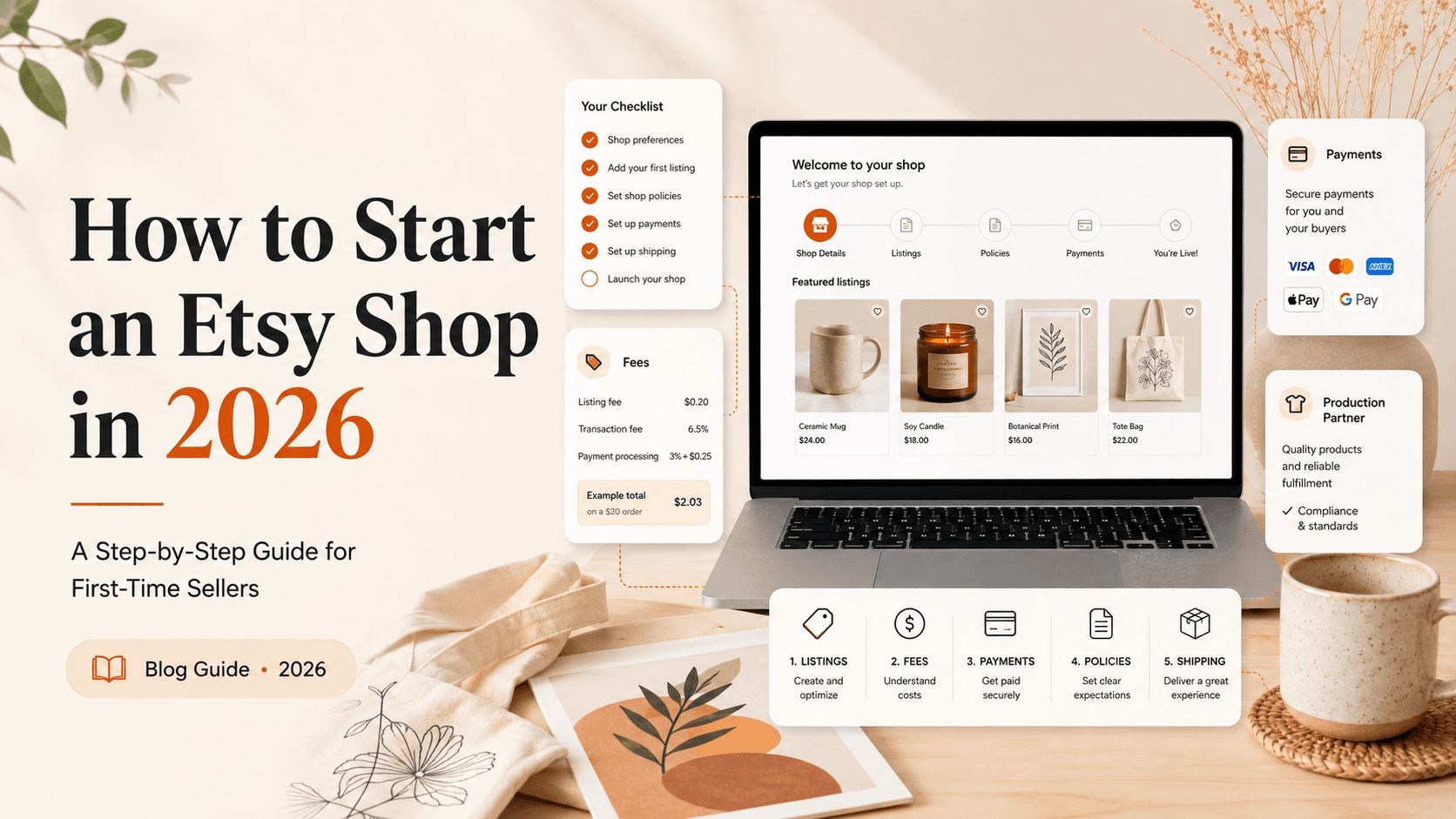
Here's what a $24.99 item with $4.99 shipping actually costs in fees, assuming a US-based Etsy Payments account:
Fee Amount What it's for Listing fee $0.20 Charged when you publish a listing, and again automatically each time it sells Transaction fee (6.5%) $1.95 Etsy's commission, calculated on item price plus shipping Payment processing (3% + $0.25) $1.15 Handling the actual payment; the percentage varies by country Subtotal, every seller pays this $3.30 (~11%) Unavoidable on every sale Offsite Ads (12-15%), if attributed $3.75-$4.50 Only applies once a shop crosses $10,000 in trailing 12-month sales, and it becomes mandatory at that point
So a typical sale costs somewhere around 11% in unavoidable fees, and can climb toward 25-28% once a shop is large enough to be auto-enrolled in Offsite Ads. Payment processing rates differ outside the US, and sellers using Payoneer for payouts should check their specific rate rather than assume the US figure applies. None of this is a reason to avoid Etsy. It's a reason to price your products with the full fee stack in mind from day one, instead of discovering it after your first ten sales feel smaller than they should. We cover full pricing math, including how these fees interact with your product cost and ad spend, in POD Pricing and Profit Margins: The Honest Arithmetic.
If You're Selling Print-on-Demand, There's One More Step
Etsy has never banned print-on-demand. That rumor circulates constantly because sellers get their listings deactivated and assume POD itself is the problem, when the actual cause is almost always one specific, fixable issue: they never disclosed their production partner.
Under Etsy's current Seller Policy, anyone using an outside company to produce their products, which includes any POD fulfillment platform, is required to name that partner in their shop's production partner settings. This isn't buried admin work. It's a public disclosure that tells Etsy and buyers who actually makes the item. Skip it, and you're operating outside policy even if your designs are completely original.
There are two other failure points that get lumped in with "POD is banned" complaints: designs that don't meet Etsy's originality standard (a purchased template or stock clip-art doesn't qualify as "designed by a seller," even with a commercial license), and undisclosed use of AI-generated artwork. All three of these are compliance issues, not POD bans, and all three are avoidable. We've broken down exactly how to handle disclosure, prove originality, and stay compliant in Etsy Print-on-Demand Rules 2026: Disclosure, Originality & AI. If you're running POD on Etsy, read that one next.
How Many Listings Should You Start With
There's no magic number, but launching with one or two listings and waiting to see what happens is the single most common reason new shops stall. A one-listing shop gives Etsy's search algorithm almost nothing to match against, and gives you no way to tell whether the problem is your product, your price, or your photos.
Sellers who gain traction faster tend to launch with a broader spread from the start, usually a handful of different product types or design variations rather than one item in five colors. That breadth does two things: it gives you real signal on what's actually selling, and it gives Etsy's search more surface area to index. If you're not sure which products are worth designing for in the first place, our guide on Etsy Product Research: Validate Before You Design walks through validating demand before you spend time on artwork nobody's searching for.
Mistakes That Slow Down a New Shop
A few patterns show up again and again in shops that struggle in their first month:
Pricing from a competitor's storefront instead of your own costs. Seeing a similar product listed at $22 and matching it, without knowing your own base cost, shipping, and fee stack, is how sellers end up working for less than minimum wage on every sale.
Processing times that don't match reality. A 1-3 day promise when your actual production partner needs 4-5 days sets you up for late shipments and damaged ratings before you've sold ten items.
Thin, unedited listing descriptions. Etsy's search rewards complete, keyword-relevant listings. A three-sentence description with no sizing, materials, or care information underperforms a thorough one, even at identical price and photos.
Skipping the production partner disclosure. Covered above, and worth repeating: this single step is behind a large share of the "why was I deactivated" panic in Etsy's seller community.
Treating shop policies as boilerplate. Buyers read return and shipping policies before their first purchase from a new shop far more often than sellers assume. Vague or missing policies cost trust you haven't earned yet.
Building Toward Star Seller Status
Once your shop has been making sales for a while, Etsy's Star Seller badge becomes worth aiming for. It's not required, but it's a visible trust signal next to your shop name in search results, and Etsy has confirmed it factors into your shop's ranking. To qualify, your shop needs, over a rolling three-month window: a 95% or higher response rate to first buyer messages within 24 hours, 95% or higher on-time shipping with valid tracking, an average rating of 4.8 or above, at least five completed orders, and a minimum of $300 in sales. Etsy reviews eligibility on the first of each month, and you become eligible starting 90 days after your first sale.
None of that is achievable on day one, and that's fine. What it does tell you is that the habits worth building from your very first sale (fast replies, honest processing times, real tracking numbers) are the same habits that earn the badge later. Building them into your workflow from the start is easier than retrofitting them after a slow month.
Getting found in the first place is its own separate skill. Once your shop is live, our Etsy SEO guide covers how Etsy's search actually ranks listings, and it's worth reading before you assume a quiet first week means your products aren't wanted.
Your Etsy Launch Checklist
Before you flip your shop from draft to live, run through this:
- [ ] Confirmed your country is Etsy Payments eligible, or you have a working alternative
- [ ] Identity verification submitted and approved
- [ ] Shop name chosen and available
- [ ] Shipping and processing times set to match your real production turnaround
- [ ] Return and exchange policy written, not left blank
- [ ] Production partner added and disclosed, if you're using one
- [ ] At least five to ten listings published, not just one
- [ ] Each listing has a keyword-researched title, multiple photos, and a full description
- [ ] Pricing calculated from your actual costs and fees, not a competitor's price
- [ ] A plan for the first message you get from a buyer (response templates save time later)
Frequently Asked Questions
How much does it cost to open an Etsy shop? Opening a shop itself is free. Your first cost is the $0.20 listing fee per item, charged when you publish and again each time it sells. Beyond that, fees are transaction-based (6.5% per sale plus payment processing), so there's no upfront investment required to get a shop live.
Which countries can open an Etsy shop? Any country where Etsy Payments is available, which covers most of North America, the EU, the UK, Australia, and a growing list of countries served through Etsy's Payoneer partnership. Bangladesh is currently not on that list, which means new shops can't be opened directly from there. See our guide on selling to US buyers from Bangladesh for the realistic alternatives.
Can I sell print-on-demand products on Etsy? Yes. Etsy explicitly allows print-on-demand, provided you disclose your production partner in your shop settings, your designs meet Etsy's originality standard, and you disclose any AI-generated artwork. The deactivations sellers blame on "POD being banned" almost always trace back to one of those three requirements being missed, not POD itself being disallowed.
How many listings should I start with? More than one or two. A broader initial catalogue, ideally a handful of distinct products rather than color variations of a single item, gives you real data on what sells and gives Etsy's search more to index. There's no fixed minimum, but shops that launch thin tend to stall longer than shops that launch with breadth.
Do I need a business licence to open an Etsy shop? Etsy itself doesn't require a registered business to open a shop; you can start as an individual seller. Whether your own country requires you to register as a business or report the income is a separate, local question, and it's worth confirming with a tax or business professional rather than guessing, since the answer varies by country and by how much you're earning.
Key Takeaways
- Etsy Payments is mandatory for new shops, and country eligibility is the first thing to confirm, not an afterthought.
- Expect roughly 11% in unavoidable fees on a typical sale (listing, transaction, and payment processing combined), rising toward 25-28% once Offsite Ads become mandatory at $10,000 in trailing annual sales.
- If you're running print-on-demand, disclosing your production partner is the single most important compliance step, and skipping it is the most common cause of deactivation.
- Launch with a real spread of listings, not one or two, and price from your actual costs rather than a competitor's storefront.
- Star Seller status, shop policies, and processing-time accuracy all compound over time. The habits that earn trust in month one are the same ones that earn the badge later.
How Rabfy Helps
Everything above assumes you're producing and shipping your own inventory, or figuring that part out separately. Rabfy removes that half of the equation. Rabfy is your production partner, which also makes your Etsy production-partner disclosure straightforward: when one of your listings sells, you place that order with Rabfy, and we print and ship it from our US and UK warehouses within 24-48 hours, then hand you the tracking to add to your Etsy order. There's no inventory to buy and no minimum order to hit. Over 300 sellers currently run their shops this way, across more than 50,000 fulfilled orders, with a 0% return rate last Q4. It's free to start, and it's built specifically so the "processing time" line in your Etsy shop policies is a promise you can actually keep.
Start Fulfilling With Rabfy
You've got the setup steps, the real fee numbers, and the compliance checklist. The next move is making sure fulfillment doesn't become the part that slows you down. Create your free Rabfy account and hand off production and shipping while you focus on what actually grows a shop: better listings, better products, and buyers who come back.
Abul Bashar Suman mentors Etsy sellers inside Rabfy's community and works directly with sellers setting up and troubleshooting their first Etsy shops.