You've filled in your titles, added your tags, maybe run a few ads, and your listings still sit where buyers never scroll. The frustrating part is that Etsy SEO advice from two years ago is still everywhere, and a lot of it now actively works against you. Renewing listings daily, stuffing the same keyword into all thirteen tags, treating ads as a ranking shortcut: these were never great, and in 2026 they range from useless to harmful.
This guide explains how Etsy search actually decides what to show, in the order the algorithm applies it, and gives you a repeatable process to work through your own listings. It also covers the ranking factor almost no other guide mentions: your service performance. Dispatch speed, cancellation rate, and how you handle buyers feed directly into where your listings appear. If you haven't set up your shop yet, start with our guide on how to start an Etsy shop. If you have listings but no traffic, you're in the right place.
What Is Etsy SEO?
Etsy SEO is the practice of optimising your listings so Etsy's search algorithm shows them to the right buyers. It has two distinct halves that most sellers blur together: getting your listing into the pool of results a search can return at all, and then ranking well inside that pool. The first half is about matching words. The second half is about proving your listing will sell.
Get this distinction wrong and you optimise the wrong thing. A listing can have flawless keywords and still sink, because keywords only decide whether you're eligible to appear, not how high. The sellers who stay stuck are usually the ones who keep polishing tags when their real problem is that nobody clicks or buys once they do appear.
How Does Etsy Search Actually Work in 2026?
Etsy search runs in two stages: relevance decides which listings can appear for a search, then ranking orders them by how likely each one is to sell. Understanding which stage your problem lives in is the single most useful thing in this entire guide, because the fixes are completely different.
In the first stage, Etsy scans your title, tags, categories, and attributes for the words the shopper typed. If none of those fields contain the search phrase, your listing never enters the running, full stop. In the second stage, Etsy takes every listing that matched and sorts them, predicting which one that specific shopper is most likely to buy based on how listings have performed before.
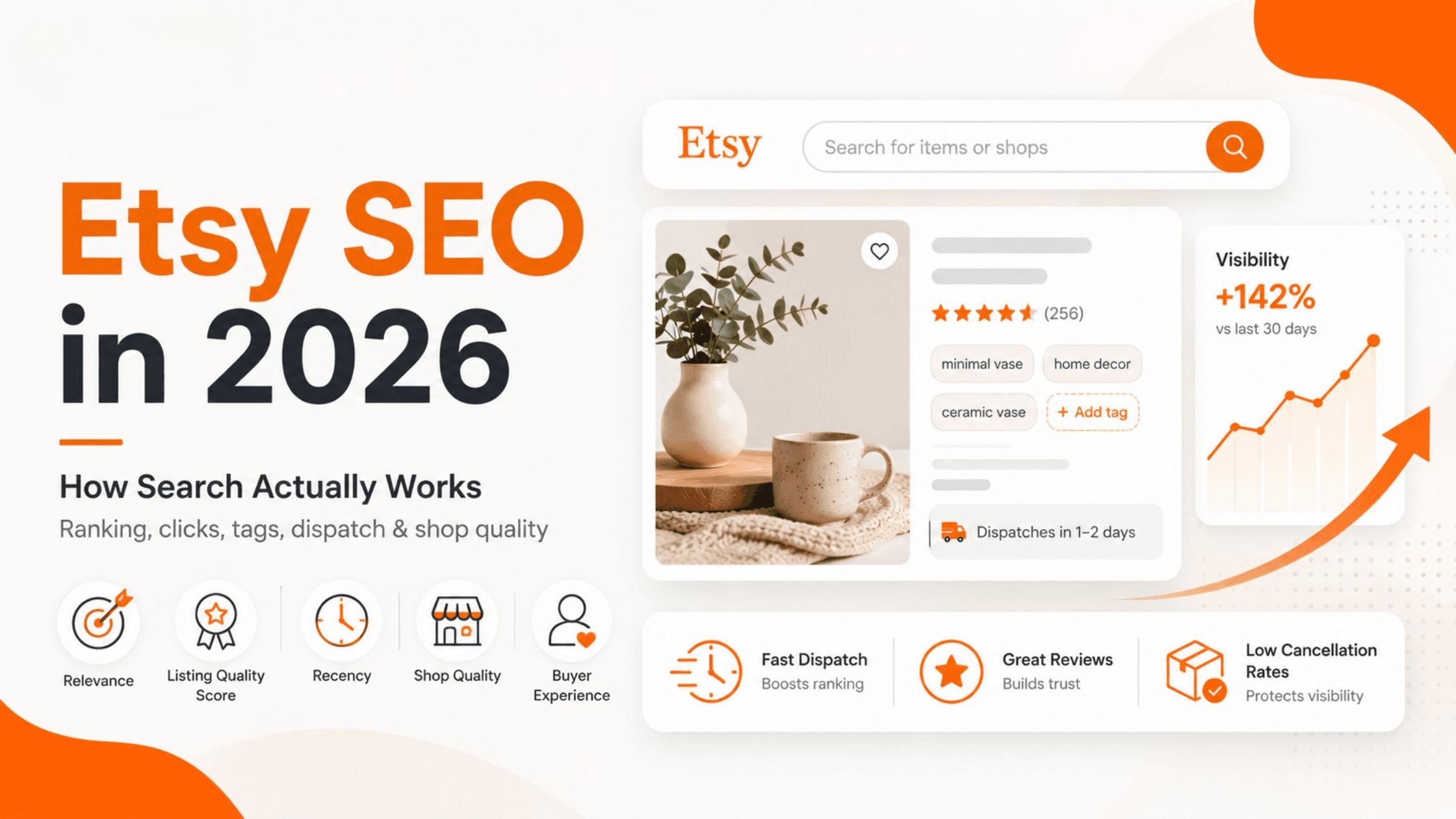
The five factors below are what Etsy weighs, roughly in the order that matters. Here they are at a glance before we take each one apart.
Factor What it covers Which stage Relevance Title, tags, categories, attributes matching the query Eligibility Listing quality score Click, favourite, add-to-cart, and purchase rates Ranking Recency Temporary boost for new and renewed listings Ranking Shop quality Star Seller, reviews, dispatch, response, case rate Ranking Buyer experience Pricing, shipping, complete attributes Ranking
Relevance: Getting Into the Race
Relevance is Etsy matching the buyer's search words against your title, tags, categories, and attributes. This is the gatekeeper. No match, no appearance, no matter how good your product is. Your title carries the most weight here, and Etsy front-loads it, so your main search phrase should land inside the first forty characters rather than buried at the end after a string of adjectives.
For example, a listing titled "Handmade Gift Cute Boho Sunset Wave Retro Vintage T-Shirt" wastes its most valuable position on vague words. "Retro Surf Sunset T-Shirt, Vintage Beach Wave Tee" leads with the phrase a buyer actually types. Etsy's search now reads context and meaning, not just isolated keywords, so a title a human would want to click beats a title crammed with every word you could think of.
Listing Quality Score: Why You Sink After Getting In
Your listing quality score is Etsy's read on how shoppers behave when your listing appears: whether they click it, favourite it, add it to cart, and buy. This is where perfectly keyworded listings quietly die. Etsy shows your listing to some buyers, watches what they do, and adjusts. Strong engagement lifts you. Being shown and ignored drops you.
For 2026, Etsy also weighs dwell time, meaning how long a shopper stays on your listing after clicking. A shopper who clicks and bounces in two seconds signals the listing wasn't what they wanted. One who stays to read the description or watch a video signals the opposite. That makes your first photo, your title, and your price the levers for the click, and your description, photos, and reviews the levers for what happens after. Your first image is doing more work than any other single element on the page, because it decides whether the click ever happens.
Recency: The New-Listing Boost
Etsy gives new listings a temporary visibility boost for roughly two to four weeks, and a smaller, shorter boost when you renew an existing one. This exists so new sellers can compete against established shops with years of sales history. It's real, but it's a window, not a strategy. The boost fades, and what you're left with is your quality score and relevance.
This is where the old "renew daily" advice goes wrong. Renewing gives a small, brief bump, but if the listing isn't built to convert, the bump fades fast and you've paid a renewal fee for nothing. Worse, renewing aggressively every day can trip spam signals. Publishing genuinely new listings on a steady schedule earns the boost honestly and gives Etsy more of your shop to test.
Shop Quality and Service: The Factor Nobody Talks About
Etsy folds your shop's service performance directly into search ranking: your Star Seller status, review score, on-time dispatch rate, message response time, and case rate over the trailing three months. This is the differentiator most Etsy SEO guides skip entirely, and it's the one that connects fulfilment to visibility in a way that matters enormously for print-on-demand sellers.
Read that list again, because three of those five signals have nothing to do with keywords and everything to do with operations. On-time dispatch. Cancellation and case rate. Response time. If your production runs late, if you cancel orders you can't fulfil, if a buyer opens a case and it goes against you, Etsy reads those as evidence your shop is a riskier bet to show, and it shows you less. You can have textbook SEO and still lose ranking because your shipping is unreliable. We come back to what this means for POD sellers specifically at the end.
Buyer Experience: The Tiebreakers
Buyer experience covers the signals that make a listing more likely to convert once seen: competitive pricing, shipping cost and speed, and complete listing attributes. These act as tiebreakers and quality inputs rolled together. Etsy wants to show listings that turn into sales, and price and shipping are two of the biggest reasons a buyer does or doesn't complete a purchase.
Completing every relevant attribute (colour, size, material, occasion, recipient) does double duty here. Attributes help you match more searches in the relevance stage, and they reassure buyers in the conversion stage. Leaving them blank is leaving both visibility and trust on the table.
Do Etsy Ads Affect Your Organic Ranking?
No. Etsy has confirmed that running Etsy Ads does not change where your listings appear in organic search results. Ads occupy separate, designated ad slots. Your organic position is earned through relevance and conversion signals, not ad spend. Paying for ads will not lift your free ranking, and pausing ads will not sink it.
This matters because a lot of struggling sellers pour money into ads expecting it to fix an organic visibility problem. It won't. If your listings don't convert, ads just pay to show a listing that still doesn't convert. Fix the listing first. We cover when ads actually make sense, alongside off-platform traffic and repeat-buyer tactics, in Etsy Marketing Beyond Search.
How to Optimise an Etsy Listing, Step by Step
Here's the repeatable process. Run any underperforming listing through it in this order, because the order mirrors how Etsy itself evaluates the listing.
Step 1: Research the Words Buyers Actually Type
Start with the exact phrases real buyers search, not the words you'd use to describe your own product. Type your main keyword into Etsy's search bar and read the autocomplete suggestions, since those are real, popular searches. Etsy Search Analytics in your shop dashboard shows which queries already bring you impressions and clicks, which tells you what you're close to ranking for. Designing products around validated demand beats guessing, which is the whole subject of our guide on Etsy product research.
Step 2: Write a Title a Human Would Click
Put your primary search phrase in the first forty characters. Keep the whole title readable and ideally under about seventy characters of core content, because long titles get cut off on mobile, and by Etsy's own data a large share of purchases now happen in the app. Lead with the noun. Two or three real search phrases woven into a natural title beat a wall of stacked keywords.
Step 3: Use All Thirteen Tags, Each One Different
Fill every one of the thirteen tag slots, and make each a distinct multi-word phrase. The most common tag mistake is repeating the same root word across several tags, which doesn't expand your reach, it wastes slots. If "sunset t-shirt" is already in your title, your tags should chase different phrases: "beach lover gift," "retro surf tee," "vintage wave shirt." Each unique tag is another phrase you can rank for.
Step 4: Complete Every Attribute and Category
Select the most specific category available and fill in every attribute Etsy offers for your product type. These feed the relevance stage and the buyer-experience stage at once. A fully completed listing is eligible for more searches and reads as more trustworthy than a half-finished one.
Step 5: Lead With a Click-Worthy First Photo
Your first image decides your click-through rate, and click-through rate feeds your quality score. Use a clean, clear main image that reads well as a thumbnail on a small screen. Fill the remaining image slots with different angles, scale references, and context, and add a video if you can, since video gives shoppers a reason to stay on the page and lift your dwell time.
Step 6: Write a Description That Earns the Sale
The opening lines of your description carry light SEO weight, so lead with your product and its main keyword phrases in natural language. Then write for the human: sizing, materials, care, what makes it a good fit. A thorough description improves conversion, and conversion is what holds your ranking once the recency boost fades.
Step 7: Protect Your Service Metrics
This step happens after publishing, but it's part of SEO now. Dispatch on time, keep your processing times honest, respond to messages quickly, and avoid cancellations. Every one of those protects the shop-quality signals that feed your ranking. This is the step sellers forget is even part of SEO, and it's the one covered least anywhere else.
Why Did My Etsy Views Drop Suddenly?
A sudden overnight drop in Etsy views is usually caused by the end of a new-listing boost, an algorithm update, a recent listing edit being re-evaluated, or a seasonal or competitive shift, not by anything permanently broken. Views come from search, and search moves. Before you panic and change everything, work through the likely causes in order.
If your shop is newish and traffic fell off a cliff after a good couple of weeks, your new-shop or new-listing boost most likely ended, and you're now ranking on merit. If you recently edited titles or tags, Etsy re-evaluates edited listings for roughly two to four weeks, and a temporary dip during that window is normal. Etsy also updates its algorithm several times a year, and major updates can churn rankings shop-wide for a month or two while things settle. Add seasonal cycles, a wave of new competitors in your niche, or a drop in your external traffic, and most "overnight" drops have a findable, fixable cause.
The wrong response is to frantically rewrite every listing at once, because that resets them into the re-evaluation window and makes the drop feel worse. Change one thing, give it time, and watch the data.
What This Means for Print-on-Demand Sellers
Here's where the service-signal factor becomes decisive rather than academic. Three of Etsy's five ranking inputs (on-time dispatch, cancellation and case rate, and by extension Star Seller status) are fulfilment outcomes, not keyword choices. For a print-on-demand seller, that means your production and shipping reliability isn't separate from your SEO. It is part of your SEO.
Think about what that does to a seller running POD manually or through an unreliable supplier. A slow production run turns into a late dispatch. A stock or quality problem turns into a cancellation. Both feed straight into the shop-quality signal Etsy uses to decide how often to show your listings. You can do everything right on titles, tags, and photos and still lose ranking because fulfilment let you down. Getting your dispatch consistently fast and your cancellation rate near zero is one of the few SEO levers that also happens to be an operations decision.
Etsy SEO Checklist
Run each underperforming listing through this:
 [ ] Primary search phrase in the first 40 characters of the title
- [ ] Title readable, noun-led, core content roughly under 70 characters
- [ ] All 13 tags used, each a distinct multi-word phrase, no repeated root words
- [ ] Most specific category selected
- [ ] Every available attribute completed
- [ ] Clean, thumbnail-friendly first photo
- [ ] Remaining photo slots filled, plus a video if possible
- [ ] Description leads with the product and keywords, then covers sizing, materials, care
- [ ] Keywords sourced from real buyer searches, not seller jargon
- [ ] Processing time set to match real production speed
- [ ] A plan to dispatch on time and keep cancellations near zero
Frequently Asked Questions
Why did my Etsy views drop overnight? Most sudden drops trace back to a new-listing boost ending, an algorithm update, a recent edit being re-evaluated for a few weeks, or a seasonal or competitive shift. If your shop is new, a strong first couple of weeks followed by a sharp fall usually means your initial boost expired and you're now ranking on your listing's own merit. Work through those causes before rewriting anything, and change one thing at a time so you can see what actually moves.
How many tags should I use on Etsy? Use all thirteen. Each tag should be a distinct multi-word phrase, not a repeat of a root word you've already used. Filling every slot with a unique phrase gives you thirteen separate chances to match a buyer's search, while duplicating words wastes slots and doesn't expand your reach.
Do I need to renew listings to rank better? No. Renewing gives only a small, brief recency boost, and if the listing isn't built to convert, that boost fades quickly and you've paid a renewal fee for little return. Renewing aggressively every day can even trip spam signals. Publishing genuinely new listings on a steady schedule is a better use of the same effort.
Does shipping speed affect Etsy ranking? Yes, indirectly but significantly. Etsy factors on-time dispatch rate, cancellation and case rate, and response time into your shop quality score over a trailing three-month window, and shop quality feeds search ranking. Reliable, on-time fulfilment protects your visibility, while late shipments and cancellations quietly erode it.
How long before a new Etsy listing ranks? A new listing gets a temporary visibility boost for roughly two to four weeks while Etsy tests it with some traffic to gauge clicks and conversions. After that window, its position depends on how well it actually converted during the test plus its ongoing relevance and quality signals. Consistent listing and strong early engagement shorten the ramp.
Key Takeaways
- Etsy search works in two stages: relevance decides which listings can appear, and ranking orders them by likelihood to sell. Diagnose which stage your problem lives in before fixing anything.
- Keywords only get you into the pool. Your listing quality score, driven by clicks, favourites, add-to-carts, purchases, and now dwell time, decides how high you rank inside it.
- Etsy Ads do not affect organic ranking. Ads sit in separate slots, and paying for them will not lift your free position.
- Three of Etsy's five ranking factors are service signals: on-time dispatch, cancellation and case rate, and Star Seller status. Fulfilment reliability is part of your SEO.
- Sudden view drops usually come from an expiring boost, an algorithm update, a recent edit, or a seasonal shift. Change one thing at a time rather than rewriting everything at once.
How Rabfy Helps
The service signals that feed Etsy ranking are exactly where fulfilment reliability turns into visibility, and that's the part Rabfy is built to protect. When one of your Etsy listings sells, you place the order with Rabfy, and it's produced and shipped from our US or UK warehouse within 24 to 48 hours, which keeps your dispatch times fast and your processing-time promise honest. Fast, consistent dispatch and near-zero cancellations are precisely the shop-quality inputs Etsy rewards. Over 300 sellers currently fulfil through Rabfy across more than 50,000 orders, with a 0% return rate last Q4. There's no inventory to buy, no minimum order, and it's free to start. Your keywords get you into search. Reliable fulfilment helps keep you there.
Fix Your Listings, Then Protect Your Ranking
You've got the two-stage model, the five real ranking factors, and a step-by-step process to work through every listing. The last piece is making sure the service signals behind your ranking stay strong. Create your free Rabfy account and keep your dispatch fast while you focus on the titles, tags, and photos that get you found.
Abul Bashar Suman mentors Etsy sellers inside Rabfy's community and works directly with sellers optimising their listings and troubleshooting search visibility.