Every few months, the same panic spreads through Etsy seller groups: "Etsy is banning print-on-demand." It isn't true, and it never was. But the rumour survives because sellers really are getting listings deactivated, sometimes bestsellers that ran clean for a year, and when it happens, "Etsy banned POD" is an easier story to believe than the real one. The real one is more useful, because it's fixable.
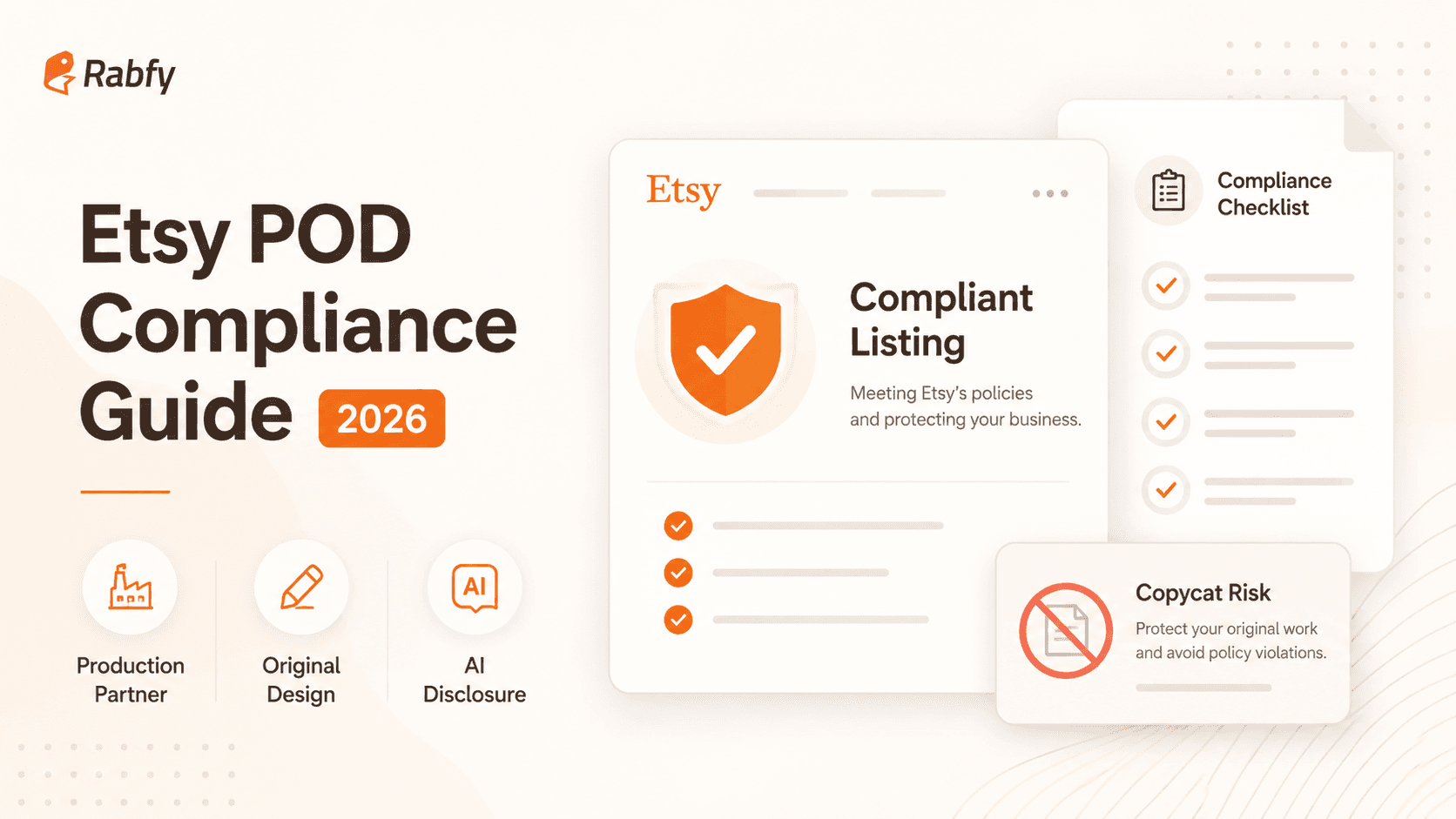
Print-on-demand is fully allowed on Etsy in 2026. What gets shops suspended is failing one of three specific requirements: disclosing your production partner, meeting the originality standard, and disclosing AI use. This guide states each one precisely, shows you the settings, and covers the situation almost no other guide explains clearly, the copycat scenario, where someone scraping your design onto Temu can get your own original listing flagged as mass-produced. A quick note first: Etsy's policies changed through 2025 and 2026 and enforcement keeps evolving, so the details here reflect August 2026. Confirm the current wording in Etsy's own Seller Policy and Creativity Standards before you act.
Is Print-on-Demand Allowed on Etsy in 2026?
Yes, print-on-demand is allowed on Etsy in 2026. Etsy has never banned POD. It permits products made by a production partner as long as you are the original designer, you disclose the production partner, and you disclose any AI involvement. The "Etsy is banning POD" headlines are wrong, but they're a distorted echo of something real: Etsy has tightened how it enforces originality and transparency, and sellers who ignore those rules do get removed.
The category your POD products belong in is "Designed by a seller." This is Etsy's own classification for items where you created the original design and a third party manufactured the physical product. That describes legitimate POD exactly: you make the artwork, a print partner produces and ships it, and you sell it on Etsy. The model is fine. The failures that get sellers removed are specific, and there are three of them. The rest of this guide takes each one in turn, then shows you how to defend yourself when the automated systems get it wrong. If you're setting up your shop for the first time, our guide on how to start an Etsy shop covers the basics first.
Failure 1: You Didn't Disclose Your Production Partner
Etsy requires you to disclose any production partner, meaning any third party that helps physically produce your items, and every POD company counts as one. Failing to disclose is a policy violation that can get your shop flagged as a reseller. This is the most common and most avoidable of the three failures, because it's pure admin: the disclosure exists, sellers just skip it.
A production partner, in Etsy's own terms, is an outside business that helps make your finished products. For a POD seller, that's the company printing your designs onto products and shipping them. Etsy treats this disclosure as a rule baked into its Seller Policy, not a suggestion, and non-disclosure sits in the same violation category as more serious offences. The reason Etsy cares so much is that disclosure is how its systems tell a legitimate POD seller (who creates original designs) apart from a plain reseller (who adds no creative value). Without the disclosure, Etsy's automated systems can quietly file you under "possible reseller," which is a much harder label to shake than a single flagged listing.
How to Add a Production Partner on Etsy
Disclosure happens in two places, and you set it up yourself, manually. First, at the account level, you add the production partner in your Shop Manager settings, giving a short, honest description of who they are and what they do (they produce and ship your designed products), without needing to reveal confidential business details. Second, at the listing level, once a production partner exists in your settings, you attach it to each relevant listing so buyers can see it on the product page. Both levels matter: the account-level record establishes the relationship, and the listing-level attachment applies it to the products it affects. Set this up once for your partner, then attach it to every POD listing.
Failure 2: Your Design Isn't Original Enough
Since mid-2025, Etsy's Creativity Standards require that products made with computerised tools, including POD, feature the seller's own original design. Purchased templates, design bundles, and clip art do not qualify as your original design, even if you bought a commercial licence. This is the failure that catches honest sellers off guard, because they assume paying for a commercial licence makes a design theirs to sell. Under Etsy's policy, it doesn't.
Here's the distinction Etsy draws, and it's sharper than most sellers realise. Allowed: your own original artwork, illustrations, photographs, or graphic designs, printed on products. Not allowed: purchased designs, templates, or clip art you didn't create, printed on products, regardless of the licence. A commercial-use licence gives you the legal right to use an asset, but it does not make the finished design "designed by you" in Etsy's sense, because you didn't create the original creative work. Tools are generally fine (a purchased font or brush used inside a design you built from scratch), but a finished design you bought and printed is the risk. Etsy has signalled an August 2026 point by which products made with computerised tools must feature the seller's own original design, so this standard is tightening, not loosening.
The practical test is simple. Ask of every listing: did I actually design this, or did I buy someone else's design and put it on a product? If it's the second, it's exposed, licence or no licence. Building genuinely original designs is also what makes your shop defensible, and our guide on Etsy product research covers finding design directions worth creating from scratch.
Failure 3: You Used AI and Didn't Disclose It
Etsy has required sellers to disclose AI-generated or AI-assisted work since its Creativity Standards were introduced, and tightened enforcement in 2025. You must disclose AI use in the listing, and Etsy only permits AI art where you provided the creative direction, such as your own prompts. AI disclosure isn't new in 2026, but enforcement has sharpened, and non-disclosure is a real removal reason.
Two things have to be true for AI-involved products. First, disclosure: if AI materially created or assisted your design, you state that plainly in the listing description, a factual line, not a marketing paragraph, and you keep the item categorised as "Designed by a seller." Second, creative direction: Etsy allows AI-generated art when you guided the output, meaning you wrote and directed your own prompts. Buying someone else's prompts and running them through an AI generator does not count as your creative direction, and neither does simply pushing a button on a generic generator. The line Etsy draws is whether you directed the creative process or just triggered it.
Enforcement here is genuine. Etsy has removed large numbers of listings in single quarters for disclosure failures, and removals can arrive with no warning. Disclosing AI honestly costs you nothing and protects you. Hiding it risks the listing.
The Copycat Scenario: When Your Original Design Gets You Flagged
One of the most damaging and least understood removals happens when someone scrapes your original design onto a site like Temu, Shein, or AliExpress, and Etsy's automated system, detecting your image on those sites, flags your genuine original listing as mass-produced. This is the scenario that blindsides honest sellers hardest, because you did nothing wrong, and the fix isn't obvious. Almost no guide explains it, so here it is clearly.
Etsy runs automated systems, in place since around 2023 and often called the "AliExpress bot" by sellers, that scan for images used on Etsy that also appear on sites like AliExpress and Temu. The intent is to catch dropshippers reselling cheap mass-produced goods. But the system works on visual similarity, and it can't tell who copied whom. So when a thief scrapes your bestselling original design and lists the knock-off on Temu, Etsy's system sees your image on Temu and can flag your listing as the mass-produced one. Real sellers have lost bestselling listings this exact way, including artists selling prints of paintings they hold the copyright to, because a Temu knock-off tripped the detector.
The defence is evidence of authorship, specifically dated proof that you created the design first. This is why the single most important habit for a serious POD seller is keeping your source files. A layered working file (a PSD, a Procreate file, an AI or SVG source) with a creation date that predates the copycat is the strongest thing you can show in an appeal. Photos of your process, design iterations, and your asset licences all reinforce it. You can't stop thieves from scraping your work, but you can make sure that when the flag comes, you can prove you were first.
Your Evidence-File Checklist
Keep this for every original design you sell. If a flag ever comes, this is what wins an appeal:
 [ ] The layered source file (PSD, Procreate, AI, SVG), not just the flattened export
- [ ] A creation timestamp or dated file showing when you made it
- [ ] Design iterations or earlier versions showing your process
- [ ] Licences for any fonts, brushes, or asset elements you used as tools
- [ ] Screenshots of your process where possible
- [ ] Records of your production partner disclosure being in place
- [ ] Notes on your AI prompts and direction, if AI was involved
What Happens if You Get a Violation?
A single listing removal is usually a warning: the listing comes down and you're notified, but no further action follows immediately. Repeated violations escalate, and a pattern of them can lead Etsy to suspend or permanently close your shop, along with any other shops you run. Understanding the progression helps you take the first flag seriously rather than ignoring it.
The escalation runs roughly like this. A first violation deactivates the offending listing and serves as your warning shot. A second puts your account under closer review and increases Etsy's internal risk scoring against you. A third and beyond is where Etsy may evaluate your account for permanent closure. Each unresolved violation also drags on your shop's search ranking, not just the flagged listing, so leaving problems unfixed quietly costs you visibility across the whole shop. One critical rule: do not simply edit and relist a removed listing. Etsy flags relisted takedowns as the same problem and can penalise your account further for it. Fix the underlying issue, then decide how to proceed, rather than sneaking the same listing back up.
How Do You Appeal an Etsy Deactivation?
If your listing was removed and you believe it was flagged incorrectly, you can appeal, usually through the Policy Violations page in Shop Manager, where a "View and appeal" button appears next to eligible removed listings. Include your evidence of original authorship. The appeal path exists, though enforcement is imperfect and outcomes aren't guaranteed, which is exactly why your evidence file matters so much.
For Creativity Standards removals, where Etsy's system claims your design isn't original enough, the dashboard appeal is your fastest route, and appeals are available for listings removed from around mid-2025 onward. Submit your dated source files, your design iterations, and anything proving you created the work first. For rights-holder complaints (a trademark or copyright takedown filed against you), the process is different and follows Etsy's formal counter-notice route. Be honest, be specific, and lead with proof. Sellers do win these appeals, but the ones who win are the ones who kept evidence. Note too that Etsy's automated systems make mistakes in both directions, so a wrongful flag is worth appealing calmly with documentation rather than panicking.
Why Compliance Protects Your Ranking, Not Just Your Listings
Staying compliant with Etsy's disclosure and originality rules protects more than the individual listing. Unresolved violations drag down your entire shop's search ranking, so compliance is a visibility issue, not only a legal one. Sellers often treat policy as a box-ticking chore separate from growth, but on Etsy the two are connected.
Here's the connection. Etsy factors your shop's standing into how it ranks you, and a pattern of violations signals a riskier shop that Etsy shows less. A single deactivated listing is a lost listing, but a shop carrying several unresolved flags can see its whole catalogue suppressed in search, which is a far bigger loss than the flagged items alone. This is why clean disclosure and genuine originality are worth building in from the start rather than fixing under pressure later. The mechanics of how Etsy ranks listings, and how shop-level signals feed into it, are covered in our guide on how Etsy search really ranks your listings. Compliance and ranking aren't separate projects; they're the same shop health seen from two angles.
For sellers building toward Etsy from harder-to-serve regions, compliance discipline matters even more, because a suspended shop is far costlier when re-establishing one is difficult. Our guide on reaching US buyers from Bangladesh covers the access side for sellers in that position, and the same rule applies: build clean from day one.
Frequently Asked Questions
Is print-on-demand allowed on Etsy? Yes. Etsy has never banned print-on-demand and allows it in 2026, provided you are the original designer of the artwork, you disclose your production partner, and you disclose any AI involvement. POD products fall under Etsy's "Designed by a seller" category, where you create the design and a third party manufactures the physical item. The rumours about a POD ban are false, though enforcement of originality and disclosure has genuinely tightened.
What is a production partner and how do I add one? A production partner is any third party that helps physically produce your items, which includes every POD printing and fulfilment company. You add one in two places: at the account level in your Shop Manager settings, with a short honest description of the partner, and at the listing level, by attaching that partner to each relevant POD listing. Both are required, and you set them up yourself. Non-disclosure is a policy violation that can flag your shop as a reseller.
Do I have to disclose AI use? Yes. If AI materially created or assisted your design, Etsy requires you to disclose it in the listing, and to keep the item categorised as "Designed by a seller." Etsy permits AI art only where you provided the creative direction, such as writing and guiding your own prompts. Buying someone else's prompts or simply triggering a generic generator doesn't count. Non-disclosure is a real removal reason and enforcement has tightened.
Can I sell designs I bought a commercial licence for? Generally no, not as "your" original POD design. Under Etsy's Creativity Standards, purchased templates, design bundles, and clip art do not qualify as your original design even with a commercial licence, because you didn't create the original creative work. A commercial licence gives you legal usage rights, but Etsy's originality standard asks whether you designed it. Tools like purchased fonts or brushes used inside a design you built yourself are generally fine; finished purchased designs are the risk.
What happens on a first violation? A first violation usually means the specific listing is deactivated and you're notified, serving as a warning, without immediate further action against your shop. Repeated violations escalate: a second brings closer review, and a third or more can lead to suspension or permanent shop closure. Do not edit and relist a removed listing, since Etsy detects relisted takedowns and can penalise your account further. Fix the root cause instead.
How do I appeal a deactivation? If you believe a listing was wrongly flagged, appeal through the Policy Violations page in Shop Manager, where eligible removed listings show a "View and appeal" option, and include your evidence of original authorship such as dated source files. Creativity Standards removals use this dashboard appeal; rights-holder complaints follow a separate counter-notice process. Outcomes aren't guaranteed and enforcement is imperfect, so keeping strong evidence is what gives an appeal its best chance.
Does disclosing a production partner hurt my ranking? No. Disclosing a production partner does not penalise your search ranking. It's a transparency requirement, and complying keeps your shop in good standing, which protects your visibility. What genuinely hurts your ranking is accumulating unresolved policy violations, which drag down the whole shop, so correct disclosure is a ranking protector, not a risk.
Key Takeaways
- Print-on-demand is allowed on Etsy in 2026. The "POD ban" rumour is false, but enforcement of originality and disclosure has tightened.
- Three specific failures get shops flagged: not disclosing your production partner, using designs that aren't your original work (even licensed ones), and not disclosing AI use.
- Purchased templates, bundles, and clip art don't count as your original design under Etsy's Creativity Standards, even with a commercial licence.
- The copycat scenario is real: a thief scraping your design onto Temu or AliExpress can trigger a mass-production flag on your genuine listing, and dated source files are your defence.
- Keep an evidence file for every design (layered source file, creation dates, iterations, asset licences). It's what wins an appeal. And never edit-and-relist a removed listing.
How Rabfy Helps
Two of the three failure points in this guide are things a fulfilment partner directly affects, and Rabfy is built to keep you clean on both. Because Rabfy is your production partner, disclosing it on Etsy is straightforward: you add Rabfy as your production partner in your Shop Manager settings and attach it to your POD listings, with an honest description of the relationship. You control that disclosure yourself, and it takes only a short, factual entry. On originality, Rabfy prints the designs you create, so as long as the artwork is genuinely your own original work, your listings meet the "Designed by a seller" standard. Over 300 sellers currently fulfil through Rabfy across more than 50,000 orders, with a 0% return rate last Q4. Reliable, correctly disclosed fulfilment is one less thing standing between you and a clean Etsy shop. Learn more on our features page, and see the full workflow in our guide on how Rabfy works.
Keep Your Etsy Shop Clean and Compliant
You know the three failure points, the copycat defence, and how to appeal. The next step is making sure your fulfilment side is disclosed correctly from the start. Create your free Rabfy account and set up a production partner you can disclose cleanly, so compliance is never the reason a listing comes down.
Abul Bashar Suman mentors Etsy sellers inside Rabfy's community and helps sellers keep their shops compliant with Etsy's Creativity Standards and disclosure rules. This article is informational and reflects Etsy's policies as of August 2026; confirm current requirements in Etsy's Seller Policy and Creativity Standards before acting.Every few months, the same panic spreads through Etsy seller groups: "Etsy is banning print-on-demand." It isn't true, and it never was. But the rumour survives because sellers really are getting listings deactivated, sometimes bestsellers that ran clean for a year, and when it happens, "Etsy banned POD" is an easier story to believe than the real one. The real one is more useful, because it's fixable.
Print-on-demand is fully allowed on Etsy in 2026. What gets shops suspended is failing one of three specific requirements: disclosing your production partner, meeting the originality standard, and disclosing AI use. This guide states each one precisely, shows you the settings, and covers the situation almost no other guide explains clearly, the copycat scenario, where someone scraping your design onto Temu can get your own original listing flagged as mass-produced. A quick note first: Etsy's policies changed through 2025 and 2026 and enforcement keeps evolving, so the details here reflect August 2026. Confirm the current wording in Etsy's own Seller Policy and Creativity Standards before you act.
Is Print-on-Demand Allowed on Etsy in 2026?
Yes, print-on-demand is allowed on Etsy in 2026. Etsy has never banned POD. It permits products made by a production partner as long as you are the original designer, you disclose the production partner, and you disclose any AI involvement. The "Etsy is banning POD" headlines are wrong, but they're a distorted echo of something real: Etsy has tightened how it enforces originality and transparency, and sellers who ignore those rules do get removed.
The category your POD products belong in is "Designed by a seller." This is Etsy's own classification for items where you created the original design and a third party manufactured the physical product. That describes legitimate POD exactly: you make the artwork, a print partner produces and ships it, and you sell it on Etsy. The model is fine. The failures that get sellers removed are specific, and there are three of them. The rest of this guide takes each one in turn, then shows you how to defend yourself when the automated systems get it wrong. If you're setting up your shop for the first time, our guide on how to start an Etsy shop covers the basics first.
Failure 1: You Didn't Disclose Your Production Partner
Etsy requires you to disclose any production partner, meaning any third party that helps physically produce your items, and every POD company counts as one. Failing to disclose is a policy violation that can get your shop flagged as a reseller. This is the most common and most avoidable of the three failures, because it's pure admin: the disclosure exists, sellers just skip it.
A production partner, in Etsy's own terms, is an outside business that helps make your finished products. For a POD seller, that's the company printing your designs onto products and shipping them. Etsy treats this disclosure as a rule baked into its Seller Policy, not a suggestion, and non-disclosure sits in the same violation category as more serious offences. The reason Etsy cares so much is that disclosure is how its systems tell a legitimate POD seller (who creates original designs) apart from a plain reseller (who adds no creative value). Without the disclosure, Etsy's automated systems can quietly file you under "possible reseller," which is a much harder label to shake than a single flagged listing.
How to Add a Production Partner on Etsy
Disclosure happens in two places, and you set it up yourself, manually. First, at the account level, you add the production partner in your Shop Manager settings, giving a short, honest description of who they are and what they do (they produce and ship your designed products), without needing to reveal confidential business details. Second, at the listing level, once a production partner exists in your settings, you attach it to each relevant listing so buyers can see it on the product page. Both levels matter: the account-level record establishes the relationship, and the listing-level attachment applies it to the products it affects. Set this up once for your partner, then attach it to every POD listing.
Failure 2: Your Design Isn't Original Enough
Since mid-2025, Etsy's Creativity Standards require that products made with computerised tools, including POD, feature the seller's own original design. Purchased templates, design bundles, and clip art do not qualify as your original design, even if you bought a commercial licence. This is the failure that catches honest sellers off guard, because they assume paying for a commercial licence makes a design theirs to sell. Under Etsy's policy, it doesn't.
Here's the distinction Etsy draws, and it's sharper than most sellers realise. Allowed: your own original artwork, illustrations, photographs, or graphic designs, printed on products. Not allowed: purchased designs, templates, or clip art you didn't create, printed on products, regardless of the licence. A commercial-use licence gives you the legal right to use an asset, but it does not make the finished design "designed by you" in Etsy's sense, because you didn't create the original creative work. Tools are generally fine (a purchased font or brush used inside a design you built from scratch), but a finished design you bought and printed is the risk. Etsy has signalled an August 2026 point by which products made with computerised tools must feature the seller's own original design, so this standard is tightening, not loosening.
The practical test is simple. Ask of every listing: did I actually design this, or did I buy someone else's design and put it on a product? If it's the second, it's exposed, licence or no licence. Building genuinely original designs is also what makes your shop defensible, and our guide on Etsy product research covers finding design directions worth creating from scratch.
Failure 3: You Used AI and Didn't Disclose It
Etsy has required sellers to disclose AI-generated or AI-assisted work since its Creativity Standards were introduced, and tightened enforcement in 2025. You must disclose AI use in the listing, and Etsy only permits AI art where you provided the creative direction, such as your own prompts. AI disclosure isn't new in 2026, but enforcement has sharpened, and non-disclosure is a real removal reason.
Two things have to be true for AI-involved products. First, disclosure: if AI materially created or assisted your design, you state that plainly in the listing description, a factual line, not a marketing paragraph, and you keep the item categorised as "Designed by a seller." Second, creative direction: Etsy allows AI-generated art when you guided the output, meaning you wrote and directed your own prompts. Buying someone else's prompts and running them through an AI generator does not count as your creative direction, and neither does simply pushing a button on a generic generator. The line Etsy draws is whether you directed the creative process or just triggered it.
Enforcement here is genuine. Etsy has removed large numbers of listings in single quarters for disclosure failures, and removals can arrive with no warning. Disclosing AI honestly costs you nothing and protects you. Hiding it risks the listing.
The Copycat Scenario: When Your Original Design Gets You Flagged
One of the most damaging and least understood removals happens when someone scrapes your original design onto a site like Temu, Shein, or AliExpress, and Etsy's automated system, detecting your image on those sites, flags your genuine original listing as mass-produced. This is the scenario that blindsides honest sellers hardest, because you did nothing wrong, and the fix isn't obvious. Almost no guide explains it, so here it is clearly.
Etsy runs automated systems, in place since around 2023 and often called the "AliExpress bot" by sellers, that scan for images used on Etsy that also appear on sites like AliExpress and Temu. The intent is to catch dropshippers reselling cheap mass-produced goods. But the system works on visual similarity, and it can't tell who copied whom. So when a thief scrapes your bestselling original design and lists the knock-off on Temu, Etsy's system sees your image on Temu and can flag your listing as the mass-produced one. Real sellers have lost bestselling listings this exact way, including artists selling prints of paintings they hold the copyright to, because a Temu knock-off tripped the detector.
The defence is evidence of authorship, specifically dated proof that you created the design first. This is why the single most important habit for a serious POD seller is keeping your source files. A layered working file (a PSD, a Procreate file, an AI or SVG source) with a creation date that predates the copycat is the strongest thing you can show in an appeal. Photos of your process, design iterations, and your asset licences all reinforce it. You can't stop thieves from scraping your work, but you can make sure that when the flag comes, you can prove you were first.
Your Evidence-File Checklist
Keep this for every original design you sell. If a flag ever comes, this is what wins an appeal:
- [ ] The layered source file (PSD, Procreate, AI, SVG), not just the flattened export
- [ ] A creation timestamp or dated file showing when you made it
- [ ] Design iterations or earlier versions showing your process
- [ ] Licences for any fonts, brushes, or asset elements you used as tools
- [ ] Screenshots of your process where possible
- [ ] Records of your production partner disclosure being in place
- [ ] Notes on your AI prompts and direction, if AI was involved
What Happens if You Get a Violation?
A single listing removal is usually a warning: the listing comes down and you're notified, but no further action follows immediately. Repeated violations escalate, and a pattern of them can lead Etsy to suspend or permanently close your shop, along with any other shops you run. Understanding the progression helps you take the first flag seriously rather than ignoring it.
The escalation runs roughly like this. A first violation deactivates the offending listing and serves as your warning shot. A second puts your account under closer review and increases Etsy's internal risk scoring against you. A third and beyond is where Etsy may evaluate your account for permanent closure. Each unresolved violation also drags on your shop's search ranking, not just the flagged listing, so leaving problems unfixed quietly costs you visibility across the whole shop. One critical rule: do not simply edit and relist a removed listing. Etsy flags relisted takedowns as the same problem and can penalise your account further for it. Fix the underlying issue, then decide how to proceed, rather than sneaking the same listing back up.
How Do You Appeal an Etsy Deactivation?
If your listing was removed and you believe it was flagged incorrectly, you can appeal, usually through the Policy Violations page in Shop Manager, where a "View and appeal" button appears next to eligible removed listings. Include your evidence of original authorship. The appeal path exists, though enforcement is imperfect and outcomes aren't guaranteed, which is exactly why your evidence file matters so much.
For Creativity Standards removals, where Etsy's system claims your design isn't original enough, the dashboard appeal is your fastest route, and appeals are available for listings removed from around mid-2025 onward. Submit your dated source files, your design iterations, and anything proving you created the work first. For rights-holder complaints (a trademark or copyright takedown filed against you), the process is different and follows Etsy's formal counter-notice route. Be honest, be specific, and lead with proof. Sellers do win these appeals, but the ones who win are the ones who kept evidence. Note too that Etsy's automated systems make mistakes in both directions, so a wrongful flag is worth appealing calmly with documentation rather than panicking.
Why Compliance Protects Your Ranking, Not Just Your Listings
Staying compliant with Etsy's disclosure and originality rules protects more than the individual listing. Unresolved violations drag down your entire shop's search ranking, so compliance is a visibility issue, not only a legal one. Sellers often treat policy as a box-ticking chore separate from growth, but on Etsy the two are connected.
Here's the connection. Etsy factors your shop's standing into how it ranks you, and a pattern of violations signals a riskier shop that Etsy shows less. A single deactivated listing is a lost listing, but a shop carrying several unresolved flags can see its whole catalogue suppressed in search, which is a far bigger loss than the flagged items alone. This is why clean disclosure and genuine originality are worth building in from the start rather than fixing under pressure later. The mechanics of how Etsy ranks listings, and how shop-level signals feed into it, are covered in our guide on how Etsy search really ranks your listings. Compliance and ranking aren't separate projects; they're the same shop health seen from two angles.
For sellers building toward Etsy from harder-to-serve regions, compliance discipline matters even more, because a suspended shop is far costlier when re-establishing one is difficult. Our guide on reaching US buyers from Bangladesh covers the access side for sellers in that position, and the same rule applies: build clean from day one.
Frequently Asked Questions
Is print-on-demand allowed on Etsy? Yes. Etsy has never banned print-on-demand and allows it in 2026, provided you are the original designer of the artwork, you disclose your production partner, and you disclose any AI involvement. POD products fall under Etsy's "Designed by a seller" category, where you create the design and a third party manufactures the physical item. The rumours about a POD ban are false, though enforcement of originality and disclosure has genuinely tightened.
What is a production partner and how do I add one? A production partner is any third party that helps physically produce your items, which includes every POD printing and fulfilment company. You add one in two places: at the account level in your Shop Manager settings, with a short honest description of the partner, and at the listing level, by attaching that partner to each relevant POD listing. Both are required, and you set them up yourself. Non-disclosure is a policy violation that can flag your shop as a reseller.
Do I have to disclose AI use? Yes. If AI materially created or assisted your design, Etsy requires you to disclose it in the listing, and to keep the item categorised as "Designed by a seller." Etsy permits AI art only where you provided the creative direction, such as writing and guiding your own prompts. Buying someone else's prompts or simply triggering a generic generator doesn't count. Non-disclosure is a real removal reason and enforcement has tightened.
Can I sell designs I bought a commercial licence for? Generally no, not as "your" original POD design. Under Etsy's Creativity Standards, purchased templates, design bundles, and clip art do not qualify as your original design even with a commercial licence, because you didn't create the original creative work. A commercial licence gives you legal usage rights, but Etsy's originality standard asks whether you designed it. Tools like purchased fonts or brushes used inside a design you built yourself are generally fine; finished purchased designs are the risk.
What happens on a first violation? A first violation usually means the specific listing is deactivated and you're notified, serving as a warning, without immediate further action against your shop. Repeated violations escalate: a second brings closer review, and a third or more can lead to suspension or permanent shop closure. Do not edit and relist a removed listing, since Etsy detects relisted takedowns and can penalise your account further. Fix the root cause instead.
How do I appeal a deactivation? If you believe a listing was wrongly flagged, appeal through the Policy Violations page in Shop Manager, where eligible removed listings show a "View and appeal" option, and include your evidence of original authorship such as dated source files. Creativity Standards removals use this dashboard appeal; rights-holder complaints follow a separate counter-notice process. Outcomes aren't guaranteed and enforcement is imperfect, so keeping strong evidence is what gives an appeal its best chance.
Does disclosing a production partner hurt my ranking? No. Disclosing a production partner does not penalise your search ranking. It's a transparency requirement, and complying keeps your shop in good standing, which protects your visibility. What genuinely hurts your ranking is accumulating unresolved policy violations, which drag down the whole shop, so correct disclosure is a ranking protector, not a risk.
Key Takeaways
- Print-on-demand is allowed on Etsy in 2026. The "POD ban" rumour is false, but enforcement of originality and disclosure has tightened.
- Three specific failures get shops flagged: not disclosing your production partner, using designs that aren't your original work (even licensed ones), and not disclosing AI use.
- Purchased templates, bundles, and clip art don't count as your original design under Etsy's Creativity Standards, even with a commercial licence.
- The copycat scenario is real: a thief scraping your design onto Temu or AliExpress can trigger a mass-production flag on your genuine listing, and dated source files are your defence.
- Keep an evidence file for every design (layered source file, creation dates, iterations, asset licences). It's what wins an appeal. And never edit-and-relist a removed listing.
How Rabfy Helps
Two of the three failure points in this guide are things a fulfilment partner directly affects, and Rabfy is built to keep you clean on both. Because Rabfy is your production partner, disclosing it on Etsy is straightforward: you add Rabfy as your production partner in your Shop Manager settings and attach it to your POD listings, with an honest description of the relationship. You control that disclosure yourself, and it takes only a short, factual entry. On originality, Rabfy prints the designs you create, so as long as the artwork is genuinely your own original work, your listings meet the "Designed by a seller" standard. Over 300 sellers currently fulfil through Rabfy across more than 50,000 orders, with a 0% return rate last Q4. Reliable, correctly disclosed fulfilment is one less thing standing between you and a clean Etsy shop. Learn more on our features page, and see the full workflow in our guide on how Rabfy works.
Keep Your Etsy Shop Clean and Compliant
You know the three failure points, the copycat defence, and how to appeal. The next step is making sure your fulfilment side is disclosed correctly from the start. Create your free Rabfy account and set up a production partner you can disclose cleanly, so compliance is never the reason a listing comes down.
Abul Bashar Suman mentors Etsy sellers inside Rabfy's community and helps sellers keep their shops compliant with Etsy's Creativity Standards and disclosure rules. This article is informational and reflects Etsy's policies as of August 2026; confirm current requirements in Etsy's Seller Policy and Creativity Standards before acting.Every few months, the same panic spreads through Etsy seller groups: "Etsy is banning print-on-demand." It isn't true, and it never was. But the rumour survives because sellers really are getting listings deactivated, sometimes bestsellers that ran clean for a year, and when it happens, "Etsy banned POD" is an easier story to believe than the real one. The real one is more useful, because it's fixable.
Print-on-demand is fully allowed on Etsy in 2026. What gets shops suspended is failing one of three specific requirements: disclosing your production partner, meeting the originality standard, and disclosing AI use. This guide states each one precisely, shows you the settings, and covers the situation almost no other guide explains clearly, the copycat scenario, where someone scraping your design onto Temu can get your own original listing flagged as mass-produced. A quick note first: Etsy's policies changed through 2025 and 2026 and enforcement keeps evolving, so the details here reflect August 2026. Confirm the current wording in Etsy's own Seller Policy and Creativity Standards before you act.
Is Print-on-Demand Allowed on Etsy in 2026?
Yes, print-on-demand is allowed on Etsy in 2026. Etsy has never banned POD. It permits products made by a production partner as long as you are the original designer, you disclose the production partner, and you disclose any AI involvement. The "Etsy is banning POD" headlines are wrong, but they're a distorted echo of something real: Etsy has tightened how it enforces originality and transparency, and sellers who ignore those rules do get removed.
The category your POD products belong in is "Designed by a seller." This is Etsy's own classification for items where you created the original design and a third party manufactured the physical product. That describes legitimate POD exactly: you make the artwork, a print partner produces and ships it, and you sell it on Etsy. The model is fine. The failures that get sellers removed are specific, and there are three of them. The rest of this guide takes each one in turn, then shows you how to defend yourself when the automated systems get it wrong. If you're setting up your shop for the first time, our guide on how to start an Etsy shop covers the basics first.
Failure 1: You Didn't Disclose Your Production Partner
Etsy requires you to disclose any production partner, meaning any third party that helps physically produce your items, and every POD company counts as one. Failing to disclose is a policy violation that can get your shop flagged as a reseller. This is the most common and most avoidable of the three failures, because it's pure admin: the disclosure exists, sellers just skip it.
A production partner, in Etsy's own terms, is an outside business that helps make your finished products. For a POD seller, that's the company printing your designs onto products and shipping them. Etsy treats this disclosure as a rule baked into its Seller Policy, not a suggestion, and non-disclosure sits in the same violation category as more serious offences. The reason Etsy cares so much is that disclosure is how its systems tell a legitimate POD seller (who creates original designs) apart from a plain reseller (who adds no creative value). Without the disclosure, Etsy's automated systems can quietly file you under "possible reseller," which is a much harder label to shake than a single flagged listing.
How to Add a Production Partner on Etsy
Disclosure happens in two places, and you set it up yourself, manually. First, at the account level, you add the production partner in your Shop Manager settings, giving a short, honest description of who they are and what they do (they produce and ship your designed products), without needing to reveal confidential business details. Second, at the listing level, once a production partner exists in your settings, you attach it to each relevant listing so buyers can see it on the product page. Both levels matter: the account-level record establishes the relationship, and the listing-level attachment applies it to the products it affects. Set this up once for your partner, then attach it to every POD listing.
Failure 2: Your Design Isn't Original Enough
Since mid-2025, Etsy's Creativity Standards require that products made with computerised tools, including POD, feature the seller's own original design. Purchased templates, design bundles, and clip art do not qualify as your original design, even if you bought a commercial licence. This is the failure that catches honest sellers off guard, because they assume paying for a commercial licence makes a design theirs to sell. Under Etsy's policy, it doesn't.
Here's the distinction Etsy draws, and it's sharper than most sellers realise. Allowed: your own original artwork, illustrations, photographs, or graphic designs, printed on products. Not allowed: purchased designs, templates, or clip art you didn't create, printed on products, regardless of the licence. A commercial-use licence gives you the legal right to use an asset, but it does not make the finished design "designed by you" in Etsy's sense, because you didn't create the original creative work. Tools are generally fine (a purchased font or brush used inside a design you built from scratch), but a finished design you bought and printed is the risk. Etsy has signalled an August 2026 point by which products made with computerised tools must feature the seller's own original design, so this standard is tightening, not loosening.
The practical test is simple. Ask of every listing: did I actually design this, or did I buy someone else's design and put it on a product? If it's the second, it's exposed, licence or no licence. Building genuinely original designs is also what makes your shop defensible, and our guide on Etsy product research covers finding design directions worth creating from scratch.
Failure 3: You Used AI and Didn't Disclose It
Etsy has required sellers to disclose AI-generated or AI-assisted work since its Creativity Standards were introduced, and tightened enforcement in 2025. You must disclose AI use in the listing, and Etsy only permits AI art where you provided the creative direction, such as your own prompts. AI disclosure isn't new in 2026, but enforcement has sharpened, and non-disclosure is a real removal reason.
Two things have to be true for AI-involved products. First, disclosure: if AI materially created or assisted your design, you state that plainly in the listing description, a factual line, not a marketing paragraph, and you keep the item categorised as "Designed by a seller." Second, creative direction: Etsy allows AI-generated art when you guided the output, meaning you wrote and directed your own prompts. Buying someone else's prompts and running them through an AI generator does not count as your creative direction, and neither does simply pushing a button on a generic generator. The line Etsy draws is whether you directed the creative process or just triggered it.
Enforcement here is genuine. Etsy has removed large numbers of listings in single quarters for disclosure failures, and removals can arrive with no warning. Disclosing AI honestly costs you nothing and protects you. Hiding it risks the listing.
The Copycat Scenario: When Your Original Design Gets You Flagged
One of the most damaging and least understood removals happens when someone scrapes your original design onto a site like Temu, Shein, or AliExpress, and Etsy's automated system, detecting your image on those sites, flags your genuine original listing as mass-produced. This is the scenario that blindsides honest sellers hardest, because you did nothing wrong, and the fix isn't obvious. Almost no guide explains it, so here it is clearly.
Etsy runs automated systems, in place since around 2023 and often called the "AliExpress bot" by sellers, that scan for images used on Etsy that also appear on sites like AliExpress and Temu. The intent is to catch dropshippers reselling cheap mass-produced goods. But the system works on visual similarity, and it can't tell who copied whom. So when a thief scrapes your bestselling original design and lists the knock-off on Temu, Etsy's system sees your image on Temu and can flag your listing as the mass-produced one. Real sellers have lost bestselling listings this exact way, including artists selling prints of paintings they hold the copyright to, because a Temu knock-off tripped the detector.
The defence is evidence of authorship, specifically dated proof that you created the design first. This is why the single most important habit for a serious POD seller is keeping your source files. A layered working file (a PSD, a Procreate file, an AI or SVG source) with a creation date that predates the copycat is the strongest thing you can show in an appeal. Photos of your process, design iterations, and your asset licences all reinforce it. You can't stop thieves from scraping your work, but you can make sure that when the flag comes, you can prove you were first.
Your Evidence-File Checklist
Keep this for every original design you sell. If a flag ever comes, this is what wins an appeal:
- [ ] The layered source file (PSD, Procreate, AI, SVG), not just the flattened export
- [ ] A creation timestamp or dated file showing when you made it
- [ ] Design iterations or earlier versions showing your process
- [ ] Licences for any fonts, brushes, or asset elements you used as tools
- [ ] Screenshots of your process where possible
- [ ] Records of your production partner disclosure being in place
- [ ] Notes on your AI prompts and direction, if AI was involved
What Happens if You Get a Violation?
A single listing removal is usually a warning: the listing comes down and you're notified, but no further action follows immediately. Repeated violations escalate, and a pattern of them can lead Etsy to suspend or permanently close your shop, along with any other shops you run. Understanding the progression helps you take the first flag seriously rather than ignoring it.
The escalation runs roughly like this. A first violation deactivates the offending listing and serves as your warning shot. A second puts your account under closer review and increases Etsy's internal risk scoring against you. A third and beyond is where Etsy may evaluate your account for permanent closure. Each unresolved violation also drags on your shop's search ranking, not just the flagged listing, so leaving problems unfixed quietly costs you visibility across the whole shop. One critical rule: do not simply edit and relist a removed listing. Etsy flags relisted takedowns as the same problem and can penalise your account further for it. Fix the underlying issue, then decide how to proceed, rather than sneaking the same listing back up.
How Do You Appeal an Etsy Deactivation?
If your listing was removed and you believe it was flagged incorrectly, you can appeal, usually through the Policy Violations page in Shop Manager, where a "View and appeal" button appears next to eligible removed listings. Include your evidence of original authorship. The appeal path exists, though enforcement is imperfect and outcomes aren't guaranteed, which is exactly why your evidence file matters so much.
For Creativity Standards removals, where Etsy's system claims your design isn't original enough, the dashboard appeal is your fastest route, and appeals are available for listings removed from around mid-2025 onward. Submit your dated source files, your design iterations, and anything proving you created the work first. For rights-holder complaints (a trademark or copyright takedown filed against you), the process is different and follows Etsy's formal counter-notice route. Be honest, be specific, and lead with proof. Sellers do win these appeals, but the ones who win are the ones who kept evidence. Note too that Etsy's automated systems make mistakes in both directions, so a wrongful flag is worth appealing calmly with documentation rather than panicking.
Why Compliance Protects Your Ranking, Not Just Your Listings
Staying compliant with Etsy's disclosure and originality rules protects more than the individual listing. Unresolved violations drag down your entire shop's search ranking, so compliance is a visibility issue, not only a legal one. Sellers often treat policy as a box-ticking chore separate from growth, but on Etsy the two are connected.
Here's the connection. Etsy factors your shop's standing into how it ranks you, and a pattern of violations signals a riskier shop that Etsy shows less. A single deactivated listing is a lost listing, but a shop carrying several unresolved flags can see its whole catalogue suppressed in search, which is a far bigger loss than the flagged items alone. This is why clean disclosure and genuine originality are worth building in from the start rather than fixing under pressure later. The mechanics of how Etsy ranks listings, and how shop-level signals feed into it, are covered in our guide on how Etsy search really ranks your listings. Compliance and ranking aren't separate projects; they're the same shop health seen from two angles.
For sellers building toward Etsy from harder-to-serve regions, compliance discipline matters even more, because a suspended shop is far costlier when re-establishing one is difficult. Our guide on reaching US buyers from Bangladesh covers the access side for sellers in that position, and the same rule applies: build clean from day one.
Frequently Asked Questions
Is print-on-demand allowed on Etsy? Yes. Etsy has never banned print-on-demand and allows it in 2026, provided you are the original designer of the artwork, you disclose your production partner, and you disclose any AI involvement. POD products fall under Etsy's "Designed by a seller" category, where you create the design and a third party manufactures the physical item. The rumours about a POD ban are false, though enforcement of originality and disclosure has genuinely tightened.
What is a production partner and how do I add one? A production partner is any third party that helps physically produce your items, which includes every POD printing and fulfilment company. You add one in two places: at the account level in your Shop Manager settings, with a short honest description of the partner, and at the listing level, by attaching that partner to each relevant POD listing. Both are required, and you set them up yourself. Non-disclosure is a policy violation that can flag your shop as a reseller.
Do I have to disclose AI use? Yes. If AI materially created or assisted your design, Etsy requires you to disclose it in the listing, and to keep the item categorised as "Designed by a seller." Etsy permits AI art only where you provided the creative direction, such as writing and guiding your own prompts. Buying someone else's prompts or simply triggering a generic generator doesn't count. Non-disclosure is a real removal reason and enforcement has tightened.
Can I sell designs I bought a commercial licence for? Generally no, not as "your" original POD design. Under Etsy's Creativity Standards, purchased templates, design bundles, and clip art do not qualify as your original design even with a commercial licence, because you didn't create the original creative work. A commercial licence gives you legal usage rights, but Etsy's originality standard asks whether you designed it. Tools like purchased fonts or brushes used inside a design you built yourself are generally fine; finished purchased designs are the risk.
What happens on a first violation? A first violation usually means the specific listing is deactivated and you're notified, serving as a warning, without immediate further action against your shop. Repeated violations escalate: a second brings closer review, and a third or more can lead to suspension or permanent shop closure. Do not edit and relist a removed listing, since Etsy detects relisted takedowns and can penalise your account further. Fix the root cause instead.
How do I appeal a deactivation? If you believe a listing was wrongly flagged, appeal through the Policy Violations page in Shop Manager, where eligible removed listings show a "View and appeal" option, and include your evidence of original authorship such as dated source files. Creativity Standards removals use this dashboard appeal; rights-holder complaints follow a separate counter-notice process. Outcomes aren't guaranteed and enforcement is imperfect, so keeping strong evidence is what gives an appeal its best chance.
Does disclosing a production partner hurt my ranking? No. Disclosing a production partner does not penalise your search ranking. It's a transparency requirement, and complying keeps your shop in good standing, which protects your visibility. What genuinely hurts your ranking is accumulating unresolved policy violations, which drag down the whole shop, so correct disclosure is a ranking protector, not a risk.
Key Takeaways
- Print-on-demand is allowed on Etsy in 2026. The "POD ban" rumour is false, but enforcement of originality and disclosure has tightened.
- Three specific failures get shops flagged: not disclosing your production partner, using designs that aren't your original work (even licensed ones), and not disclosing AI use.
- Purchased templates, bundles, and clip art don't count as your original design under Etsy's Creativity Standards, even with a commercial licence.
- The copycat scenario is real: a thief scraping your design onto Temu or AliExpress can trigger a mass-production flag on your genuine listing, and dated source files are your defence.
- Keep an evidence file for every design (layered source file, creation dates, iterations, asset licences). It's what wins an appeal. And never edit-and-relist a removed listing.
How Rabfy Helps
Two of the three failure points in this guide are things a fulfilment partner directly affects, and Rabfy is built to keep you clean on both. Because Rabfy is your production partner, disclosing it on Etsy is straightforward: you add Rabfy as your production partner in your Shop Manager settings and attach it to your POD listings, with an honest description of the relationship. You control that disclosure yourself, and it takes only a short, factual entry. On originality, Rabfy prints the designs you create, so as long as the artwork is genuinely your own original work, your listings meet the "Designed by a seller" standard. Over 300 sellers currently fulfil through Rabfy across more than 50,000 orders, with a 0% return rate last Q4. Reliable, correctly disclosed fulfilment is one less thing standing between you and a clean Etsy shop. Learn more on our features page, and see the full workflow in our guide on how Rabfy works.
Keep Your Etsy Shop Clean and Compliant
You know the three failure points, the copycat defence, and how to appeal. The next step is making sure your fulfilment side is disclosed correctly from the start. Create your free Rabfy account and set up a production partner you can disclose cleanly, so compliance is never the reason a listing comes down.
Abul Bashar Suman mentors Etsy sellers inside Rabfy's community and helps sellers keep their shops compliant with Etsy's Creativity Standards and disclosure rules. This article is informational and reflects Etsy's policies as of August 2026; confirm current requirements in Etsy's Seller Policy and Creativity Standards before acting.